








White Force Group says Wira automates hiring until approval
MAX Plan at ₹4,999/yr

Find your next multibaggerBe a Pro Investor
Research stocks and track your picks on the go. Download the app.
Key highlights
- White Force says Wira sources, engages and screens candidates before recruiter interview approval.
- The illustrated Wira candidate has an 86 out of 100 screening score and 3 years of sales experience.
- Wira is presented as a manager coordinating 35 specialists across hiring tasks.
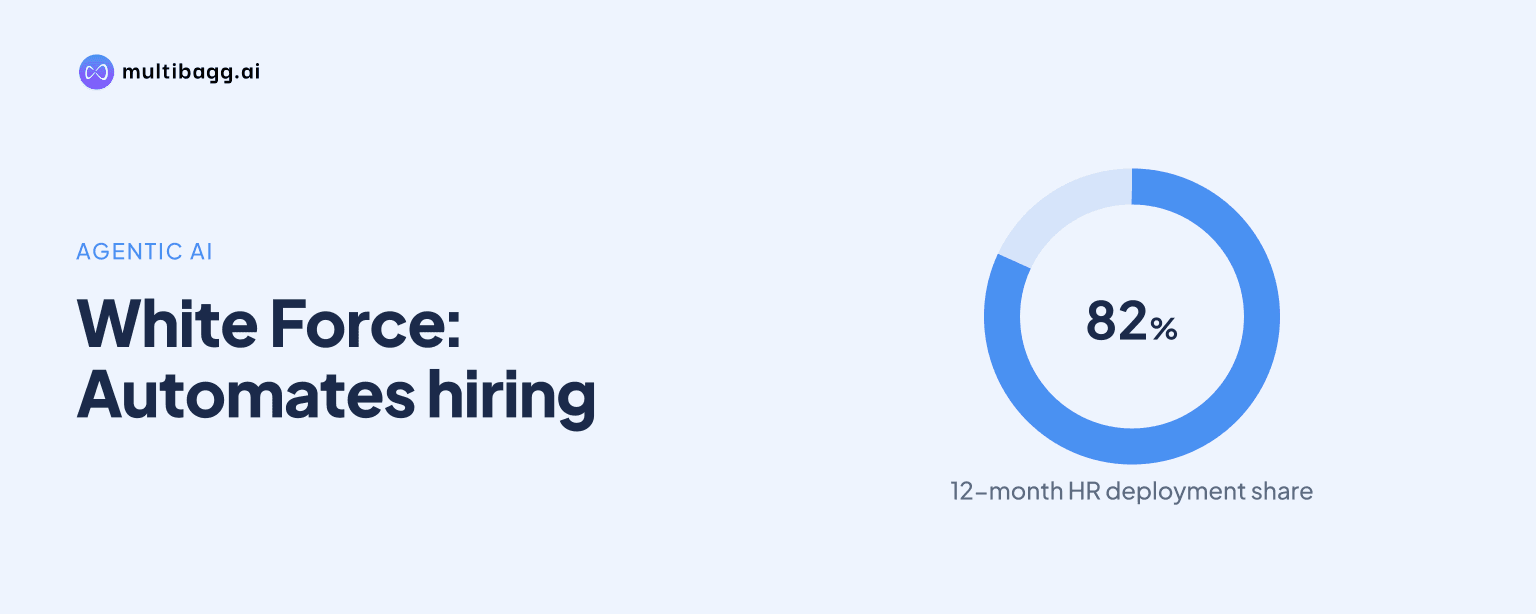
- White Force cites 82% of human-resources leaders planning agentic artificial-intelligence deployment within 12 months.
powered by IRIS
White Force Group says Wira can source, contact and screen candidates autonomously once a job is listed, while recruiters retain approval over formal interview scheduling. White Force illustrates the proposed workflow with a Field Sales Executive candidate who has a screening score of 86 out of 100, high interest and a prep test sent.
Know Happy Square Outsourcing Services inside out
Results, valuation, peers and who's buying, in one view.
How does White Force say Wira’s autonomous pipeline work?
White Force says Wira starts when a job enters the system and follows five steps: job entry, talent discovery, candidate engagement, evaluation and surfacing of prepared candidates. The stated process has Wira read candidate profiles, build a shortlist, contact people through WhatsApp, calls or another route, assess each interaction and select the next action before presenting candidates to recruiters.
White Force presents Wira as a manager directing 35 specialists, rather than a single conversational tool. In its example, the instruction to find suitable jobs and apply to the best ones produces four tasks: fetching the candidate profile, conducting a semantic job search, evaluating matches and submitting applications. White Force says the manager can assign specialist work in parallel, check results and determine what happens next.
What decisions still need White Force recruiter approval?
White Force says formal interview scheduling is the principal human approval point in the Wira workflow. The proposed interview appears in the company’s software, where a recruiter can approve and schedule it, modify the proposal or reject it. Wira is described as completing the earlier sourcing, outreach and screening steps without that approval.
The presentation’s example identifies Rahul S. for a Field Sales Executive role in Indore after Wira found, called and screened him. It records 3 years of sales experience, an 86 out of 100 screening score, high interest and a prep test sent. Wira then proposes a face-to-face interview at 11:00 AM on Thursday at the Indore office, leaving the recruiter to make the scheduling decision.
How does Wira differ from recruitment software described by White Force?
White Force contrasts Wira with recruitment software that it says requires recruiters to search, call, screen and follow up with candidates individually. Under Wira’s proposed model, a job posting triggers profile review and outreach automatically, with the system choosing whether to call or use WhatsApp, screening the person and selecting a next step before a recruiter approves an interview.
White Force also says Wira holds shared memory across calls, WhatsApp and website chat, allowing a candidate’s information to be recalled by meaning across channels. Its specific example is that a resume can be sent over WhatsApp during a live call, while a document received on WhatsApp can be read during that call. The presentation further says Wira can run tasks in the background while the conversation continues.
Got a follow-up? Ask IRIS
How is Wira linked to White Force’s staffing operations?
White Force says Wira was developed within White Force Group, an NSE-listed company, with NSE referring to the National Stock Exchange, that operates in staffing, recruitment and manpower outsourcing. It identifies live job openings and recruiter workflows across the group as the environment to train, prove and scale Wira, rather than launching the product without initial hiring demand.
Wira is designed to connect with White Force Plus, the group’s applicant tracking system, or ATS, for candidate, job, application, test and screening-result information. White Force also names HappyHire and Happiest Resume as group brands that already reach job seekers each day. The ATS connection, live staffing workflows and those brands are presented as Wira’s initial sources of operating demand, data flow and distribution.
What market plan does White Force present for Wira?
White Force positions Wira around high-volume, multilingual hiring in India as its initial beachhead, followed by international placements through the same engine. Its presentation separately cites global artificial-intelligence-in-human-resources market estimates for 2025 and 2030, and India staffing and recruitment market estimates for 2025 and 2031. This separates the software opportunity from the staffing-market opportunity rather than treating them as one market.
The presentation cites a 2025 Gartner finding that 82% of human-resources leaders plan to deploy agentic artificial intelligence within 12 months. White Force describes Wira as both an internal advantage and a product to sell, but it does not disclose an external launch date, customer list, pricing model or revenue target. The stated plan therefore begins with group workflows and extends to external product distribution only at a stated strategic level.
Conclusion
White Force’s stated proposition is that Wira shifts recruitment from a recruiter-led sequence to an automated pipeline that finds, contacts, assesses and prepares candidates before interview approval. The 35-specialist manager model, the 86 out of 100 candidate example and the White Force Plus ATS connection are the presentation’s specific mechanisms for that proposition.
The next point to watch is execution of White Force’s stated India high-volume, multilingual hiring beachhead and its later international-placement plan. Evidence of usage through group job openings, White Force Plus, HappyHire and Happiest Resume would clarify whether Wira’s internal deployment develops into the product-to-sell strategy described in the presentation.

