










HCG lifts non-institutional revenue share to 69% in Q2 FY27
Key highlights
- HCG’s non-institutional revenue grew 21% year on year and reached 69% of Q2 FY27 revenue.
- HCG’s Q2 FY27 revenue rose 16% to Rs 731.8 crore, with patient volumes up 9% and ARPP up 7%.
- HCG’s robotic surgeries increased 37% year on year in Q2 FY27.
- HCG’s Q2 FY27 EBITDA margin rose to 19.7% from 19.2% a year earlier.
powered by IRIS
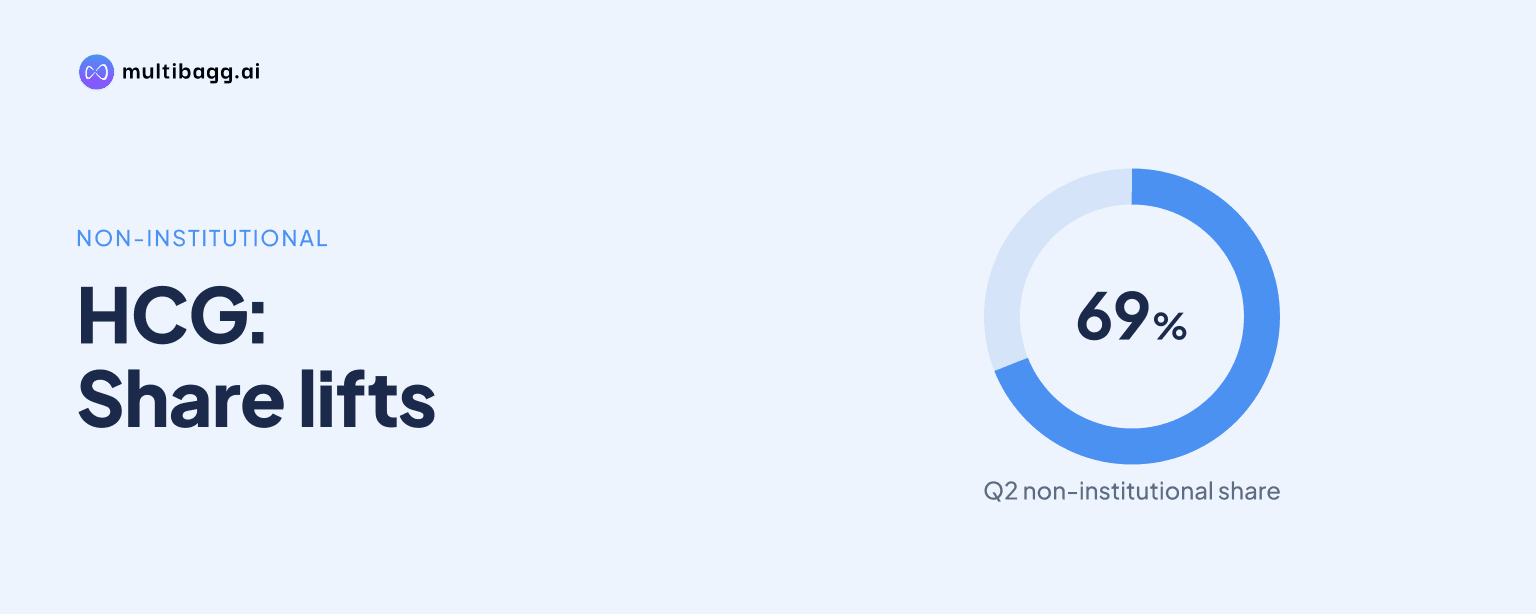
In Q2 FY27 ended September 30, 2026, HealthCare Global Enterprises Limited lifted non-institutional revenue to 69% of total revenue, more than 300 basis points above the prior year, after that business grew 21%. Total revenue increased 16% to Rs 731.8 crore, supported by 9% patient-volume growth, a 7% rise in average revenue per patient and 37% growth in robotic surgeries.
Know Healthcare Global Enterprises inside out
Results, valuation, peers and who's buying, in one view.
How did HCG change its revenue mix in Q2 FY27?
HCG increased non-institutional revenue to 69% of Q2 FY27 revenue after this business grew 21% year on year. Management said the revenue share rose by more than 300 basis points as the company expanded non-institutional business and progressively optimized its exposure to lower-realisation segments.
The mix change formed part of management’s stated aim to improve revenue quality as well as patient volumes. Q2 FY27 revenue rose 16% to Rs 731.8 crore, or 14% excluding the new North Bengaluru hospital, while average revenue per patient, or ARPP, increased 7% because of favourable payor mix and higher-complexity oncology procedures.
All financial figures discussed by HCG exclude the Milann Fertility business, which was divested in June 2026. The company said it also adjusted the corresponding prior-year figures, making the reported 16% Q2 FY27 revenue growth a like-for-like comparison.
What drove HCG’s higher revenue per patient?
HCG attributed the 7% Q2 FY27 ARPP increase to favourable payor mix and a greater contribution from complex oncology treatments. Robotic surgeries rose 37% year on year, and management also cited increased adoption of advanced therapies and surgical procedures across the network.
Patient volumes increased 9% in Q2 FY27, so both patient inflows and revenue per patient contributed to the 16% revenue increase. The South cluster showed a more ARPP-led pattern, with revenue up 18%, ARPP up 14% and patient volumes up 4%, while the East cluster grew 23% on an 18% volume increase and 5% ARPP growth.
The pattern continued in H1 FY27, when consolidated revenue rose 15% year on year to Rs 1,410 crore. Patient volumes rose 9% and ARPP increased 6% in the half, with management again linking the ARPP movement to payor mix and higher-end procedures, including robotic surgeries.
Which HCG clusters delivered Q2 FY27 growth?
HCG’s East cluster posted the fastest growth among the reported Indian clusters, with Q2 FY27 revenue rising 23% year on year to Rs 92.8 crore. Management said the increase was broad-based and led by Ranchi, while the cluster’s 18% volume growth exceeded its 5% ARPP increase.
The South cluster generated Rs 294.1 crore, up 18% year on year and equal to 40% of overall revenue. Management cited the Bengaluru Centre of Excellence, the progressive ramp-up of North Bengaluru, favourable payor mix and a higher contribution from high-end procedures and therapies.
The West cluster remained the largest reported contributor, generating Rs 314.7 crore, or 43% of revenue, but grew 10%, below South and East. Its patient volumes rose 7% and ARPP increased 3%; management said Maharashtra delivered mid-teens growth, partly offset by moderated Gujarat growth after a deliberate rationalisation of institutional business.
Kenya revenue increased approximately 54% to Rs 30.2 crore in Q2 FY27. Management attributed the growth to stronger radiation-oncology inflows after adding a radiation therapy machine, and increased medical-oncology therapies after adding 13 beds.
Got a follow-up? Ask IRIS
Did HCG’s revenue mix affect profitability?
HCG reported earnings before interest, tax, depreciation and amortisation, or EBITDA, of Rs 142.5 crore in Q2 FY27, up 17% year on year, and an EBITDA margin of 19.7%, compared with 19.2% in Q2 FY26. The result included a Rs 6.1 crore EBITDA loss at North Bengaluru.
Management said margin expansion was partly moderated by about Rs 6 crore of incremental employee costs following the Karnataka Wage Act 2026 revision. Excluding that wage impact, management said Q2 FY27 EBITDA growth would have exceeded 20% year on year, while it attributed underlying progress to revenue quality and operating efficiencies.
For H1 FY27, adjusted EBITDA rose 18% to Rs 274 crore and the adjusted EBITDA margin increased 84 basis points to 19.7%, from 18.8% in H1 FY26. Finance costs declined 11% to Rs 77.5 crore after Rs 170 crore of debt repayments, while depreciation and amortisation rose 16% to Rs 136.5 crore as capacity expanded, including North Bengaluru.
What supports HCG’s higher-complexity treatment plan?
HCG operationalised 25 beds in Q2 FY27, including 13 in Kenya, seven in Kolkata and five in Nagpur, taking its H1 FY27 total to 146 beds. It incurred Rs 127.9 crore of capital expenditure in the half, primarily for capacity expansion, medical equipment and infrastructure upgrades.
During Q2 FY27, HCG operationalised an MR-LINAC adaptive radiation therapy system at North Bengaluru and added a cardiac surgical robotic system at its Ahmedabad multispecialty hospital. Other clinical additions included the first CAR T-cell therapy at HCG Ahmedabad, robotic breast surgery at KR Road, robotic spine surgery at Rajkot, transoral robotic surgery at Vadodara, a 1,212-gene liquid-biopsy panel and two nuclear-medicine tracers.
The mix strategy also faces a regulatory issue involving trade margins on 137 non-scheduled anti-cancer drugs. Management estimated a mid-to-high single-digit percentage annualised impact on EBITDA on an absolute basis, while citing trade-channel optimisation, volume growth, asset utilisation, revenue optimisation and operating efficiencies as potential response levers.
Conclusion
HCG’s Q2 FY27 performance shows a deliberate revenue-mix shift alongside growth: non-institutional revenue reached 69% after rising 21%, while total revenue increased 16% to Rs 731.8 crore. Higher-complexity activity, including 37% growth in robotic surgeries, accompanied the 9% increase in patient volumes and the 50-basis-point year-on-year improvement in EBITDA margin.
The next disclosed milestones are North Bengaluru’s planned monthly EBITDA breakeven by the end of Q4 FY27 and management’s expectation that Gujarat will return to mid-teens growth by Q4 FY27. The effect of the 137-drug trade-margin framework also remains an unresolved factor, with management estimating a mid-to-high single-digit annualised EBITDA impact.