










Hexagon Q2 gross margin rises to 47% after pricing actions
Key highlights
- Hexagon's Q2 FY27 gross margin rose to 47% from 43.9% in Q1 FY27.
- Q2 FY27 revenue was Rs 109.7 crore, up 15.2% year on year and 5.1% sequentially.
- H1 FY27 revenue rose 27.3% to Rs 214 crore, while profit after tax was Rs 16.2 crore.
- Inventory rose to Rs 136 crore at September 30, 2026, from Rs 84 crore in March 2026.
powered by IRIS
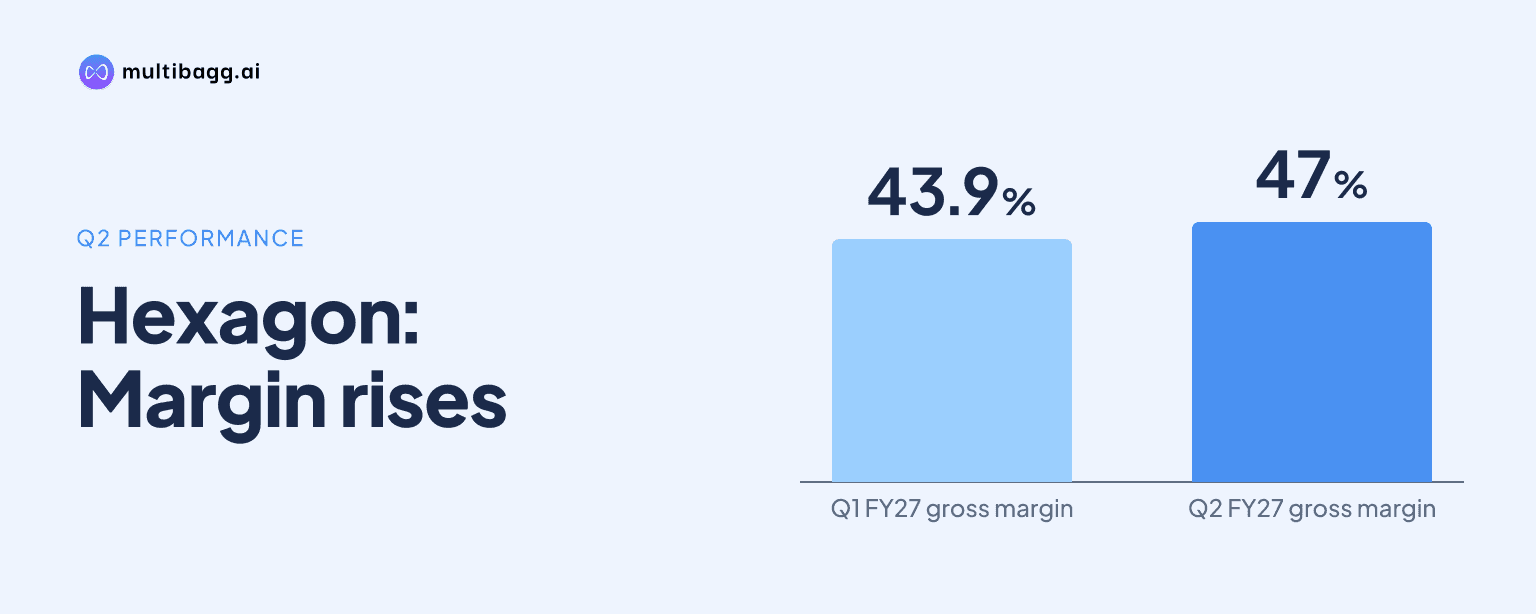
Hexagon Nutrition Limited raised gross margin to 47% in Q2 FY27, up about 310 basis points from 43.9% in Q1 FY27, after branded-product price increases, longer raw-material contracts and product-mix measures began to take effect. The margin remained below the 53.1% reported in Q2 FY26.
Know Hexagon Nutrition inside out
Results, valuation, peers and who's buying, in one view.
How did Hexagon's gross margin change in Q2 FY27?
Hexagon's gross margin improved to 47% in Q2 FY27 from 43.9% in Q1 FY27, while gross profit reached Rs 51.6 crore on revenue from operations of Rs 109.7 crore for the quarter ended September 30, 2026. Revenue increased 5.1% from Q1 FY27 and 15.2% from Q2 FY26, supported by higher sales volume and value in branded and premix businesses.
The sequential recovery did not restore the prior-year margin level. Hexagon reported a gross margin of 53.1% in Q2 FY26, which was 610 basis points above Q2 FY27's 47%. Management said the margin movement reflected efforts to rebuild the product mix with better-margin products while also pursuing volumes that carried lower margins.
What actions are supporting Hexagon's margin recovery?
Hexagon said its three-part margin plan is based on pricing, procurement and product mix. Management said it had increased prices for branded products, negotiated longer contracts for key raw materials and secured supplies, while directing sales towards higher-margin products and customers; it described the 310-basis-point Q2 FY27 improvement as an early sign of progress.
Management said the price increase on branded products should contribute over the next one to two quarters. It also said research and development work would seek lower-cost formulations, which management expects to affect gross margin. These measures are intended to address the gap between Q2 FY27's 47% margin and the 53.1% recorded a year earlier.
Higher input costs had been the main pressure on gross margin. Management identified whey as a critical material that experienced a major price rise, while primary inputs used in the premix segment also became more expensive compared with Q1 FY27 and Q4 FY26. Management said these raw-material prices were fairly stable during Q2 FY27, while adding that the direction beyond the quarter would require more time to assess.
Why did Hexagon's H1 FY27 profit growth trail revenue growth?
Hexagon reported H1 FY27 revenue of Rs 214 crore, up 27.3% from Rs 168 crore in H1 FY26, while profit after tax was Rs 16.2 crore compared with Rs 15.6 crore a year earlier. Management attributed the difference between revenue growth and profit progression to higher raw-material costs, investment in people and a one-time exceptional item.
Q2 FY27 earnings before interest, tax, depreciation and amortisation, or EBITDA, were Rs 10.9 crore after an exceptional loss of Rs 1.1 crore on disposal of older plant and equipment. EBITDA before that item was Rs 12 crore, or 10.9% of revenue, while profit before tax was Rs 10.1 crore and profit after tax was Rs 8.2 crore, up 1% from Q1 FY27.
Costs below gross profit also rose during H1 FY27. Employee cost was 14.7% of revenue, compared with 13.3% in H1 FY26, as Hexagon invested in its branded-nutrition field force and in research and development, quality, sales and compliance. Management said it had about 270 people on the ground and expected employee costs to remain stable at the Q2 FY27 level.
Got a follow-up? Ask IRIS
What do inventory and orders indicate for H2 FY27?
Hexagon increased inventory to Rs 136 crore at September 30, 2026, from Rs 84 crore in March 2026, to secure key materials and prepare for confirmed H2 orders. The build-up was the main reason operating cash flow was negative Rs 8.6 crore in H1 FY27, despite operating profit before working-capital changes of Rs 26.4 crore after Rs 8.4 crore of tax payments.
Management expects inventory to return to normal levels by March 2027 as it converts into sales and cash. It also said inventory linked to orders awaiting customer letters of credit would be dispatched in Q3 FY27. Trade payables rose to about Rs 47 crore and funded part of the working-capital increase, while receivables declined to Rs 77 crore from Rs 82 crore.
Management said the total order book was close to Rs 100 crore and that about Rs 75 crore was likely to ship in H2 FY27. It cited the branded-business field force and orders in premix and ESG business as support for second-half momentum, although ESG dispatches in Q2 FY27 were delayed pending customer letters of credit.
What is Hexagon's balance-sheet position and operating plan?
Hexagon held Rs 46.5 crore in cash, bank deposits and liquid funds at September 30, 2026, against total borrowings of Rs 37.4 crore, leaving it net cash positive by around Rs 9 crore. Total equity was Rs 245 crore, and the debt-to-equity ratio was about 0.15 after equity instruments of about Rs 12 crore were converted into equity shares during H1 FY27.
Capital expenditure was Rs 4 crore in H1 FY27 and dividend payments totalled Rs 3.7 crore. Management said it would continue modifying the Nashik premix facility, with major funding through a bank loan of up to Rs 20 crore. Capacity utilisation was around 30% during H1 FY27, and management said reconstruction work at Nashik had been initiated.
Hexagon also said it collaborated with Particles for Humanity on development of a stable form of Vitamin A+. Management said the product development could support expansion into new geographies and that its future premix-business focus included Europe and North America. These remain management plans rather than reported revenue contributions.
Conclusion
Hexagon's Q2 FY27 performance shows that pricing, procurement and mix actions coincided with a 310-basis-point sequential recovery in gross margin to 47%, while quarterly revenue rose 15.2% year on year to Rs 109.7 crore. Yet the margin remained 610 basis points below Q2 FY26, and H1 FY27 profit after tax increased to Rs 16.2 crore despite revenue growth of 27.3% to Rs 214 crore.
The next results will show whether management's expectation of further margin improvement in Q3 and Q4 FY27 is realised as price actions and procurement contracts take effect. Other disclosed milestones are shipment of about Rs 75 crore from the close to Rs 100 crore order book in H2 FY27, inventory normalisation by March 2027 and progress on the Nashik facility modification financed partly by up to Rs 20 crore of bank borrowing.