










Hinduja Global Solutions targets recurring Rackspace revenue
Key highlights
- HGS said site-reliability engineering and managed services should be the recurring-revenue parts of its Rackspace collaboration.
- Digital and Media Services contributed 46% of HGS operating revenue in Q2 FY27.
- HGS reported Rs 108.40 crore of operating cash flow in H1 FY27.
- HGS said sequential EBITDA margin recovered to 13.1%.
powered by IRIS
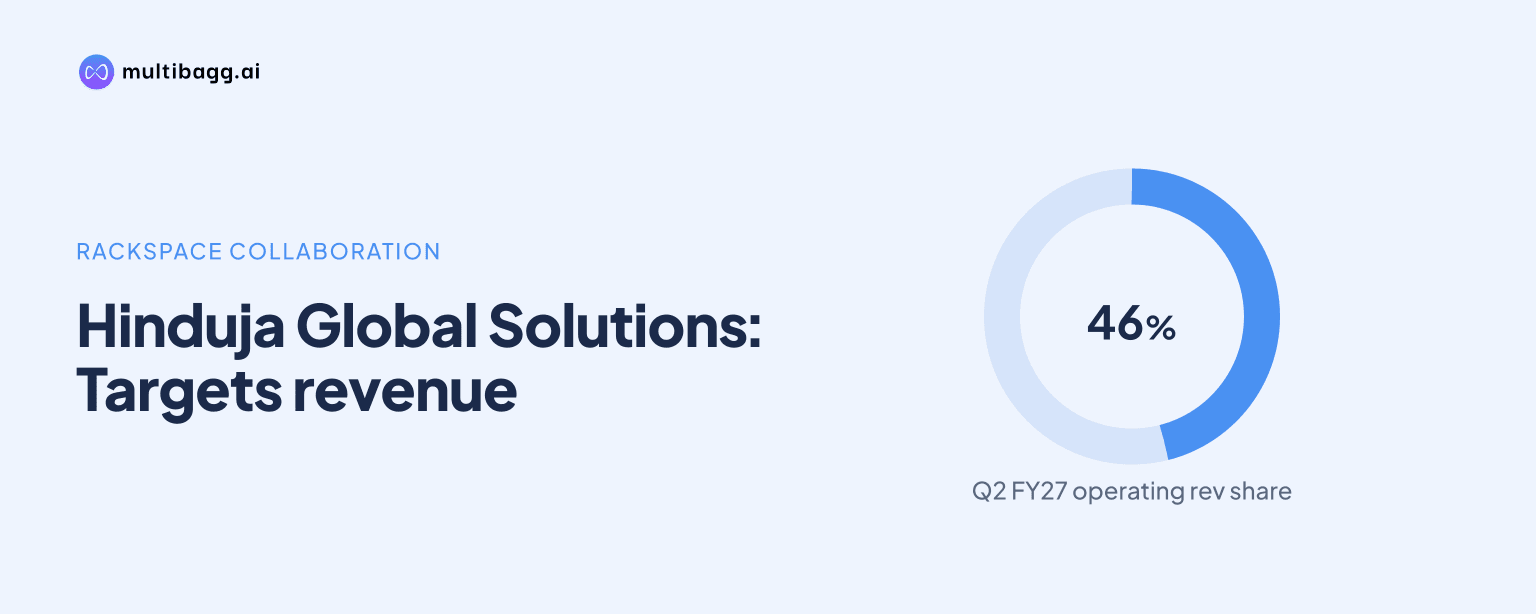
Hinduja Global Solutions said on its Q2 FY27 call that site-reliability engineering and managed services in its Rackspace collaboration are expected to generate recurring revenue, while Digital and Media Services represented 46% of operating revenue. Management positioned migration as part of delivery, but identified ongoing infrastructure operations as the long-term growth mechanism.
Know Hinduja Global Solutions inside out
Results, valuation, peers and who's buying, in one view.
What will HGS do under the Rackspace collaboration?
HGS will provide site-reliability engineering, migration and management of infrastructure for Rackspace customers operating sovereign artificial-intelligence, or AI, models. Management described Rackspace as a provider of infrastructure that lets enterprises run their own models on physical servers dedicated to individual clients, rather than relying only on public-cloud infrastructure.
The operating model addresses enterprise concerns around data privacy, data sovereignty and control over data visibility to external foundational models. Management said these concerns are prompting enterprises to consider dedicated infrastructure for AI models, and HGS’s role is to migrate and manage that infrastructure once deployed.
Management called the collaboration significant because it expects sovereign-AI adoption to mature from the use of models available through laboratories and application programming interfaces, or APIs, to enterprise-operated models on dedicated infrastructure. The call did not disclose a Rackspace contract value, customer count, deployment date, revenue contribution or margin contribution.
Which Rackspace services are expected to create recurring revenue?
HGS said site-reliability engineering and managed services are expected to be the recurring-revenue components of the Rackspace collaboration. When asked about cloud modernisation, security engineering, migration engineering and product development, management singled out those two operational service lines as the areas that should drive long-term growth.
Migration is part of HGS’s disclosed role, but management distinguished ongoing site reliability and managed operations from initial deployment work. That distinction is central to the strategy: a customer may require migration when it sets up dedicated infrastructure, while the infrastructure can require continuing engineering and management after the initial transition.
Management gave no target for the proportion of Rackspace work that could become managed services, nor did it quantify the expected timing of recurring revenue. Its expectation depends on enterprises increasingly shifting from externally available AI models to models they run on sovereign infrastructure, rather than on reported Rackspace revenue in Q2 FY27.
Got a follow-up? Ask IRIS
How does the Rackspace plan fit HGS’s current revenue mix?
HGS is using the Rackspace collaboration to support its technology-led growth effort, while CX Services still accounted for 54% of operating revenue and Digital and Media Services for 46%. The company did not report Rackspace as a separate segment, so the call does not show its current contribution to either revenue category.
Technology, Media and Telecommunications, or TMT, was HGS’s largest vertical at 45% of revenue, followed by Consumer Goods and Retail at 21%, Banking, Financial Services and Insurance, or BFSI, at 15%, and public sector at 10%. Management did not identify which verticals, geographies or named customers are expected to use the Rackspace offering.
The broader technology strategy is also based on expanding smaller initial assignments. Management said it had closed 79 new logos in the prior year, including customers in technology, digital and AI services where HGS had not historically been a major provider. It expects those relationships to increase in value as customers gain confidence in its delivery and transformation capabilities.
Management said a changing revenue mix, cross-selling and more efficient deployment of talent helped sequential earnings before interest, tax, depreciation and amortisation, or EBITDA, margin recover to 13.1%. It did not attribute any part of that margin movement to Rackspace, which remains a strategic capability rather than a disclosed current earnings driver.
How will HGS support its managed-services expansion?
HGS said it plans to redeploy cash generated from operations into new engagements, deeper client relationships, a healthier revenue mix and an AI-native workforce. Cash from operating activities was Rs 108.40 crore in H1 FY27, compared with Rs 412.60 crore in FY26, although management said the half-year and full-year periods are not directly comparable.
Capital expenditure was Rs 81.90 crore in H1 FY27 and net cash used in investing was Rs 31.50 crore, while financing outflow was Rs 169.50 crore. Management said cash needs would also rise as the business expands because more working capital will be required to support its growth priorities.
Cash and bank balances stood at Rs 528.10 crore in September 2026, down from Rs 568.90 crore in March 2026, while total borrowings rose to Rs 1,406 crore from Rs 1,294 crore. Management said measured capital expenditure and self-funded operations leave room for investment in growth engines including domain and delivery solutions, intellectual property and partner ecosystems.
HGS is also building the skills needed for technology-led work. Management said it is investing in internal capabilities, organic talent development and hiring, and expects the business mix to change over the coming quarters and the next financial year as customers develop trust in its technology transformation and deployment work.
Conclusion
HGS is positioning the Rackspace collaboration as a route to recurring sovereign-AI infrastructure-management revenue, with site-reliability engineering and managed services carrying more long-term importance than migration work. The plan fits its wider effort to combine AI, systems integration, domain knowledge and people-led delivery, alongside a business where Digital and Media Services already contributes 46% of operating revenue.
The next items to watch are management’s stated priorities of ramping new engagements, deepening existing clients, improving the revenue mix and enabling an AI-native workforce. Future calls may show whether HGS discloses customer deployments, managed-service contracts, revenue or margin contribution from Rackspace, none of which were quantified in Q2 FY27.