










HGS targets 2 million Uttar Pradesh homes via Project Ganga
Key highlights
- HGS aims to connect nearly 2 million Uttar Pradesh households through Project Ganga within two to three years.
- Project Ganga had 16 live local networks and 200 paying customers as of November 14, 2026.
- More than 1,221 applicants had been trained, while 40 interest-free, collateral-free loans had been approved.
- HGS broadband revenue grew about 8% year on year in H1 FY2027 as the subscriber base rose 6%.
powered by IRIS
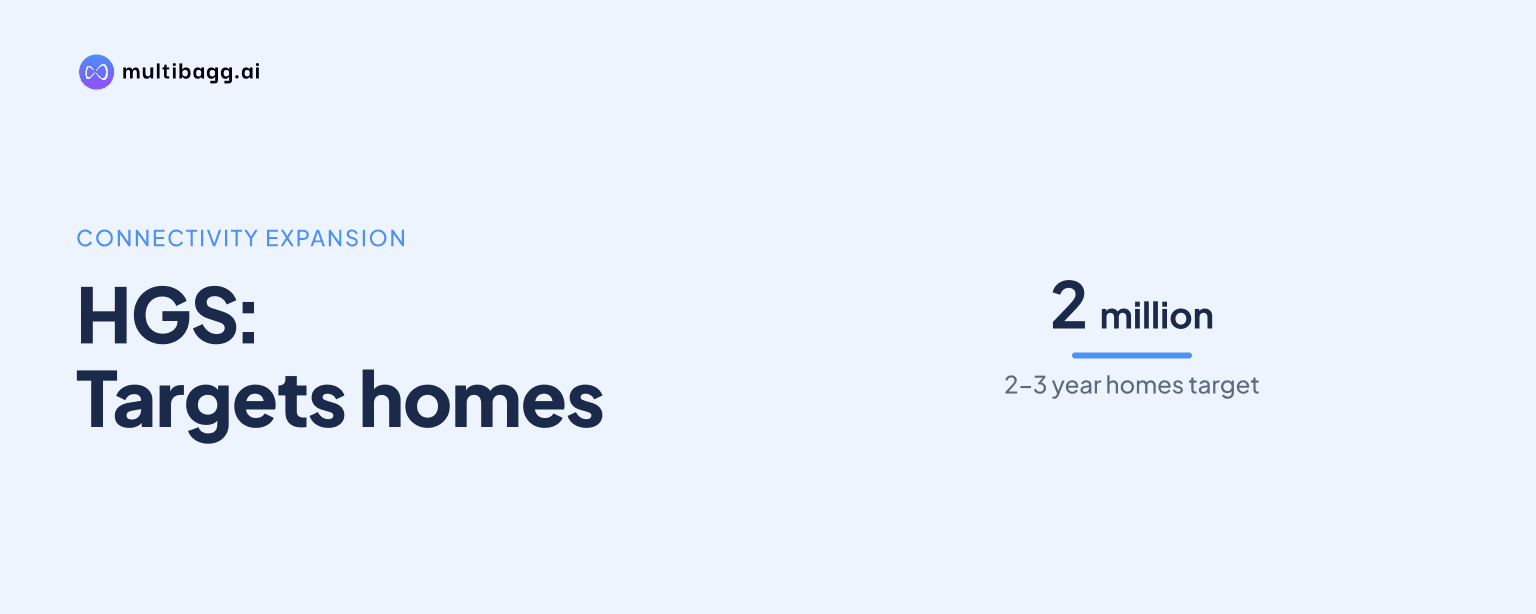
Hinduja Global Solutions Limited said Project Ganga aims to connect nearly 2 million Uttar Pradesh households with high-speed broadband over two to three years through 8,000 to 10,000 local digital service providers. As of November 14, 2026, HGS had 16 live networks serving 200 paying customers after signing the project in June.
Know Hinduja Global Solutions inside out
Results, valuation, peers and who's buying, in one view.
What is HGS Project Ganga?
HGS Project Ganga is a digital-inclusion and social-transformation project being executed for the State Transformation Commission of the Government of Uttar Pradesh. The company said the project was signed in June and is intended to extend broadband across urban, semi-urban and rural parts of the state through local operators rather than only a centrally owned retail footprint.
HGS is building the distribution network through first-generation digital service entrepreneurs, or DSPs. Each DSP is expected to market, install and support the Ganga Fiber service in a local area. Management said the first live operators had completed the project’s stages of application, training, loan processing and network deployment within about four to five months of the June 9 scheme launch.
How far has HGS rolled out Project Ganga?
HGS had trained more than 1,221 applicants, received more than 4,000 applications and made 16 DSP networks live as of November 14, 2026. The 16 live operators had secured 200 paying customers, providing the first disclosed customer base for Ganga Fiber.
Management said 85% of evaluated applicants qualified, while 835 applicants were document-ready for the next loan-processing stage and another 2,500 had qualified for training. HGS did not disclose revenue, capital expenditure or average revenue per Ganga Fiber customer from the 200 live connections.
HGS described the next phase as an assembly-line process: applications are received, qualified candidates are trained, loan applications are filed and approved operators deploy their networks. The company has established an online learning management system and a physical training centre in Lucknow to support candidates in remote locations.
How does the HGS local-operator model work?
HGS recruits and trains applicants to become DSPs, then helps them apply under the CM-YUVA government scheme for loans of up to Rs 5 lakh. Management said these loans are interest-free and collateral-free, and HGS assists successful applicants with technology rollout and customer marketing after financing is approved.
The operator model includes location and eligibility screening. Management said selection uses government criteria and technology conditions, including that an operator cannot be more than 5 kilometres from the nearest base transceiver station. This process is intended to assess whether a prospective operator can be supported by the underlying network before rollout.
Each DSP can initially serve close to 350 customers with its first capital expenditure, according to management. HGS said an operator can expand further as its business grows, while the company’s stated two-year goal is to create 8,000 to 10,000 DSPs.
The 40 approved loans exceeded the 16 operators already live as of November 14, indicating that some financed operators were still progressing through deployment. Similarly, 355 loan applications had been filed from more than 1,221 trained applicants, making conversion from training and financing to live service a central operational measure.
Got a follow-up? Ask IRIS
What broadband products will HGS sell through Ganga Fiber?
HGS will market the service under the Ganga Fiber brand, with plans starting at Rs 399 a month including goods and services tax, or GST. Every plan includes 100 television channels, and management said customers will later be able to add packages containing pay television channels.
The company identified GangaFirst as a household-oriented offering for reliable connectivity and entertainment. It described Ganga Pro for small and medium businesses, and Ganga Elite for businesses toward the medium end of that segment. Management did not provide individual speed tiers, prices beyond the Rs 399 starting plan, or product-level customer take-up.
The bundle connects Project Ganga with HGS’s digital television, or DTV, operations. Management said its DTV business faces structural subscriber pressure as viewers move to online streaming, while broadband inclusion, upselling and cross-selling are intended to offer existing television customers broadband services.
How does Project Ganga fit HGS broadband growth?
Project Ganga adds an Uttar Pradesh distribution channel while HGS reported broadband revenue growth of about 8% year on year in H1 FY2027. The subscriber base grew 6% in the same period, which management said reflected a focus on higher average revenue per user, or ARPU, customers.
HGS said growth was recorded across retail, strategic alliance partners, CelerityX, its enterprise business unit, and subsidiary One7Star. This contrasts with DTV operations, where management is pursuing cost optimisation in response to industry-wide shifts toward streaming. HGS did not separately disclose Project Ganga revenue within the H1 FY2027 broadband figure.
The subscriber mix moved toward faster plans in H1 FY2027. Customers on plans above 100 megabits per second accounted for 13.5% of the base, up from 10.4% a year earlier, while the entry-level 0 to 30 megabits per second segment fell to 18.8% from 23.7%. HGS also said three-month-plus recharges rose 5% year on year and churn declined quarter after quarter.
Digital and Media Services accounted for 46% of HGS operating revenue, compared with 54% from CX Services. India represented 39% of operating revenue by origination, a category that includes broadband, media and Project Ganga. Management did not provide a financial target for the Uttar Pradesh project.
Conclusion
Project Ganga gives HGS a planned route to reach nearly 2 million Uttar Pradesh households through 8,000 to 10,000 local DSPs, combining entrepreneur training, government-backed financing, network deployment and Ganga Fiber services. The early rollout had produced 16 live networks and 200 paying customers by November 14, 2026, alongside 8% H1 FY2027 broadband revenue growth.
The next measure to watch is conversion through the rollout funnel, as 835 document-ready applicants, 355 loan applications and 40 approved loans had not all become live operators by November 14. Management said it expected significant traction and indicated it could report further Project Ganga growth on the next quarterly call while pursuing the two- to three-year household target.