










Techknowgreen Sees Data Centres and Sewage Audits Driving Growth
Key highlights
- Techknowgreen said it consults for 9 out of 10 data centres on environmental and sustainability matters.
- Management put data-centre environmental-clearance ticket sizes at Rs 70 lakh to Rs 2 crore.
- Techknowgreen completed a 140-STP audit trial in Pune, against an estimated Maharashtra universe of about 8,000 plants.
- Management said Singapore Telecom placed a Yuka Yantra order worth about Rs 2.5 crore.
powered by IRIS
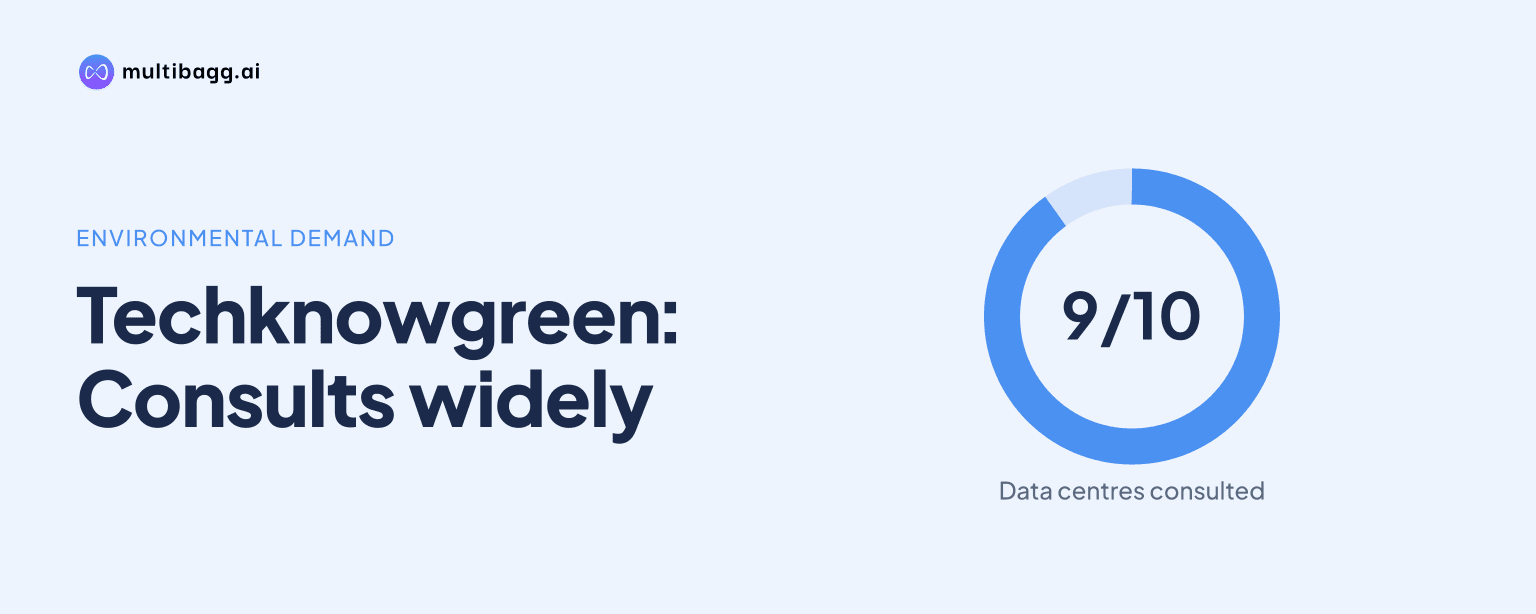
Techknowgreen Solutions Limited said on November 18, 2026 that data-centre clearances and sewage-treatment-plant audits are growth drivers, supported by its claimed consulting role at nine out of 10 data centres, data-centre assignment sizes of Rs 70 lakh to Rs 2 crore, and a completed 140-plant Maharashtra trial.
Know Techknowgreen Solutions inside out
Results, valuation, peers and who's buying, in one view.
What are Techknowgreen's main growth drivers?
Techknowgreen identified government policy, urban environmental infrastructure and demand from data centres and infrastructure construction as its three main growth drivers for the next 12 months. Management cited the National Clean Air Program, or NCAP, for which it said Rs 80,000 crore had been allocated, including Rs 4,000 crore received by Maharashtra, as an example of policy support for environmental work.
Management said urban air-quality and wastewater regulations, together with government spending on environmental infrastructure and studies, form the second driver. It linked the third driver to data centres and construction projects requiring environmental approvals, pollution-control permissions and sustainability support. Techknowgreen is also running trials for Yuka Yantra, its technology product, in pursuit of air-quality opportunities.
Techknowgreen said it prefers sustained growth over isolated large contracts, even though management said work orders of Rs 20 crore to Rs 30 crore can be available. Management described such opportunities as one-time projects that may not support consistent annual expansion, and said the company has grown at an average rate of 30% to 40% over the past three years.
How does Techknowgreen earn from data centres?
Techknowgreen earns from data centres mainly through environmental clearances and Pollution Control Board clearances, with management placing typical assignment sizes between Rs 70 lakh and Rs 2 crore. Management said the company is the environmental and sustainability consultant for nine out of 10 data centres, a claim that was not accompanied by a count of active assignments or client names.
The company described data-centre work as sustained business because it can continue after the initial clearance process. Management said clients require post-environment compliance work, which Techknowgreen's laboratory handles. This can connect its consulting activity to laboratory, specialised-services and research-and-development work, which management said together usually account for about 20% of business.
Techknowgreen also cited cross-selling of Yuka Yantra to existing customers. Management said Singapore Telecom had placed a Yuka Yantra order worth about Rs 2.5 crore, and added that customers can need both technology products and compliance support after environmental approvals. The call did not identify whether that order was a data-centre assignment or disclose its execution timetable.
Can Techknowgreen expand its sewage-treatment-plant audits?
Techknowgreen said it has completed a trial audit covering 140 sewage treatment plants, or STPs, in the Pune region, and management expects the work could expand. The assignment was given by the state government through the State Pollution Control Board, according to management, which said it had received a positive response to the 140-plant trial.
Management estimated that about 8,000 STPs across Maharashtra need to be audited, compared with the 140 plants already reviewed in the trial. The 8,000-plant figure represents a potential audit universe rather than a confirmed statewide mandate for Techknowgreen. No value, tender schedule or scope for a wider Maharashtra rollout was disclosed on the November 18 call.
Techknowgreen said it has integrated an artificial intelligence, or AI, platform into the STP audit process, which management expects will make larger-scale implementation easier. The project fits management's wastewater and urban-infrastructure growth theme, but the transcript provides no revenue estimate for either the 140-plant assignment or a possible expansion beyond Pune.
Got a follow-up? Ask IRIS
What revenue visibility has Techknowgreen provided?
Techknowgreen has not provided revenue guidance for data-centre clearances, the Maharashtra STP audit opportunity or Yuka Yantra deployments. Management instead said it aims to maintain the 30% to 40% average growth rate it cited for the last three years, while declining to attach financial forecasts to initiatives still moving through government and client approval processes.
Management described its usual revenue mix as roughly 50% consulting, 30% technology and 20% specialised services, research and development, and laboratory services. It said the composition can shift, including to 40%-40% or 40%-40%-10%-10% across categories. Data-centre clearances sit primarily in consulting, while Yuka Yantra is included in technology.
The company also declined to provide expected revenue from its CEWT technology for FY27 or FY28. Management said government authorities were giving the technology attention and that it was being pitched in multiple states, but did not provide an order value, number of potential installations or revenue target.
What could determine execution over the next year?
Techknowgreen's ability to convert public-sector technology opportunities into revenue depends on a process management said can take about nine months from request for proposal to tender, earnest money deposit, work order, implementation and the first bill. Management stressed that patent status or validation does not automatically result in government business.
For Yuka Yantra, Techknowgreen said it had completed a trial with the Uttarakhand government and expected a final report within a few days of the November 18, 2026 call. Separately, management said it expected to disclose some data-centre environmental-clearance projects in the next few days, although it did not name the projects or state their values.
The immediate indicators are therefore different for the two main growth areas. Data-centre progress can be measured by disclosed clearance awards within the stated Rs 70 lakh to Rs 2 crore ticket range, while the Maharashtra opportunity depends on whether the completed 140-STP trial becomes a broader assignment from the estimated 8,000-plant audit universe.
Conclusion
Techknowgreen's stated growth plan combines private-sector compliance work with potential public-infrastructure mandates. Data-centre clearances can generate consulting revenue and later laboratory compliance work, while the STP trial provides evidence of work completed in Maharashtra but not yet of a statewide contract. Management's 30% to 40% sustained-growth objective remains an aim rather than guidance tied to these individual initiatives.
The next developments to watch are the management-promised disclosure of data-centre projects, the Uttarakhand Yuka Yantra final report, and any decision to expand the 140-STP Pune trial. Progress through the government procurement process, which management said can take about nine months before first revenue, will determine when public-sector technology opportunities can become billable work.