










Techknowgreen Says Government Technology Sales Need Nine Months
Key highlights
- Techknowgreen said government patented-technology projects take about nine months from RFP to first revenue.
- Techknowgreen completed a positive Uttarakhand government Yuka Yantra trial, with its final report expected within days of November 18, 2026.
- Techknowgreen described its usual business mix as 50% consulting, 30% technology and 20% specialised, R&D and laboratory services.
- Techknowgreen said it had audited 140 sewage treatment plants in Pune against an estimated Maharashtra opportunity of about 8,000 plants.
powered by IRIS
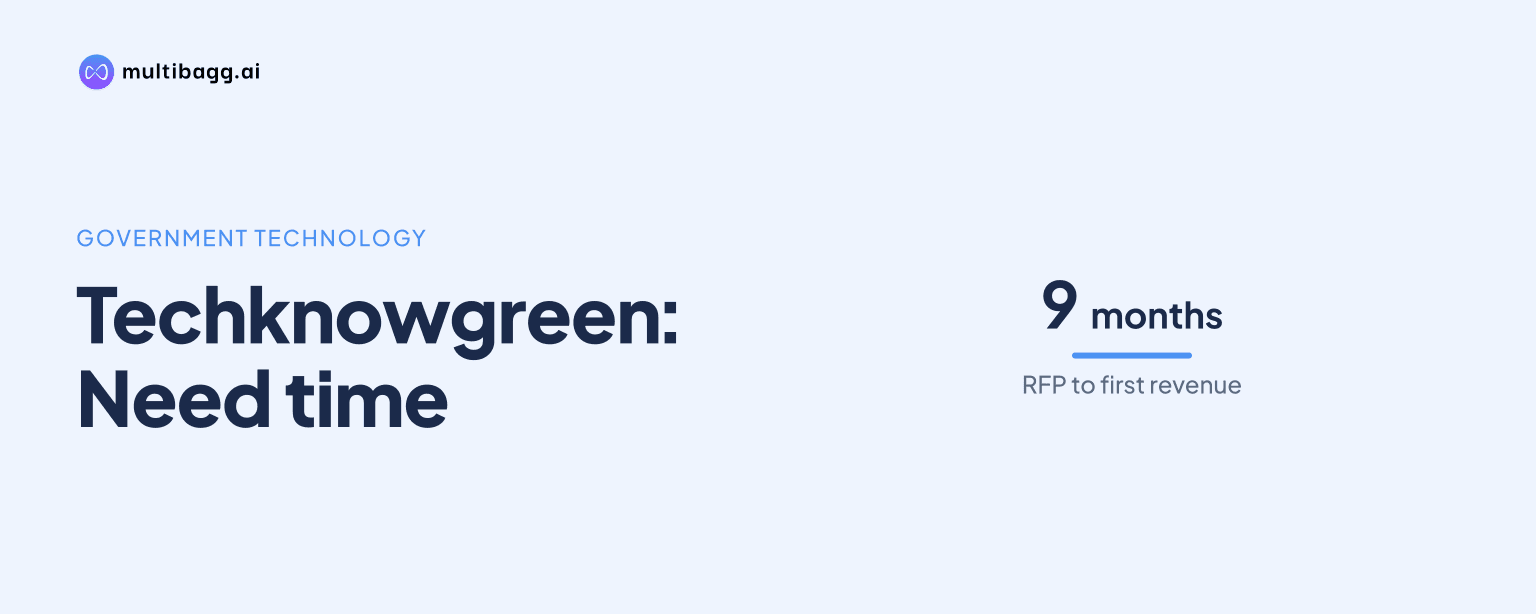
Techknowgreen Solutions Limited said on November 18, 2026 that government commercialisation of its patented technologies takes about nine months from a request for proposal to first revenue, because tendering, work orders, implementation and bill realisation must occur after technical validation.
Know Techknowgreen Solutions inside out
Results, valuation, peers and who's buying, in one view.
Why does Techknowgreen need nine months to convert government technology projects?
Techknowgreen said the process for a government technology project starts with placing the technology in a request for proposal, or RFP, and then moves through tender conversion, tender submission, earnest money deposit, work order, implementation and first revenue generation. Management described this sequence as taking about nine months, and declined to attach a revenue estimate to the process when asked about the outlook for FY27 and FY28.
The cycle extends beyond winning an order because implementation and the realisation of the first bill happen after the work order. Management said that having a patent or National Research Development Corporation validation does not itself secure government business. The company must still complete the procedural stages before revenue is generated, making official interest different from a disclosed sale.
What has Techknowgreen said about demand for its patented technologies?
Techknowgreen said government authorities were giving its technology good attention and were inclined to implement it at multiple state levels, but it did not quantify an order pipeline. When asked for FY27 and FY28 revenue from the patented technology discussed as CEWT on the call, management said it was pitching in many places and receiving good responses but could not responsibly provide a number.
An analyst referred to the technology having achieved Technology Readiness Level 9, or TRL 9, and management confirmed that status. However, Techknowgreen distinguished technical readiness from commercial conversion: RFPs must become tenders, tenders must produce work orders, and installed projects must reach their first bill. The approximately nine-month timetable is management’s explanation for that gap.
Could the Uttarakhand Yuka Yantra trial create revenue?
Techknowgreen said it had completed a Yuka Yantra trial with the Uttarakhand government and obtained a positive result. On November 18, 2026, management said the final report was expected within a few days, but it did not disclose a purchase order, contract amount, installation schedule or date of first revenue from the trial.
The company also clarified that a Rs 104 crore Delhi Pollution Control Committee opportunity raised by an investor was a pilot, not a direct product-sale tender. According to management, participants would need to invest under a model intended to generate revenue through advertising rather than from a direct sale of the equipment. Techknowgreen said it had met the committee’s chairman and introduced the technology in Delhi, without identifying it as booked revenue.
How does the technology cycle compare with Techknowgreen’s other work?
Techknowgreen said consulting generally has a shorter cash-conversion process than projects involving equipment supply or technology implementation. For consulting, management said an application can often be billed after roughly one month of filing work, followed by about two months for payment, or three months on average. This differs from the government technology route, which includes tendering and physical implementation before initial revenue.
Management described its usual business mix as approximately 50% consulting, 30% technology and 20% specialised services, research and development, or R&D, and laboratory services. Yuka Yantra is included in the technology category. Management also said the split changes across periods, including possible 40%-40% and 40%-40%-10%-10% combinations.
The mix means the nine-month government route does not apply to all of Techknowgreen’s operations. Management said its average receivable period was 60 to 90 days, with about 80% of clients at a maximum of 60 days. For equipment projects, it said the company may invest 40% to 50% before delivery, then wait about 60 days after billing, creating a longer project cash cycle.
Got a follow-up? Ask IRIS
What growth plans did Techknowgreen identify for FY28?
Techknowgreen did not give FY27 or FY28 revenue guidance for its patented technologies, though management suggested FY28 could show greater traction once opportunities progress through the disclosed nine-month process. This was a management expectation rather than a forecast, and the company did not disclose how many RFPs, tenders or work orders might convert during either year.
Management also said artificial intelligence, or AI, integration was already under way at Techknowgreen and would become one of its products. It gave no launch date, customer name, price or projected revenue contribution. The disclosed plan therefore identifies a future product initiative, while its financial effect remains unquantified as of the November 18, 2026 call.
Which operating areas could support Techknowgreen’s growth plans?
Techknowgreen said it was pursuing sustained growth of 30% to 40%, a range management said reflected its average growth over the previous three years. Management contrasted this approach with accepting a one-time Rs 20 crore to Rs 30 crore assignment, saying such opportunity-based work might not support continuing year-on-year growth. No revenue target accompanied the stated growth range.
Management identified government environmental policy, urban infrastructure and legal updates on air quality and wastewater as external drivers. It said the company had received a state-government audit assignment covering 140 sewage treatment plants in the Pune region, compared with an estimated 8,000 plants across Maharashtra. Techknowgreen said it had integrated an AI platform into that audit work to make further implementation easier, but did not state the assignment’s value.
Data-centre environmental clearances were another disclosed operating area. Management said Techknowgreen was consultant on environmental and sustainability matters for 9 out of 10 data centres referred to in its remarks, with individual assignments ranging from Rs 70 lakh to Rs 2 crore. It also cited a previously disclosed Yuka Yantra order from Singapore Telecom of about Rs 2.5 crore and said such work could create laboratory and post-environment-compliance cross-selling.
Conclusion
Techknowgreen’s central disclosure is that government interest, a patent, TRL 9 status and positive trials are preliminary commercial milestones rather than immediate technology revenue. The company’s stated path from RFP to first revenue takes about nine months, whereas consulting can generally be billed and paid within about three months and represented roughly 50% of its usual business mix.
The next items to watch are the final report from the Uttarakhand Yuka Yantra trial, movement of government pitches into tenders and work orders, and progress on the planned AI product. Management also pointed to FY28 for potential technology traction, but it disclosed no FY27 or FY28 revenue target, no AI launch date and no quantified government order pipeline.