










Hindustan Foods Limited footwear returns to profit in Q2FY27
Key highlights
- HFL’s footwear division returned to profitability in Q2FY27 after legacy fixed-price orders were completed and new orders were repriced.
- HFL says its footwear order book is full until March 2027, and October 2026 delivered the division’s highest-ever monthly turnover.
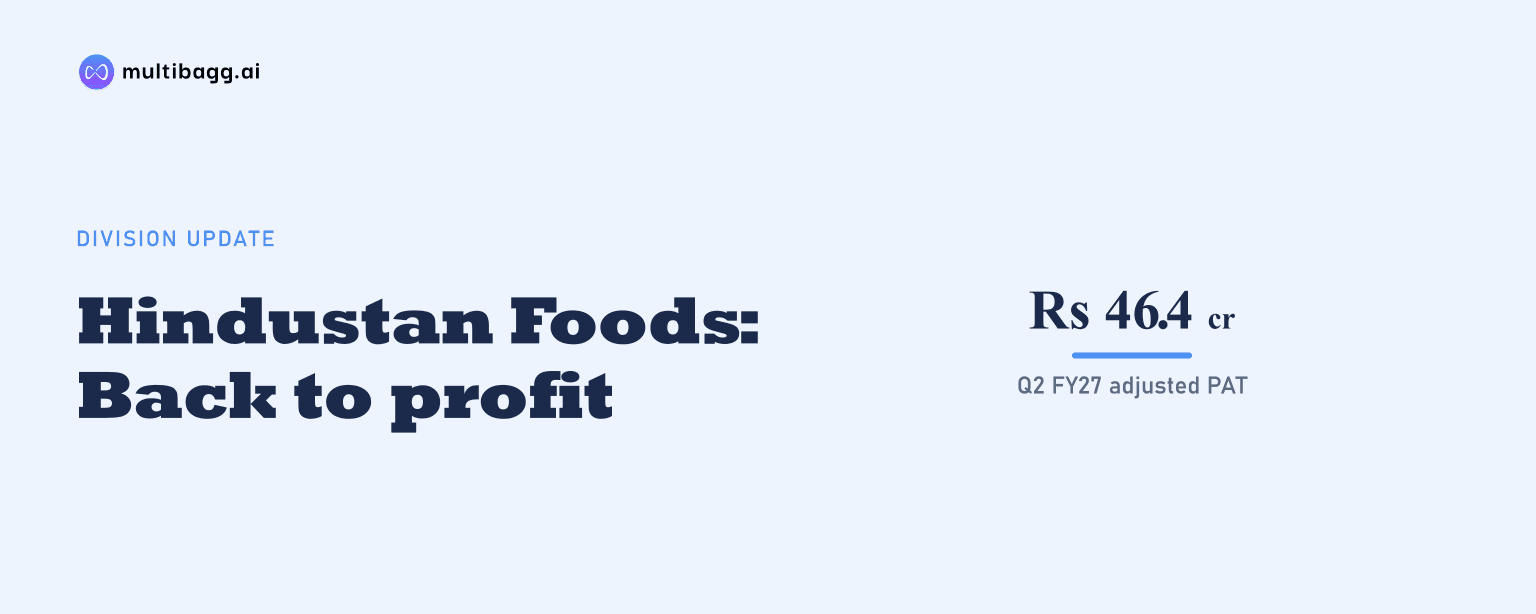
- HFL reported Q2FY27 adjusted profit after tax of Rs 46.4 crore, up 21.7% year on year.
- HFL’s footwear gross block is projected to rise from Rs 113 crore in September 2026 to Rs 146 crore by March 2027.
powered by IRIS
Hindustan Foods Limited’s footwear division returned to profitability in Q2FY27 after completing legacy fixed-price orders and booking new business at revised prices, while its order book became full until March 2027. HFL also reported October 2026 as the division’s highest-ever monthly turnover, indicating continued activity in H2FY27.
Know Hindustan Foods inside out
Results, valuation, peers and who's buying, in one view.
How did HFL’s footwear division return to profit?
HFL’s footwear division returned to profit in Q2FY27 by completing deliveries under legacy fixed-price orders, repricing new orders for the prevailing cost structure, procuring materials on time and maintaining operational efficiencies. The division had faced higher raw-material costs and revised wage rates, pressures that HFL had highlighted in Q1FY27. The presentation does not disclose footwear revenue, profit or margin figures for either Q1FY27 or Q2FY27.
The turnaround followed an operational response rather than a stated reduction in input costs. Legacy fixed-price orders reflected an earlier cost base, whereas new orders were booked at revised prices intended to account for current costs. HFL says supply-chain disruption in footwear affected the early part of H1FY27, but identifies Q2FY27 as the quarter in which the shoes division became profitable.
HFL has also expanded its customer portfolio by onboarding new brands for sports shoes and sneakers. At the same time, work has started at its existing Chennai plant to create additional capacity for sports shoes. These are operational developments disclosed alongside the Q2FY27 profitability milestone, rather than quantified revenue commitments from the new brands.
What order visibility does HFL have in footwear?
HFL says its footwear order book is full until March 2027, providing disclosed order visibility beyond H2FY27. The company also says October 2026 produced the footwear division’s highest-ever monthly turnover, although it does not provide the turnover amount or compare it with a prior monthly figure.
Management expects footwear profitability to ramp up further in H2FY27. That expectation is based on completed legacy orders, revised pricing of newer orders and the reported order-book position, rather than a published divisional earnings forecast. HFL’s statement is an expectation, not a guarantee of a particular footwear profit or margin outcome.
The order-book update is more specific than HFL’s company-wide earnings guidance. HFL reiterated FY27 adjusted profit after tax guidance of Rs 200–220 crore and said it expects to land around Rs 200 crore, with Q4FY27 as the major contributor. This outlook covers company-wide operations, including flood disruption at Silvassa and project commissioning delays, and is not a footwear-only target.
How did HFL’s overall Q2FY27 performance compare?
HFL reported Q2FY27 revenue of Rs 1,269.4 crore, up 18.0% year on year from Rs 1,075.9 crore, while earnings before interest, tax, depreciation and amortisation, or EBITDA, rose 25.6% to Rs 115.4 crore. Profit before tax increased 24.5% to Rs 61.2 crore before the exceptional item, and reported profit after tax rose 18.2% to Rs 45.0 crore.
Reported profit after tax included a Rs 1.30 crore exceptional loss for the deductible on an insurance policy related to floods at the Silvassa facility. On an adjusted basis excluding that item, HFL reported Q2FY27 profit after tax of Rs 46.4 crore, up 21.7% year on year and 8.4% quarter on quarter. The footwear division’s return to profit occurred within this broader quarter, but HFL does not assign a numerical share of consolidated earnings to footwear.
For H1FY27, revenue increased 18.0% to Rs 2,476.4 crore and EBITDA increased 25.8% to Rs 221.6 crore from H1FY26. Adjusted profit after tax was Rs 89.1 crore, up 29.5%, while reported profit after tax was Rs 87.8 crore after the Silvassa insurance deductible. HFL says early-H1FY27 footwear supply-chain disruption and about 1.5 months of flood disruption at Silvassa affected first-half profitability.
Got a follow-up? Ask IRIS
What investment is HFL making in footwear capacity?
HFL has a Rs 50 crore footwear project for capacity expansion in North and South India that is listed as in progress. Its footwear gross block, including capital work in progress and capital advances under the presentation’s definition, was Rs 113 crore in September 2026, up from Rs 90 crore in March 2025.
The footwear capital-expenditure summary lists Rs 23 crore of capitalised gross block between March 2025 and September 2026, Rs 33 crore of in-progress projects and no new projects. HFL projects footwear gross block of Rs 146 crore by March 2027. This is a planned Rs 33 crore increase from September 2026, matching the amount listed for in-progress projects.
Capacity work at the Chennai plant is specifically aimed at sports shoes, while the customer additions span sports shoes and sneakers. However, HFL does not state the additional capacity volume, the commissioning date for Chennai work, or the expected revenue contribution of the Rs 50 crore North and South India expansion. Those details remain unresolved in the presentation.
What cash-flow and execution factors could affect HFL’s H2FY27?
HFL reported net cash from operating activities of Rs 57.7 crore in H1FY27, compared with Rs 109.5 crore in H1FY26, but this marked a recovery from negative Rs 9.5 crore in H2FY26. The company attributes the H2FY26 result to goods and services tax, or GST, rate changes under an inverted-duty structure and a proactive inventory build-up, and says it retained that inventory stance through H1FY27 amid geopolitical uncertainty.
HFL has begun moving selected customer businesses from gross to net revenue recognition to release working capital without affecting profitability. It says additional customers have agreed to move to net revenue recognition from Q4FY27 and that this, together with recently announced GST changes, is expected to produce significantly stronger operating cash flow in H2FY27. The expected improvement is company-wide and is intended to help fund growth projects.
At September 30, 2026, inventories were Rs 1,150.5 crore, up from Rs 969.5 crore at March 31, 2026, while total borrowings were Rs 1,182.9 crore, up from Rs 1,050.0 crore. Net debt to equity was 0.90 times, and cash and cash equivalents were Rs 17.0 crore at September-end. These balance-sheet measures provide context for project execution, including footwear capacity, but HFL does not allocate borrowings or cash flow by division.
Conclusion
HFL’s disclosed footwear turnaround rests on the completion of older fixed-price commitments, repricing of new business, timely procurement and operational efficiencies. Profitability returned in Q2FY27, October 2026 set a record monthly turnover for the division, and the order book was full through March 2027. Consolidated Q2FY27 adjusted profit after tax of Rs 46.4 crore rose 21.7% year on year, though footwear’s direct financial contribution was not disclosed.
The next disclosed milestones are H2FY27 footwear profitability progress, Q4FY27 as management’s expected major contributor to FY27 earnings, and the planned expansion of footwear gross block to Rs 146 crore by March 2027. Readers can also watch whether net revenue recognition from Q4FY27 and GST changes deliver the stronger H2FY27 operating cash flow HFL expects, while capacity expansion in North and South India remains in progress.