










Hindustan Zinc sees Indian demand doubling as steel hits 300 MTPA
Key highlights
- Hindustan Zinc says Indian zinc demand could double within five to 10 years.
- India’s crude-steel capacity is projected to rise from 205 MTPA in FY2025 to 300 MTPA in FY2030.
- Hindustan Zinc cites Rs 11.21 lakh crore of government infrastructure capital expenditure in FY2026.
- Global zinc demand is projected to grow at a 1.4% CAGR over the next decade.
powered by IRIS
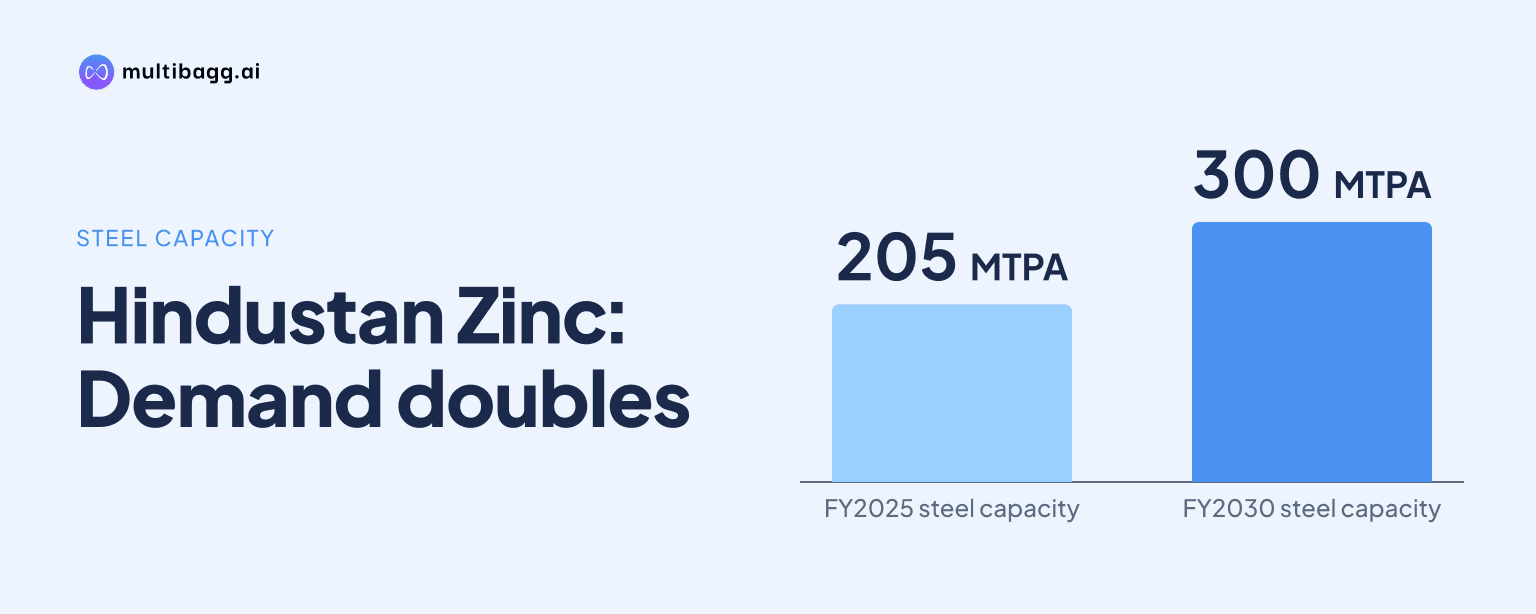
Hindustan Zinc Limited says Indian zinc demand could double within five to 10 years, anchored by crude-steel capacity projected to reach 300 million tonnes per annum (MTPA) by fiscal year (FY) 2030 from 205 MTPA in FY2025. Hindustan Zinc contrasts that domestic outlook with projected global zinc-demand growth of 1.4% compound annual growth rate (CAGR) over the next decade.
Know Vedanta inside out
Results, valuation, peers and who's buying, in one view.
Why does Hindustan Zinc expect Indian zinc demand to double?
Hindustan Zinc bases its domestic-demand outlook on India’s industrial expansion, infrastructure spending and growth in zinc-consuming end markets. The presentation says Indian zinc demand is expected to double in five to 10 years, while identifying steel capacity expansion, construction, automobiles, renewable energy and manufacturing as the principal supports. This is a company outlook rather than a reported forecast of actual zinc consumption, and its timing is expressed as a range rather than a single target year.
The demand case is also set against India’s macroeconomic growth profile. India’s gross domestic product growth is shown at 7.7% in 2025, followed by International Monetary Fund forecasts of 6.4% in 2026 and 6.7% in 2027. Those rates exceed the presentation’s figures for China, at 5.0%, 4.6% and 4.1% respectively, and for the world, at 3.5%, 3.4% and 3.4%. Hindustan Zinc presents this gap as a foundation for faster India-specific metal demand.
How does steel capacity support Hindustan Zinc’s zinc-demand case?
Hindustan Zinc identifies steel as the central link in its demand argument because its presentation is titled around a surge in steel capacity driving zinc consumption. India’s crude-steel capacity rose from 34 MTPA in FY2000 to 205 MTPA in FY2025, and is shown reaching 300 MTPA in FY2030. The FY2030 level would add 95 MTPA from FY2025, following an increase of 171 MTPA over the preceding 25 fiscal years.
The change matters to Hindustan Zinc because the company links expanded steelmaking and downstream steel use to zinc consumption. The presentation does not quantify the tonnes of zinc required for each additional tonne of steel capacity, nor does it provide a year-by-year Indian zinc-demand forecast. It instead presents 300 MTPA of FY2030 steel capacity as a key demand driver alongside its five-to-10-year doubling expectation, so execution of the steel-capacity build-out remains material to that case.
Got a follow-up? Ask IRIS
Which Indian sectors besides steel are expected to use more zinc?
Hindustan Zinc identifies construction as a major supporting sector, citing Indian rupees (Rs) 11.21 lakh crore of government infrastructure capital expenditure in FY2026. Separately, the presentation shows government capital expenditure rising from Rs 4.1 lakh crore in FY21 to a budget estimate of Rs 12.2 lakh crore in FY27. Grant in aid for the creation of capital assets is shown at Rs 4.9 lakh crore in FY27, compared with Rs 3.1 lakh crore in FY26(RE), where RE means revised estimate.
The presentation labels FY27(BE) as the budget estimate, or BE, and says capital-expenditure growth rose 2.6 times over the last six years. It also describes proposed effective capital expenditure for FY27 as about 4.4% of gross domestic product, its highest-ever level.
The presentation also points to four operating indicators for FY2026: passenger-vehicle sales grew 7.9% year on year to a record level, renewable-energy capacity additions reached 54.6 gigawatts, and manufacturing gross value added grew 11.6%. These segments are relevant because Hindustan Zinc places them alongside construction in its list of zinc end-user sectors. The document does not split the expected demand doubling between these sectors, so it does not identify which one is expected to contribute the largest share.
How does India’s zinc outlook compare with the global market?
Hindustan Zinc presents a marked contrast between its domestic outlook and the global trajectory. Global zinc demand is projected to grow at a 1.4% CAGR over the next decade, driven by infrastructure and electrification, while Indian demand is expected to double over five to 10 years. The two measures are not directly like-for-like because one is an annualised global growth rate and the other is a cumulative Indian-demand expectation over a range of periods, but the presentation’s message is that Indian growth could outpace the global market.
On supply, Hindustan Zinc says mined zinc supply could decline sharply after 2030 because of mine closures and limited new projects. It also cites a decline in grades from 6.9% in the 1990s to 2.8%, while saying smelter-capacity growth could remain constrained by tight mine supply and project delays. These are market assumptions used in the presentation’s demand-and-supply framing, not a disclosed forecast for Hindustan Zinc’s sales volumes, prices or earnings.
Conclusion
Hindustan Zinc’s central finding is that India offers a potentially faster zinc-demand setting than the global market, with crude-steel capacity shown rising from 205 MTPA in FY2025 to 300 MTPA in FY2030. Government infrastructure capital expenditure of Rs 11.21 lakh crore in FY2026, 54.6 gigawatts of renewable additions and 11.6% manufacturing gross-value-added growth provide the company’s supporting evidence across end-user sectors.
The next point to watch is whether the capacity and sector assumptions are delivered. Hindustan Zinc’s board-approved expansion includes an additional 265 thousand tonnes per annum of zinc-smelting capacity at Debari, with expected commissioning in the second quarter of FY29, plus 700 thousand tonnes per annum of further zinc and lead smelting capacity expected in three to five years. The presentation cautions that forward-looking statements depend on assumptions and may differ materially from actual outcomes.