










Hindustan Zinc Limited mine base supports 25-plus-year mine life
Key highlights
- Hindustan Zinc reported 219.1 million tonnes of reserves and 249.5 million tonnes of resources across six Rajasthan mines as at 31 March 2026.
- Zawar Mining Complex held the largest combined inventory at 166.4 million tonnes, including 103.7 million tonnes of resources.
- Sindesar Khurd produced 5.43 MTPA of ore in FY26, ahead of Rampura Agucha’s 5.08 MTPA.
- Hindustan Zinc plans about 1 MTPA of additional metal capacity over three to five years with investment of about Rs 80,000 crore.
powered by IRIS
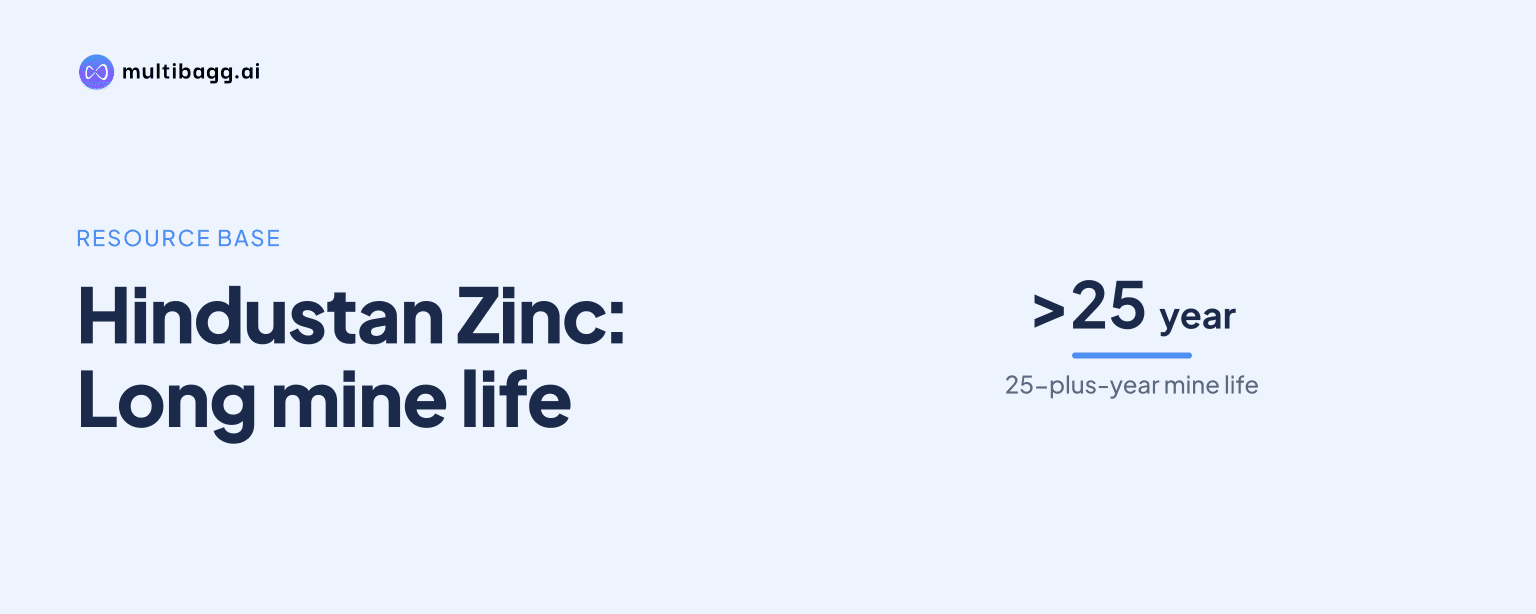
As at 31 March 2026, Hindustan Zinc Limited said its Rajasthan mine base supported more than 25 years of mine life, reporting 219.1 million tonnes of reserves and 249.5 million tonnes of resources across six mines, or 468.6 million tonnes in total reported inventory.
Know Vedanta inside out
Results, valuation, peers and who's buying, in one view.
How large is Hindustan Zinc’s Rajasthan mine inventory?
Hindustan Zinc reported 468.6 million tonnes of combined reserves and resources across six Rajasthan mines as at 31 March 2026. The total comprised 219.1 million tonnes of reserves and 249.5 million tonnes of resources, which the presentation reports as separate categories.
Zawar Mining Complex had the largest combined inventory at 166.4 million tonnes, comprising 62.7 million tonnes of reserves and 103.7 million tonnes of resources. Rajpura Dariba had the largest reserve base at 65.9 million tonnes, while Sindesar Khurd ranked second in resources at 54.7 million tonnes.
MnT means million tonnes. The ranking differs depending on the category: Rajpura Dariba led on reserves, whereas Zawar led on resources and combined inventory, showing that the reported mineral base is spread across multiple operations rather than centred on one mine.
Which Hindustan Zinc mines provide current ore output?
Hindustan Zinc reported FY26 ore production from five mines totalling 16.62 million tonnes per annum, or MTPA. Sindesar Khurd was the largest producer at 5.43 MTPA, followed by Rampura Agucha at 5.08 MTPA and Zawar Mining Complex at 4.36 MTPA.
Rajpura Dariba produced 1.03 MTPA in FY26 and Kayad produced 0.72 MTPA. Bamnia Kalan was reported with 8.4 million tonnes of reserves and 33.7 million tonnes of resources, but the presentation gave no FY26 ore-production figure for that mine.
Sindesar Khurd produced 0.35 MTPA more ore than Rampura Agucha in FY26, despite Rampura Agucha reporting a higher zinc reserve grade. Hindustan Zinc also described Rampura Agucha as the world’s largest zinc mine, while describing itself as the world’s largest integrated zinc producer.
How do zinc and lead grades vary across Hindustan Zinc’s mines?
Hindustan Zinc reported the highest zinc reserve grade at Rampura Agucha, at 9.6%, with a lead grade of 1.5%. Kayad followed on zinc grade at 5.1%, although its lead grade of 0.7% was the lowest among the six mines disclosed.
Rajpura Dariba reported a zinc grade of 5.0% and a lead grade of 1.7%. Sindesar Khurd reported 3.1% zinc and 1.8% lead, the highest disclosed lead grade, while Zawar reported 2.5% zinc and 1.2% lead.
Bamnia Kalan reported grades of 2.8% zinc and 0.9% lead, alongside 42.1 million tonnes of combined reserves and resources. Comparing the 468.6 million tonnes of combined inventory with FY26 output of 16.62 MTPA gives about 28 years, but this is not a company mine-life calculation because it includes resources and assumes unchanged output.
Got a follow-up? Ask IRIS
What mine-to-metal infrastructure does Hindustan Zinc operate?
Hindustan Zinc’s operating chain covers exploration, underground mining, concentrators, smelting, refining and delivery. Its Rajasthan processing network includes the Chanderiya Lead-Zinc Smelter, Dariba Smelting Complex and Debari Zinc Smelter.
Chanderiya has 105,000 tonnes per annum, or TPA, of pyrometallurgical zinc capacity, 489,500 TPA of hydrometallurgical zinc capacity and 90,000 TPA of lead-smelting capacity. The site also has a 290 megawatt captive power plant.
Dariba has 250,000 TPA of hydrometallurgical zinc capacity, 120,000 TPA of lead-smelting capacity and 170 megawatts of captive power. Debari has 89,500 TPA of hydrometallurgical zinc capacity, while Zawar has a 90 megawatt captive power plant and Hindustan Zinc reported 273.50 megawatts of wind-generation capacity.
How could Hindustan Zinc’s expansion plan change processing capacity?
Hindustan Zinc reported existing refined-metal capacity of 1.1 MTPA and utilisation of about 92% in FY25-26. Its board-approved 2.0 projects envisage about 1 MTPA of additional metal capacity over three to five years, with investment of about Rs 80,000 crore funded through internal accruals and debt.
The plan includes a 265,000 TPA integrated zinc smelter at Debari, expected to be commissioned in the second quarter of FY29. Hindustan Zinc said it increased this project from 250,000 TPA, which its board had approved in June 2025, following internal evaluation and optimisation within the same approved budget.
The presentation also lists a further 500,000 TPA zinc smelter, a 200,000 TPA lead smelter and a new 700 TPA silver refinery, with commissioning expected in three to five years. Hindustan Zinc’s projected refined-metal capacity is 2.0 MTPA, including 1.6 MTPA of zinc and 0.4 MTPA of lead, and the programme includes Rs 3,823 crore for a Rampura Agucha tailings-reprocessing plant intended to provide smelter feed.
Conclusion
Hindustan Zinc’s stated more-than-25-year mine life is supported by reported reserves of 219.1 million tonnes and resources of 249.5 million tonnes across six Rajasthan mines as at 31 March 2026. Zawar holds the largest combined inventory, Rajpura Dariba has the largest reserve base, Rampura Agucha has the highest reported zinc grade, and Sindesar Khurd delivered the largest FY26 ore output at 5.43 MTPA.
The next disclosed milestone is expected commissioning of Debari’s 265,000 TPA integrated zinc smelter in the second quarter of FY29, alongside the wider three-to-five-year capacity programme. Hindustan Zinc has not disclosed mine-by-mine production targets or the required expansion at each mine and mill, leaving execution of the additional mine and processing capacity as the key matter to watch.