










Hitachi Energy shifts 62% of Q2 orders beyond utilities
Key highlights
- Non-utility sectors represented 62% of Hitachi Energy’s domestic orders in Q2FY27, versus 4% in Q2FY26.
- Utilities’ share of Hitachi Energy’s domestic order mix fell to 38% in Q2FY27 from 96% a year earlier.
- Hitachi Energy reported Rs 4,120.8 crore of Q2FY27 orders including HVDC, up 85.9% year on year.
- Service orders grew 77.1% and export orders grew 41.0% year on year in Q2FY27.
powered by IRIS
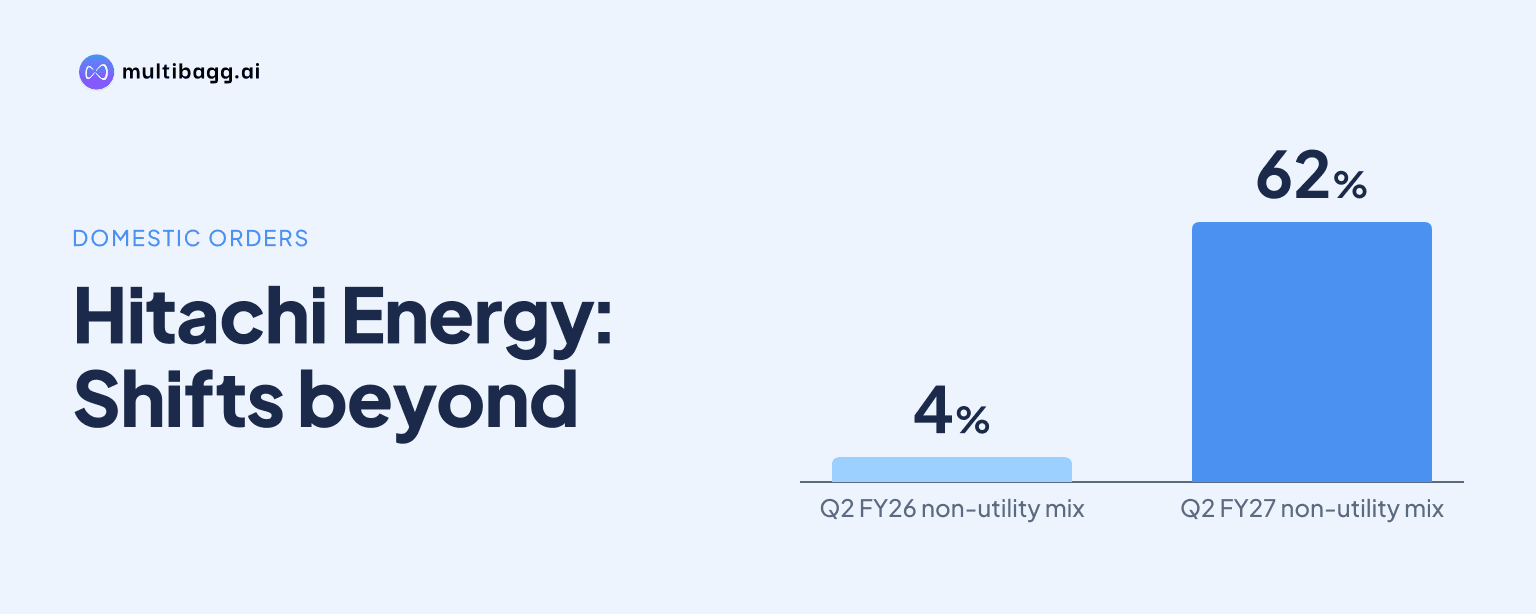
Hitachi Energy India shifted 62% of Q2FY27 domestic orders to industries and transport and infrastructure, versus 4% in Q2FY26, while utility share fell from 96% to 38%. Hitachi Energy reported Rs 4,120.8 crore in Q2FY27 orders including high-voltage direct current, or HVDC, up 85.9% year on year.
Know Hitachi Energy India inside out
Results, valuation, peers and who's buying, in one view.
Why did Hitachi Energy’s domestic order mix change in Q2FY27?
Hitachi Energy’s domestic order mix became less concentrated in utilities during Q2FY27 because industries represented 34% and transport and infrastructure represented 28%, together accounting for 62%. Utilities accounted for the remaining 38%, down 58 percentage points from 96% in Q2FY26. The presentation specifies that this sector mix covers domestic orders only.
The year-on-year movement was substantial in both non-utility categories. Industries rose from 2% of domestic orders in Q2FY26 to 34% in Q2FY27, a 32-percentage-point increase, while transport and infrastructure increased from 2% to 28%, up 26 percentage points. These percentages show order distribution, not the rupee value of orders within each sector.
Hitachi Energy identified transmission, industries and data centers as segments that fuelled Q2FY27 performance. Railway and metro, along with wind and solar renewables, were marked with downward indicators. Therefore, the 28% transport-and-infrastructure share does not establish that every transport-related segment grew during the quarter.
How did Hitachi Energy’s product and channel mix change?
Hitachi Energy’s Q2FY27 domestic mix moved toward projects: project orders represented 34%, up from 19% in Q2FY26, while product share declined from 74% to 60%. Service was unchanged at 7% in both periods. The disclosed shift in offering mix was consequently led by a 15-percentage-point increase in projects.
The channel mix also broadened beyond the channel labelled DEU in the presentation, whose share declined from 87% to 62%. Engineering, procurement and construction, or EPC, increased from 5% to 19%, and original equipment manufacturer, or OEM, share rose from 6% to 16%. Distributor share increased by one percentage point to 3%.
The increase in project share occurred alongside a 25-percentage-point reduction in the DEU-labelled channel. However, Hitachi Energy does not allocate product, project or service orders across utilities, industries and transport in the presentation. It therefore does not disclose whether industrial or transport orders specifically caused the higher project share.
Got a follow-up? Ask IRIS
How did orders, service and exports perform in Q2FY27?
Hitachi Energy reported Rs 4,120.8 crore of Q2FY27 orders including HVDC, compared with Rs 2,217.1 crore in Q2FY26, an 85.9% year-on-year increase. Orders including HVDC were 19.1% lower than Rs 5,096.5 crore in Q1FY27. The presentation separately reports 85.9% year-on-year and 21.8% quarter-on-quarter growth for orders excluding HVDC orders and order components.
Service orders grew 77.1% year on year in Q2FY27 and 36.4% in H1FY27. Hitachi Energy cited digitally enabled services, service-level agreements, and augmentation and extension services, with orders spanning utilities, industries and EPCs, including a major semiconductor customer. The presentation provides growth rates but no service-order value.
Export orders increased 41.0% year on year in Q2FY27 and 164.4% in H1FY27. Hitachi Energy said it received orders from Asia, Africa, the Middle East, Europe and the United States, including a TenneT order. These export growth figures are separate from the domestic order-mix data and are not part of the 62% non-utility domestic share.
Revenue from operations rose 63.5% year on year to Rs 2,996.5 crore in Q2FY27, while operational earnings before interest, tax, depreciation and amortisation, or operational EBITDA, increased 69.5% to Rs 494.4 crore. Operational EBITDA margin increased to 16.5% from 15.9%, whereas profit after tax margin declined to 10.6% from 14.4%, despite profit after tax rising 20.5% to Rs 318.5 crore.
Which projects and capacity plans support Hitachi Energy’s priorities?
Hitachi Energy’s project examples span utility and industrial work. The Fatehgarh III project includes India’s first grid-forming static synchronous compensator, or STATCOM, comprising a 400-kilovolt, two-unit 55-megavolt-ampere reactive system. At a pallet plant in Sandur, Karnataka, the company commissioned a 33/220-kilovolt air-insulated substation that included two 220-kilovolt bays and a 63-megavolt-ampere power transformer.
A grid-automation project for a Southern Region pooling substation was designed to evacuate 10.5 gigawatts, with 4.5 gigawatts already connected to the grid. Hitachi Energy said the project had been commissioned and handed over, and was dedicated to the nation in August 2026. The presentation does not disclose the order values or booking dates for these projects.
Hitachi Energy also listed capacity work at Karjan, Savli, Mysuru, Halol, Maneja, Peenya, Chennai and Doddaballapura. The programmes cover large power transformers, high-voltage equipment, grid automation, HVDC and power electronics, insulation, capacitors and bushings. The company says the majority of its capital expenditure will be completed by 2028.
Conclusion
The Q2FY27 figures show that Hitachi Energy’s domestic order demand was distributed more widely across industries and transport and infrastructure than in Q2FY26. The sector shift coincided with project share rising to 34%, service-order growth of 77.1%, export-order growth of 41.0%, and revenue growth of 63.5% to Rs 2,996.5 crore.
Next, management’s disclosed priorities include strengthening renewables, utilities, HVDC, industries and transport, while developing data centers, battery energy storage systems and semiconductor industries. Items to watch include the completion of most planned capital expenditure by 2028 and management’s stated aim to convert backlog into revenue and margin growth.