










Hitachi Energy Q2 revenue up 63.5%, EBITDA margin at 16.5%
Key highlights
- Hitachi Energy reported Q2FY27 revenue from operations of Rs 2,996.5 crore, up 63.5% year on year.
- Operational EBITDA rose 69.5% to Rs 494.4 crore and margin increased to 16.5% from 15.9%.
- Q2FY27 PBT margin was 14.4%, down from 19.3%, while material costs reached 61.7% of revenue.
- Service orders grew 77.1% and export orders increased 41.0% year on year in Q2FY27.
powered by IRIS
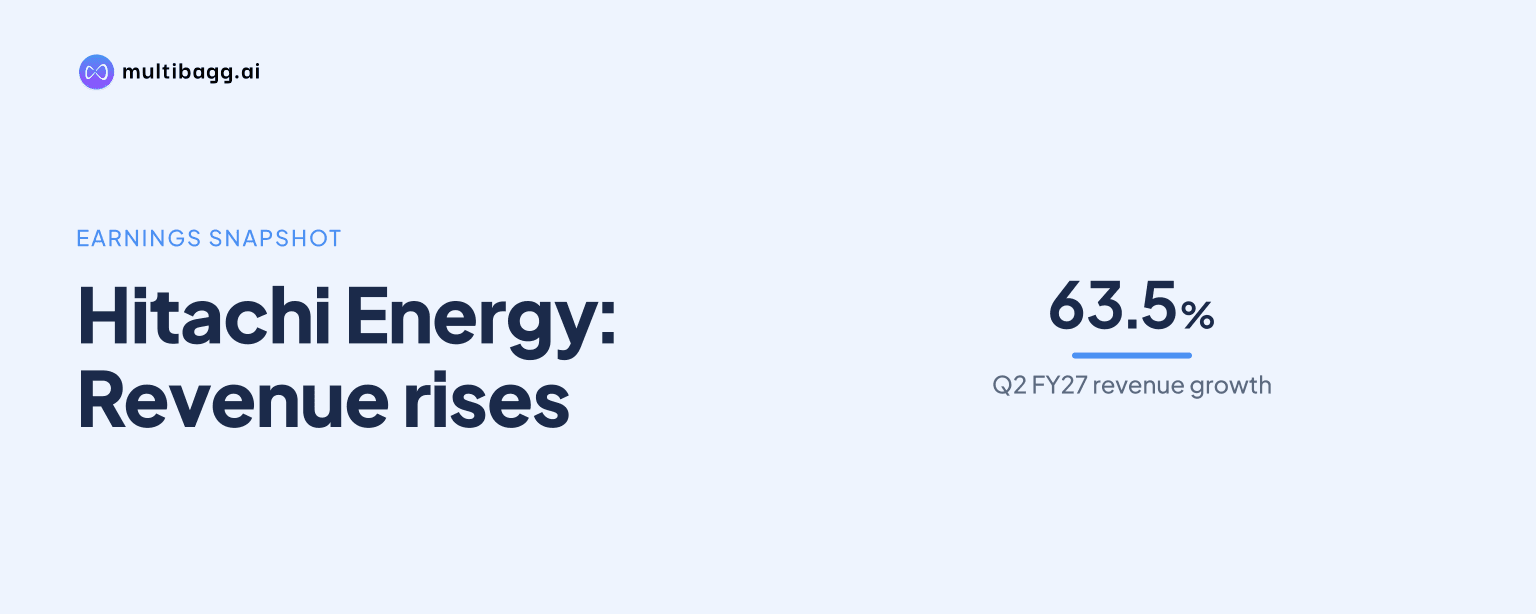
Hitachi Energy India reported Q2FY27 revenue from operations of Rs 2,996.5 crore, up 63.5% year on year, while operational earnings before interest, tax, depreciation and amortisation (EBITDA) margin reached 16.5% from 15.9%. Profit before tax margin fell to 14.4%, reflecting a higher material-cost ratio and exchange and commodity losses.
Know Hitachi Energy India inside out
Results, valuation, peers and who's buying, in one view.
Why did Hitachi Energy's Q2FY27 revenue rise 63.5%?
Hitachi Energy's Q2FY27 revenue rose 63.5% year on year to Rs 2,996.5 crore for the three months ended September 30, 2026, from Rs 1,832.6 crore in Q2FY26. Revenue was also 20.2% above Rs 2,493.7 crore in Q1FY27. For H1FY27, revenue from operations increased 65.8% to Rs 5,490.2 crore from Rs 3,311.5 crore in H1FY26.
The presentation attributed Q2FY27 performance to order growth in transmission, industries and data centers. In domestic orders, the project share increased to 34% in Q2FY27 from 19% a year earlier, while the product share fell to 60% from 74%. Industries accounted for 34% of domestic orders, compared with 2% in Q2FY26, and transport and infrastructure accounted for 28%, compared with 2%; utilities declined to 38% from 96%.
Orders including high-voltage direct current (HVDC) orders were Rs 4,120.8 crore in Q2FY27, up 85.9% from Rs 2,217.1 crore a year earlier but down 19.1% from Rs 5,096.5 crore in Q1FY27. H1FY27 orders including HVDC were Rs 9,217.3 crore, 32.0% below Rs 13,556.3 crore in H1FY26. The presentation separately reported H1FY27 order growth of 53.1% excluding HVDC, showing the significance of HVDC order timing in the half-year comparison.
How did Hitachi Energy's operational EBITDA margin reach 16.5%?
Hitachi Energy's operational EBITDA margin reached 16.5% in Q2FY27 because operational EBITDA increased 69.5% to Rs 494.4 crore from Rs 291.6 crore, outpacing the 63.5% increase in revenue. Operational EBITDA was also 23.6% above Rs 399.9 crore in Q1FY27, when the margin was 16.0%.
For H1FY27, operational EBITDA rose 93.7% to Rs 894.3 crore from Rs 461.8 crore in H1FY26. The first-half margin was 16.3%, compared with 13.9% a year earlier. Hitachi Energy states that it evaluates profitability using operational EBITDA rather than reported profit measures alone.
Operational EBITDA excludes depreciation of tangible assets, amortisation of intangible assets, restructuring-related expenses, non-operational pension costs, acquisition-related items and certain non-operational items. It also excludes foreign-exchange and commodity timing differences in operating income, including unrealised derivative movements and exchange movements on receivables and payables. At September 30, 2026, Hitachi Energy disclosed a notional loss of Rs 88.1 crore on those receivable and payable movements.
Got a follow-up? Ask IRIS
Why did Hitachi Energy's reported profit margins decline?
Hitachi Energy's profit before tax (PBT) margin declined to 14.4% in Q2FY27 from 19.3% in Q2FY26 as material costs took a larger share of revenue and the quarter recorded an exchange and commodity loss. PBT still rose 22.0% to Rs 430.4 crore from Rs 352.9 crore, but increased more slowly than revenue. Sequentially, PBT was 10.5% above Rs 389.5 crore in Q1FY27, while its margin was lower than 15.6%.
Material costs increased to Rs 1,849.5 crore, or 61.7% of Q2FY27 revenue, from Rs 1,054.0 crore, or 57.5%, in Q2FY26. Personnel expenses fell to 6.2% of revenue from 8.5%, and other expenses fell to 16.6% from 17.7%. The 4.2-percentage-point rise in the material-cost ratio nevertheless coincided with a lower reported PBT margin.
The Q2FY27 income statement included an exchange and commodity loss of Rs 56.1 crore, or 1.9% of revenue, compared with a gain of Rs 12.8 crore, or 0.7%, in Q2FY26. Other income fell to Rs 56.8 crore from Rs 69.8 crore. Profit after tax (PAT) rose 20.5% to Rs 318.5 crore, but PAT margin declined to 10.6% from 14.4%; H1FY27 PAT was Rs 612.6 crore, up 54.7%, with an 11.2% margin versus 12.0%.
Which segments and channels are supporting Hitachi Energy's growth plans?
Hitachi Energy identified transmission, industries and data centers as Q2FY27 order-growth segments, while railway and metro and renewables, including wind and solar, declined. Direct end users represented 62% of domestic Q2FY27 orders, down from 87% a year earlier. Engineering, procurement and construction customers accounted for 19%, up from 5%, while original equipment manufacturers accounted for 16%, up from 6%.
Service orders rose 77.1% from Q2FY26 to Q2FY27 and increased 36.4% between H1FY26 and H1FY27. Hitachi Energy cited digitally enabled services, service-level agreements, and augmentation and extension work as service activities. The company also reported orders across utilities, industry and engineering, procurement and construction customers, including a major semiconductor customer.
Export orders increased 41.0% year on year in Q2FY27 and 164.4% in H1FY27. Hitachi Energy said it received export orders from Asia, Africa, the Middle East, Europe and the United States, including a TenneT order. Management's stated priorities include strengthening renewables, utilities, HVDC, industries and transport while pursuing data centers, battery energy storage systems and semiconductor industries.
Conclusion
Hitachi Energy's Q2FY27 figures show that revenue conversion and operational profitability increased together, with operational EBITDA growing faster than revenue. The reported profit measures told a different story: PBT rose 22.0%, versus 69.5% for operational EBITDA, as material costs reached 61.7% of revenue and exchange and commodity losses totalled Rs 56.1 crore.
The next disclosed indicators are management's plans to convert backlog into revenue and margin growth, expand capacity, and improve productivity, quality and artificial-intelligence adoption. Progress in service orders, which grew 77.1% in Q2FY27, export orders, which rose 41.0%, and activity in data centers and semiconductor industries will show how those priorities develop.