










Hitachi Energy India operating cash flow falls to Rs 91 crore
Key highlights
- Net operating cash flow was Rs 91.33 crore in the six months ended September 30, 2026, versus Rs 874.18 crore a year earlier.
- Receivables, loans, financial assets and other assets used Rs 1,360.72 crore of cash in the first half.
- Inventory movement used Rs 724.05 crore of cash, while inventories rose to Rs 2,209.09 crore at September 30, 2026.
- Capital expenditure, including capital advances, increased to Rs 369.52 crore from Rs 66.72 crore.
powered by IRIS
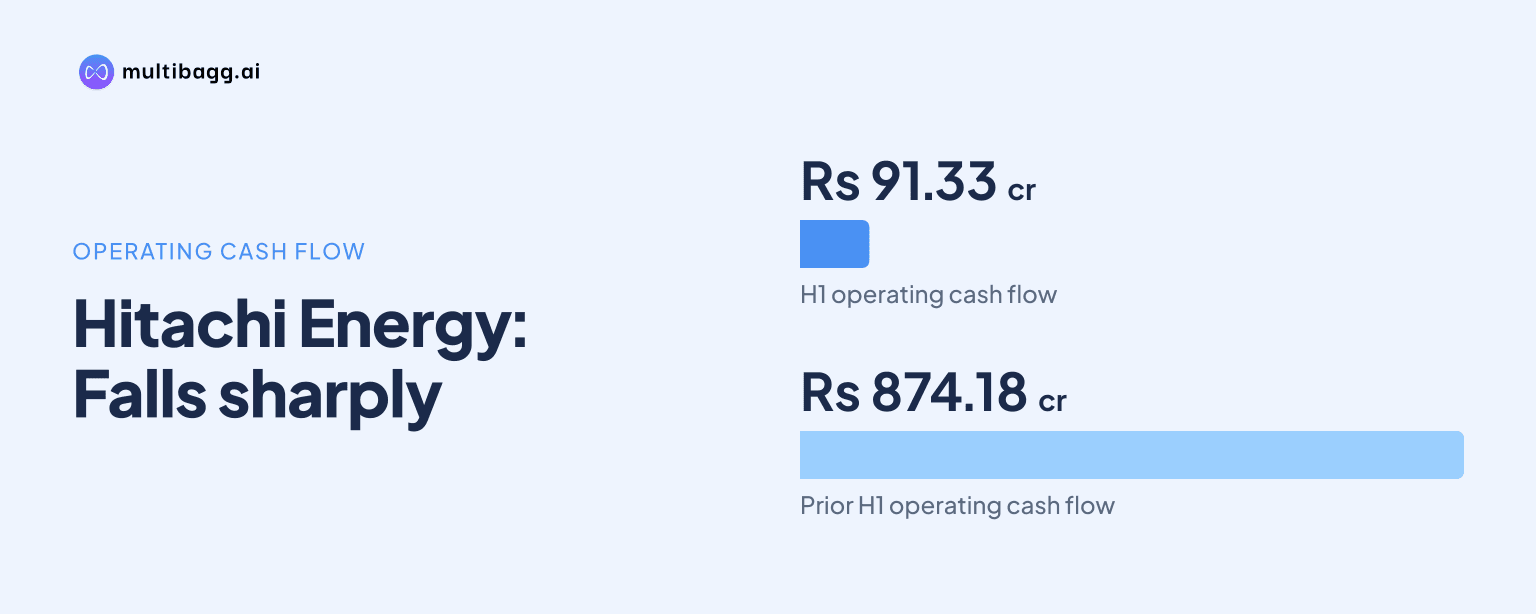
Hitachi Energy India Limited reported net operating cash flow of Rs 91.33 crore for the six months ended September 30, 2026, down from Rs 874.18 crore a year earlier, although profit before tax increased to Rs 819.91 crore. Higher cash use in receivables, other assets and inventories, alongside tax payments, reduced cash generated from operations.
Know Hitachi Energy India inside out
Results, valuation, peers and who's buying, in one view.
Why did Hitachi Energy India’s operating cash flow decline?
Hitachi Energy India’s operating cash flow declined because working-capital movements and direct tax payments more than offset the increase in operating profit. Cash generated from operations fell to Rs 302.53 crore in the six months ended September 30, 2026, from Rs 1,020.91 crore in the corresponding 2025 period, while direct taxes paid rose to Rs 211.20 crore from Rs 146.73 crore.
The result was a Rs 782.85 crore year-on-year reduction in net cash flow from operating activities, to Rs 91.33 crore from Rs 874.18 crore. This differed from reported earnings: profit before tax rose by Rs 290.12 crore to Rs 819.91 crore, and profit after tax increased by Rs 216.68 crore to Rs 612.64 crore during the same six-month period.
The higher operating profit before working-capital changes, at Rs 931.34 crore versus Rs 475.70 crore, included Rs 129.22 crore of mark-to-market changes in forward, commodity and embedded derivative contracts. The cash-flow statement also recorded an impairment allowance, bad debts and advances written off of Rs 33.87 crore, compared with Rs 9.35 crore in the prior-year first half.
What working-capital items used cash in the first half?
Trade receivables, loans, financial assets and other assets used Rs 1,360.72 crore of cash in the six months ended September 30, 2026, compared with Rs 257.89 crore in the previous corresponding period. Inventories used a further Rs 724.05 crore, whereas inventory movements contributed Rs 74.28 crore of cash in the six months ended September 30, 2025.
These cash uses were partly offset by a Rs 1,455.96 crore increase in trade payables, provisions, financial liabilities and other liabilities, up from a Rs 728.82 crore increase a year earlier. The liability movement did not cover the combined Rs 2,084.77 crore cash use from asset and inventory movements, leading to the decline in cash generated from operations.
The September 30, 2026 balance sheet showed inventories at Rs 2,209.09 crore, compared with Rs 1,485.04 crore on March 31, 2026. Trade receivables rose to Rs 2,121.34 crore from Rs 1,913.26 crore, while other current assets increased by Rs 1,099.33 crore to Rs 3,179.06 crore during the six-month interval.
Current liabilities also increased over the period. Trade payables due to creditors other than micro and small enterprises rose to Rs 3,438.21 crore on September 30, 2026, from Rs 2,899.10 crore at March 31, 2026, and other current liabilities grew to Rs 3,739.68 crore from Rs 2,861.53 crore.
Got a follow-up? Ask IRIS
How did capital expenditure affect Hitachi Energy India’s cash position?
Purchases of property, plant and equipment, including capital advances, rose to Rs 369.52 crore in the first half of fiscal 2027 from Rs 66.72 crore a year earlier. The increase in this spending contributed to a Rs 255.21 crore net cash outflow from investing activities, compared with a Rs 53.16 crore inflow in the prior-year period.
Interest received was Rs 114.30 crore in the latest six months, compared with Rs 119.87 crore a year earlier. This inflow, together with Rs 1 lakh of proceeds from the sale of property, plant and equipment, was lower than the amount spent on equipment and capital advances, while Hitachi Energy India reported no purchase of intangible assets in the latest period.
Capital work-in-progress stood at Rs 408.07 crore on September 30, 2026, more than double the Rs 192.01 crore reported on March 31, 2026. Property, plant and equipment increased to Rs 737.93 crore from Rs 727.45 crore, and other non-current assets rose to Rs 360.77 crore from Rs 252.54 crore.
Hitachi Energy India’s financial results identify Power Grids as its single operating segment because the chief operating decision-maker reviews performance at the overall-company level. The filing does not split the Rs 369.52 crore equipment and capital-advance purchases by product line or by Power Grids activity.
What happened to cash balances and financing cash flows?
Cash and cash equivalents declined by Rs 216.51 crore during the six months ended September 30, 2026, closing at Rs 4,472.66 crore from Rs 4,689.17 crore at the start of the period. In the corresponding six months of 2025, cash and cash equivalents increased by Rs 852.05 crore and ended at Rs 4,658.60 crore.
Financing activities used Rs 52.63 crore in the latest first half, compared with Rs 75.29 crore in the prior-year period. The latest outflow included Rs 35.53 crore of dividends paid, Rs 9.76 crore for the principal portion of lease liabilities, Rs 3.10 crore of lease-interest payments, Rs 2.77 crore of finance costs paid and Rs 1.47 crore of qualified institutional placement issue expenses.
Separately, Hitachi Energy India said Rs 1,665.26 crore from its earlier qualified institutional placement remained unutilised on September 30, 2026. Of that balance, Rs 1,630 crore was kept as bank deposits, according to the notes to the financial statements.
Did Hitachi Energy India’s revenue and profit continue to increase?
Revenue and reported profit increased in the first half even as operating cash flow fell. Revenue from operations grew 65.8% year on year to Rs 5,490.20 crore for the six months ended September 30, 2026, while profit before tax rose 54.8% to Rs 819.91 crore and profit after tax grew 54.7% to Rs 612.64 crore.
Operational earnings before interest, tax, depreciation and amortisation, or Operational EBITDA, rose 93.7% to Rs 894.30 crore, according to Hitachi Energy India’s results release. Operational EBITDA margin was 16.3%, compared with 13.9% in the first half of fiscal 2026, while reported profit-before-tax margin declined to 14.9% from 16.0%.
First-half orders were Rs 9,217.30 crore, down 32.0% year on year, while the company reported an order backlog of Rs 33,335.40 crore as of September 2026. Management said it had invested in new infrastructure and was strengthening existing capabilities, linking these actions to the company’s stated effort to pursue operational efficiency and order execution.
Conclusion
Hitachi Energy India’s first-half results show that higher revenue and profit did not translate into comparable operating cash generation. The Rs 1,360.72 crore cash use in receivables, loans, financial assets and other assets, combined with Rs 724.05 crore used by inventories, reduced net operating cash flow to Rs 91.33 crore despite the rise in profit before tax to Rs 819.91 crore.
The next disclosures will show whether receivables, inventories and other current assets change relative to revenue growth and whether the Rs 408.07 crore of capital work-in-progress moves into completed assets. Management’s stated infrastructure investment and the Rs 33,335.40 crore backlog reported for September 2026 provide the disclosed context for future order execution and capital spending.