










HMA Agro sees 1.5-2 percentage-point freight margin upside
Key highlights
- HMA Agro management said freight normalisation could add roughly 1.5-2 percentage points to margins.
- Shipping freight rates had risen six- to ten-fold, according to HMA Agro management.
- Q2 FY26-27 consolidated revenue was Rs 2,779.48 crore, up 31.71% quarter on quarter.
- HMA Agro said it is using about 65%-70% of its processing capacity.
powered by IRIS
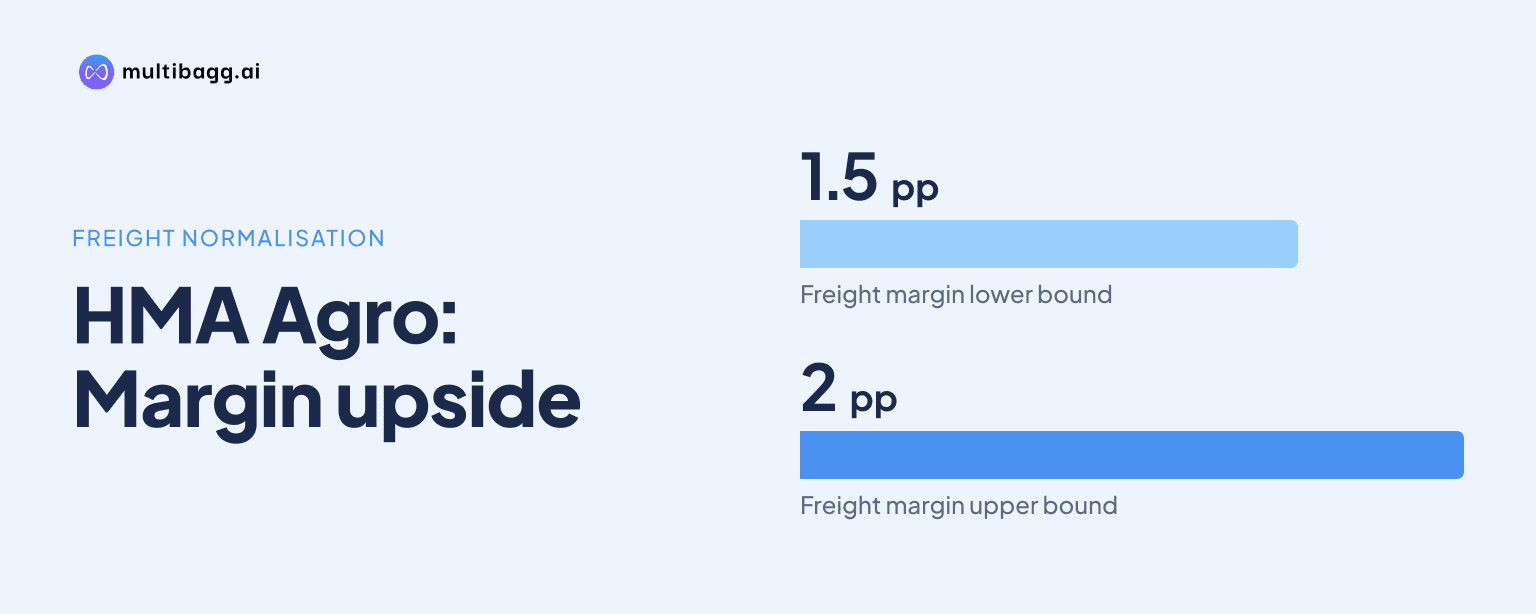
In Q2 FY26-27, HMA Agro Industries Limited said easing freight costs could add roughly 1.5-2 percentage points to margins after shipping rates had risen six- to ten-fold. Management said freight charges had shown no major increase during the preceding two months and considered current shipping prices near their peak.
Know HMA Agro Industries inside out
Results, valuation, peers and who's buying, in one view.
How could freight normalisation lift HMA Agro's margins?
HMA Agro said lower logistics costs could add roughly 1.5-2 percentage points to margins if shipping charges decline from current levels. Management based the estimate on its assessment that freight rates had increased six- to ten-fold, while prices offered to customers had already adjusted to the higher-cost environment.
The mechanism is lower export-servicing costs without a matching cut in selling prices that clients have become accustomed to paying. Management said a fall in logistics costs would therefore support margins, but it qualified that view by citing possible increases in crude-oil prices or further shipping-line rate revisions.
Management said its analysis found no major increase in logistics charges over the last two months. It linked a possible decline to an easing of war-related tensions in the Middle East and said it hoped to secure at least half of the additional freight burden being paid relative to the earlier level.
What did HMA Agro report in Q2 FY26-27?
HMA Agro reported consolidated revenue of Rs 2,779.48 crore and profit after tax of Rs 104.57 crore in Q2 FY26-27. Revenue increased 31.71% from Rs 2,110.22 crore in Q1 FY26-27 and 28.96% from Rs 2,155.34 crore in Q2 FY25-26.
Consolidated earnings before interest, tax, depreciation and amortisation, or EBITDA, reached Rs 153.54 crore in Q2 FY26-27, up from Rs 81.05 crore in Q1 FY26-27 and Rs 131.57 crore a year earlier. Consolidated profit after tax rose 107% quarter on quarter from Rs 50.51 crore and 16.46% year on year from Rs 89.79 crore.
The consolidated EBITDA margin was 5.25% in Q2 FY26-27, compared with 3.84% in Q1 FY26-27 and 6.10% in Q2 FY25-26. This means the margin improved 1.41 percentage points sequentially but remained 0.85 percentage points below the prior-year quarter, providing context for management's freight-cost outlook.
Which export markets are supporting HMA Agro's growth?
HMA Agro said Southeast Asia, South Africa and the Gulf Cooperation Council, or GCC, region were generating favourable growth responses. Management said the company serves clients in almost 49 countries across four major continents and attributed part of demand to buyers building food stocks amid global uncertainty.
Management said India has a shipping-time advantage over Australia, New Zealand and Brazil for relevant export markets. It also said these competing suppliers face higher cost burdens and that Indian red-protein products can be more economical for consumers, although the call did not provide country-level revenue or volume data.
For buffalo meat, HMA Agro identified Southeast Asia, the Middle East and North Africa, or MENA, region, GCC countries and Africa as demand areas. Management specifically named Egypt as a critical buyer and Vietnam, Malaysia and Indonesia as populous markets where buffalo meat is performing well.
Management's view that growth can continue rests on price competitiveness, food-storage demand and access to multiple buyers and countries. The call did not provide an export-growth target, segment margin, or product-wise sales split for the 49-country customer base.
Got a follow-up? Ask IRIS
How can HMA Agro increase volumes and realisations?
HMA Agro said it is using about 65%-70% of its own processing capacity, leaving room to handle more orders within existing infrastructure. Management presented higher capacity utilisation as an opportunity to serve additional export volumes rather than as a plan for a new capacity-expansion programme.
The company said it started offering vacuum-chilled meat, a higher-end product intended for hypermarkets and supermarkets. Management said chilled products can command a premium because they are sold through premium outlets, making product mix a potential contributor to realisation in addition to volume growth.
HMA Agro said it installed a new plant with upgraded technology about two years ago and uses updated processing and packaging technology. Management also referred to a fourth-generation business legacy and said customers value reliable supply, storage, distribution, quality and timely delivery.
Management described Indian buffalo meat as organic by default, saying India does not have a practice of using growth hormones comparable to some global competitors. The call did not disclose revenue, volumes, margins or customer adoption for vacuum-chilled meat, leaving its financial contribution unquantified.
What could prevent HMA Agro from capturing the freight benefit?
HMA Agro's estimate of a 1.5-2 percentage-point margin benefit is conditional on shipping charges declining after Middle East tensions ease. Management did not provide a timetable for freight normalisation and said crude-oil price movements or renewed shipping-line rate increases could alter the outcome.
Trade access is another unresolved factor for the 49-country export business. Management said a future trade agreement with Europe could open certain European markets to Indian products, but it did not name countries, specify products, or disclose an expected completion date.
Conclusion
HMA Agro's Q2 FY26-27 call identified freight as a material swing factor for an export business with clients in almost 49 countries. Consolidated EBITDA margin recovered to 5.25% from 3.84% in Q1 FY26-27, while management said a reduction in elevated shipping costs could add a further 1.5-2 percentage points to margins.
The next developments to watch are whether logistics charges fall from the level management called near a peak, whether utilisation rises from 65%-70% as orders increase, and whether vacuum-chilled meat gains scale. Management also cited potential European access through a future trade agreement, but disclosed no date, market list or revenue target.