










HMA Agro Industries Ltd Q2 Revenue Rises 29% to ₹2,779 Crore
Key highlights
- HMA Agro Industries Ltd reported Q2 FY27 consolidated revenue of ₹2,779.48 crore, up 28.96% year on year.
- Standalone EBITDA rose 70.56% year on year to ₹130.35 crore, with margin improving to 4.51% from 3.37%.
- Consolidated EBITDA margin declined to 5.25% in Q2 FY27 from 6.10% a year earlier.
- HMA Agro operates at 65% to 70% processing-capacity utilisation and sells across 49 countries.
powered by IRIS
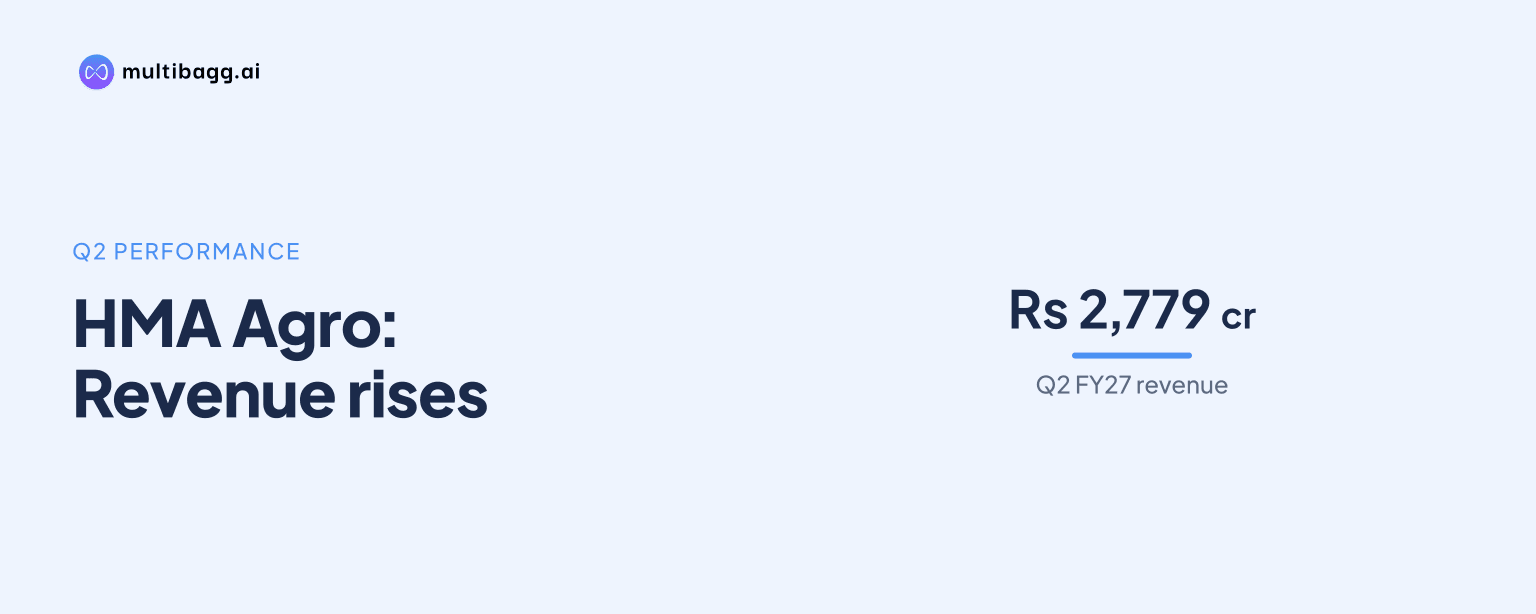
HMA Agro Industries Ltd reported Q2 FY27 consolidated revenue of ₹2,779.48 crore, up 28.96% year on year, while standalone EBITDA rose 70.56% to ₹130.35 crore. The quarter showed strong sales growth and improved standalone profitability, although consolidated margins remained under pressure from sharply higher logistics and shipping costs.
Know HMA Agro Industries inside out
Results, valuation, peers and who's buying, in one view.
How did HMA Agro perform in Q2 FY27?
HMA Agro delivered higher revenue across its standalone and consolidated operations in the quarter ended September 30, 2026. Standalone revenue rose 17.7% year on year to ₹2,733 crore, and was 31.9% higher than the preceding quarter. Consolidated revenue increased 28.96% year on year to ₹2,779.48 crore.
The company also reported growth in consolidated net profit. Consolidated profit after tax rose 16.46% year on year to ₹104.57 crore. However, the pace of profit growth was lower than revenue growth, reflecting the impact of elevated freight and logistics costs on consolidated profitability.
What lifted HMA Agro's standalone profitability?
HMA Agro's standalone EBITDA margin improved to 4.51% in Q2 FY27 from 3.37% a year earlier. Standalone profit before tax increased 68.18% year on year to ₹108.41 crore, lifting the PBT margin to 2.9%.
Management said the company retains significant operating headroom, with its own processing facilities operating at roughly 65% to 70% utilisation. This means HMA Agro has room to increase volumes through existing capacity without requiring major capital expenditure immediately. The capacity position is relevant because sales expansion can be supported without a proportionate rise in fixed processing infrastructure costs.
Why are consolidated margins under pressure?
Consolidated margins declined despite the increase in revenue and profit because logistics and shipping costs remain elevated. Consolidated EBITDA margin fell to 5.25% in Q2 FY27 from 6.10% in Q2 FY26, while consolidated PAT margin decreased to 3.76% from 4.17%.
Chief Financial Officer Gulzeb Ahmed said global shipping rates had increased by six to ten times and appeared to have peaked. He said there had been no major increase in logistics charges over the previous two months. Management expects that an easing of geopolitical tensions, particularly in the Middle East, could allow recovery of at least half of the earlier cost increase, with a potential margin benefit of about 1.5% to 2%.
The timing and extent of any freight-cost normalisation remain uncertain. Middle East tensions and broader global economic uncertainty can affect shipping routes, freight rates and demand conditions, making logistics a key variable for HMA Agro's consolidated earnings performance.
Got a follow-up? Ask IRIS
What supports HMA Agro's export business and volume opportunity?
HMA Agro operates across 49 countries and four continents, with management identifying Southeast Asia, the GCC and emerging African markets as areas of growth. The company's export position is supported by the stated cost competitiveness of Indian buffalo meat compared with Australian, New Zealand and Brazilian products.
The CFO said Indian products are priced at roughly half the level of Australian red meat. He attributed this difference to lower cattle-rearing costs in India, the agricultural nature of the domestic economy, traditional livestock farming and relatively faster shipment times to certain markets. Management also said Indian buffalo meat is perceived as organic in overseas markets, supporting demand.
The company is adding value-added offerings, including tube chilled meat aimed at premium market segments. Better realisations from such products could be relevant to the product mix, though the call did not provide revenue or margin targets for the new category. Management also noted that prospective Indian trade agreements, particularly with Europe, could create access to markets where Indian products do not currently have entry.
Conclusion
HMA Agro combined strong Q2 FY27 revenue growth with a substantial improvement in standalone EBITDA and PBT. Its existing processing capacity, geographic diversification and structural price advantage provide the operational basis for higher volumes, while the decline in consolidated EBITDA and PAT margins shows that freight costs remain a material constraint.
Investors will watch whether shipping rates ease from current levels, as management estimates that recovery of part of the earlier logistics-cost increase could add about 1.5% to 2% to margins. Progress on value-added products, capacity utilisation and any trade agreements that expand access to European markets will also be important disclosed factors for the export business.