










HMA Agro Industries Limited says spare capacity avoids major capex
Key highlights
- HMA Agro said it is using 65-70% of plant capacity, leaving 30-35% unused.
- Management said additional orders would principally require working capital rather than major capex.
- Q2 FY26-27 consolidated revenue was Rs 2,779.48 crore, up 28.96% year on year.
- HMA Agro said it serves clients in almost 49 countries across four major continents.
powered by IRIS
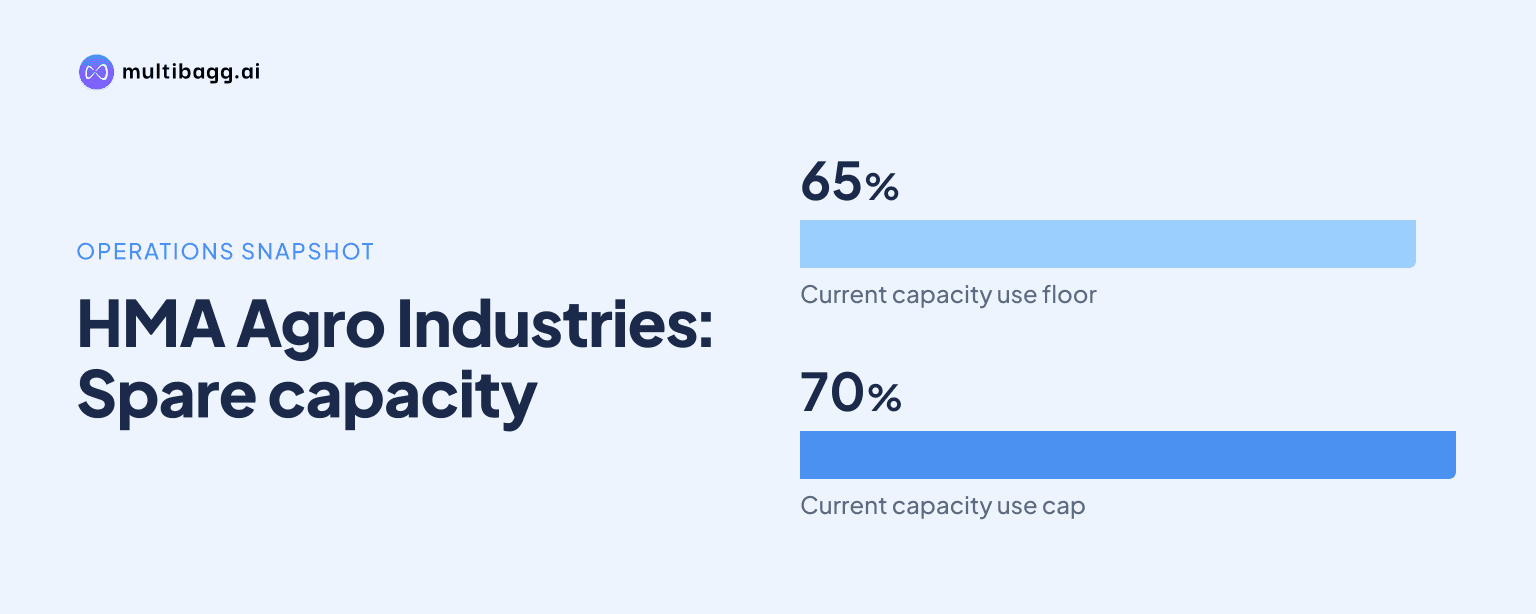
On its 4 November 2026 earnings call, HMA Agro said its plants operated at 65-70% capacity, leaving 30-35% spare capacity and removing the current need for major capital expenditure, or capex. Management said additional orders for existing products would instead require working capital, alongside routine spending on smaller machines.
Know HMA Agro Industries inside out
Results, valuation, peers and who's buying, in one view.
How much unused capacity does HMA Agro have?
HMA Agro has 30-35% unused capacity because management said it is using 65-70% of its own processing infrastructure. The company said it could accommodate further volumes and orders through existing facilities, without needing a major expansion programme for its current product range.
Management gave the utilisation range while answering a question on scaling export volumes and operating leverage. HMA Agro did not disclose processing capacity in tonnes, utilisation by plant, or a target utilisation level. The 30-35% figure is therefore an indication of available capacity rather than a disclosed forecast of incremental output.
HMA Agro also said its plants are new and that it added a new facility with upgraded technology about two years earlier. Management cited that infrastructure and the present 65-70% utilisation level as the reasons it can take additional orders using its existing facilities.
Why is HMA Agro prioritising working capital over major capex?
HMA Agro said additional orders would require working capital rather than major capex because it has capacity available for existing products. Management distinguished large facility investments from routine expenditure on small machines, saying routine equipment spending remains part of normal operations.
The company did not quantify the working-capital requirement, identify a funding source, or provide a capex budget on the 4 November 2026 call. When asked for a rough estimate of routine capex, management said it needed to recheck the data and would respond by email.
Management’s position applies to the existing product portfolio. HMA Agro said there was no major capex requirement for current products, but it did not provide a plan for capacity investment should utilisation move materially above the current 65-70% range or should its product mix change.
Can existing capacity support HMA Agro's revenue growth?
HMA Agro said its existing plants can support further orders after consolidated revenue rose 28.96% year on year to Rs 2,779.48 crore in Q2 FY26-27. Management said the increase reflected both higher volumes and higher values, or realisations, as logistics and handling costs increased export prices.
The sequential increase from Rs 2,110.22 crore in Q1 FY26-27 to Rs 2,779.48 crore in Q2 FY26-27 coincided with a rise in consolidated earnings before interest, tax, depreciation and amortisation, or EBITDA, from Rs 81.05 crore to Rs 153.54 crore. EBITDA margin increased to 5.25% in Q2 from 3.84% in Q1, but remained below 6.10% in Q2 FY25-26.
For the first half, or H1, of FY26-27, consolidated revenue was Rs 4,889.80 crore, compared with Rs 3,277.95 crore in H1 FY25-26, a 49.17% increase stated by management. HMA Agro did not separate this revenue growth into volume, average realisation, freight pass-through and product-mix components, so the revenue potential from spare capacity was not quantified.
Got a follow-up? Ask IRIS
What could determine whether HMA Agro uses its spare capacity?
HMA Agro said export demand across its markets will determine whether more of its 30-35% spare capacity is used. Management said it serves clients in almost 49 countries across four major continents and identified Southeast Asia, South Africa and the Gulf Cooperation Council, or GCC, as regions generating good growth.
Management also identified Egypt, Vietnam, Malaysia and Indonesia as markets where buffalo meat demand is relevant. It said African markets were emerging, while Southeast Asian, Middle East and GCC demand supported the company’s outlook for orders. HMA Agro did not disclose revenue by geography, product or customer.
Logistics costs could affect both order flow and margins. Management said shipping freight had risen by six to 10 times, based on data it was collecting from the market, although it had seen no major further increase during the preceding two months. If Middle East tensions eased and freight charges fell, management said it hoped to recover at least half of the higher charges and estimated a possible margin benefit of roughly 1.5-2%.
Does HMA Agro need new plants to enter more markets?
HMA Agro said it does not currently need major new facilities to pursue further orders because its own plants are operating at only 65-70% capacity. Management said Indian products have cost and shipping-distance advantages over suppliers in Australia, New Zealand and Brazil, while existing capacity can handle more volumes.
Potential market access through free trade agreements, or FTAs, remains conditional. Management said that if trade agreements with Europe are completed, India could gain access to some European markets where its products do not currently have market access. It did not name the countries, provide a timetable or disclose any capex commitment linked to those opportunities.
Product mix could also influence future capacity use. HMA Agro said it recently started supplying vacuum-chilled meat, which management described as a higher-end product for hypermarkets and supermarkets. Rice and seafood were described as being at an initial stage, and management did not disclose their revenue contribution, capacity needs or investment plans.
Conclusion
HMA Agro’s 30-35% spare capacity explains why management sees no current need for major facilities capex for existing products. The company reported Q2 FY26-27 consolidated revenue of Rs 2,779.48 crore and said further orders could be processed through current plants, with the funding requirement centred on working capital rather than large new facilities.
The next disclosures to watch are whether additional orders lift utilisation beyond the current 65-70% range, the amount and funding of any associated working-capital need, and management’s promised follow-up on routine capex. Freight charges also remain relevant because management’s estimated 1.5-2% potential margin benefit depends on logistics costs easing.