










Hindustan Media Ventures says advertising drove print growth
Key highlights
- HMVL said Hindi print operating revenue rose 11% year on year in the quarter ended September 30, 2026.
- HMVL's Hindi circulation revenue was flat year on year at Rs 39 crore.
- Total print operating revenue was Rs 386 crore, up 8% year on year.
- Print operating EBITDA declined 6% year on year as newsprint costs rose and Diwali shifted by 20 days into the third quarter.
powered by IRIS
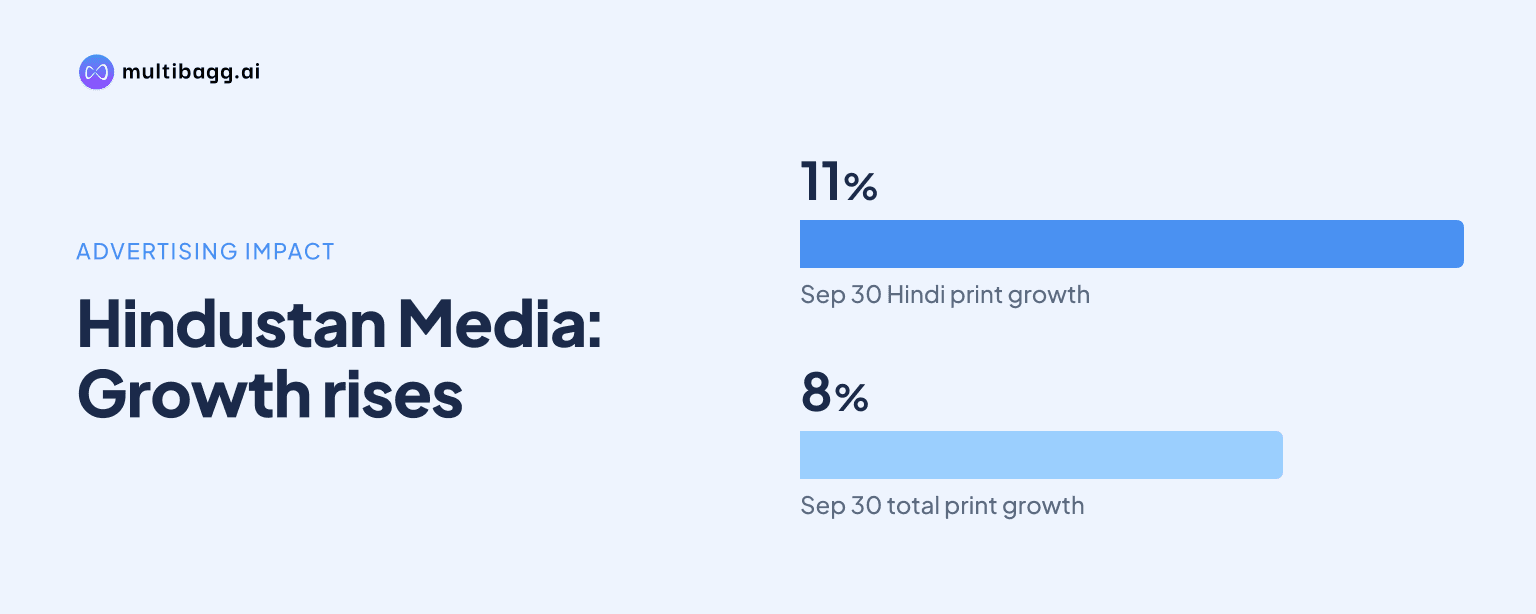
Hindustan Media Ventures Limited said advertising, not circulation, drove its print growth in the quarter ended September 30, 2026, with Hindi print operating revenue rising 11% year on year while Hindi circulation revenue remained flat at Rs 39 crore. Management cited market-share gains and higher government advertising rates as the principal drivers.
Know Hindustan Media Ventures inside out
Results, valuation, peers and who's buying, in one view.
What drove HMVL's print growth in the quarter ended September 30, 2026?
HMVL said advertising growth was driven by volume gains from holding or gaining market share and by higher government advertising rates. Management said these factors applied to both the English and Hindi print businesses discussed during the November 5, 2026 earnings call, although the Hindi business is the relevant operating business for HMVL.
Hindi print operating revenue grew 11% year on year, compared with 5% growth in English print operating revenue. The presentation reported total print operating revenue of Rs 386 crore, up 8% year on year, showing that Hindi outgrew the English print business during the quarter. Management did not disclose separate absolute advertising-revenue figures for either language title.
Management said the industry had received a government advertising rate increase in the previous year, supporting government revenue in the period under review. It also said market-share consolidation created volume gains in both language markets. Those advertising factors, rather than a higher number of newspaper copies sold, explain the disclosed 5% English and 11% Hindi operating-revenue growth rates.
The quarter did not include the full benefit of the festive advertising period, according to management. Diwali shifted by 20 days into the third quarter of FY 2026-27, and management said print advertising growth would have been higher without that movement. The call did not quantify the revenue that shifted from the second quarter into the third quarter.
Did HMVL increase newspaper circulation or circulation revenue?
No. HMVL said circulation was primarily flat in the quarter ended September 30, 2026, and Hindi circulation revenue was unchanged from the prior-year quarter at Rs 39 crore. Management also said consolidated print circulation revenue was flat at Rs 54 crore, covering the broader print operations discussed on the call.
The flat circulation result contrasts with the 11% increase in Hindi print operating revenue. Management therefore identified advertising as the source of Hindi print growth, rather than an increase in copies sold or circulation income. It did not provide a numerical copy-volume figure, but said both circulation copies and circulation revenue were flat in the reviewed quarter.
Management described its copy position as comfortable relative to competitors on a market-by-market basis. It said HMVL would use schemes and add copies where a market required them, but would not increase copies merely to pursue circulation expansion. That policy limits distribution spending unless management sees a specific commercial need.
The Rs 39 crore Hindi circulation-revenue figure was the same as in the corresponding quarter a year earlier. This means the reported 11% Hindi operating-revenue increase came despite no disclosed year-on-year improvement in circulation revenue. The transcript did not break Hindi revenue into advertising and circulation amounts beyond the Rs 39 crore circulation figure.
Got a follow-up? Ask IRIS
Why is HMVL avoiding broad copy expansion?
HMVL said it is not investing behind new copies unless needed because newsprint-related variable costs remain significantly higher than a year earlier. Management said holding copies at existing levels, while benefiting from price-led advertising growth, helps manage direct costs when newsprint rates remain elevated.
This cost position affected print profitability in the quarter ended September 30, 2026. Total print operating revenue rose 8% to Rs 386 crore, but print operating earnings before interest, tax, depreciation and amortisation, or EBITDA, declined 6% year on year. Management attributed the decline primarily to higher newsprint costs and the shift of festive revenue into the third quarter.
Management said the company was not pushing additional copies simply to increase its circulation footprint. It said schemes and incremental copies would be introduced in markets where warranted, but the current approach is to preserve copies that are holding rather than fund wider distribution. This is a cost-management mechanism, not a disclosed target for lower circulation.
The company also linked its approach to the fact that advertising growth was price-led. Higher government advertising rates and volume market-share gains supported print revenue, while restrained copy expansion reduced the need to take on additional variable costs. The call did not disclose HMVL's direct variable-cost amount or its newsprint expense for the quarter.
What changed in print profitability despite revenue growth?
Print profitability declined because higher newsprint costs outweighed the benefit of 8% revenue growth and because part of the festive advertising period moved into the next quarter. Print operating EBITDA fell 6% year on year, even as total print operating revenue reached Rs 386 crore in the quarter ended September 30, 2026.
The gap between revenue and operating-profit trends is material: Hindi operating revenue increased 11%, English revenue increased 5%, and total print revenue rose 8%, while print EBITDA declined 6%. Management said elevated newsprint prices were an industry-wide factor and that the rupee's depreciation amid global uncertainty added pressure on margins.
At the wider consolidated level, the presentation reported revenue of Rs 502 crore, up 5% year on year, and EBITDA of Rs 88 crore, up 26%. Consolidated EBITDA margin increased to 17% from 15%, but this improvement does not change management's separate disclosure that print EBITDA declined during the quarter.
Management also cited a broader programme to rationalise indirect costs, including people costs. On a consolidated basis, employee expense was Rs 95 crore, compared with Rs 99 crore in the previous quarter and Rs 105 crore in the previous-year period, according to an analyst's figures cited on the call. Management said one-off variable-pay reversals and timing differences could cause marginal variations at HMVL.
What does HMVL say about newsprint costs and the festive quarter?
HMVL said newsprint costs had flattened at an elevated level as of the November 5, 2026 call, with no downward impetus visible at that point. Management said it believed prices had peaked, but said the timing of any decline depended on currency movements and global seafaring freight rates.
The third quarter of FY 2026-27 is the next disclosed period for the delayed Diwali effect. Management said the 20-day shift in the festive period would be captured in that quarter, after reducing second-quarter advertising revenue. It did not provide a financial forecast or quantify the expected third-quarter contribution.
The unresolved cost issue is whether the rupee and freight conditions ease enough to lower newsprint prices. Management said it could not determine when this would occur, even while expressing the view that newsprint had already topped out. The company therefore faces a disclosed timing benefit from Diwali in the third quarter alongside an uncertain input-cost outlook.
Conclusion
HMVL's quarter ended September 30, 2026 showed that print growth was advertising-led rather than circulation-led. Hindi print operating revenue increased 11% year on year while Hindi circulation revenue stayed at Rs 39 crore, and management attributed advertising gains to market-share consolidation and higher government advertising rates. Higher newsprint costs, however, contributed to a 6% decline in print operating EBITDA despite 8% growth in total print operating revenue.
The next point to watch is the third-quarter FY 2026-27 result, when management expects the advertising effect of Diwali shifting by 20 days to be reflected. Newsprint costs are the other unresolved factor: management said prices had flattened and may have peaked, but identified currency conditions and global freight rates as determinants of any future reduction.