










HOAC Vidisha plant begins with Rs 300-350 crore revenue capacity
Key highlights
- HOAC began commercial production at Vidisha on November 5, 2025, after trials from November 1 to 4.
- Management estimates the Vidisha plant alone can support Rs 300 crore to Rs 350 crore of revenue at full utilisation.
- Vidisha includes a 4,000-kilogram-per-hour wheat-cleaning line and a 6,000 to 7,000-kilogram-per-24-hour oilseed-crushing line.
- HOAC reported H1 FY27 revenue of Rs 43.19 crore, up 99% from Rs 21.73 crore a year earlier.
powered by IRIS
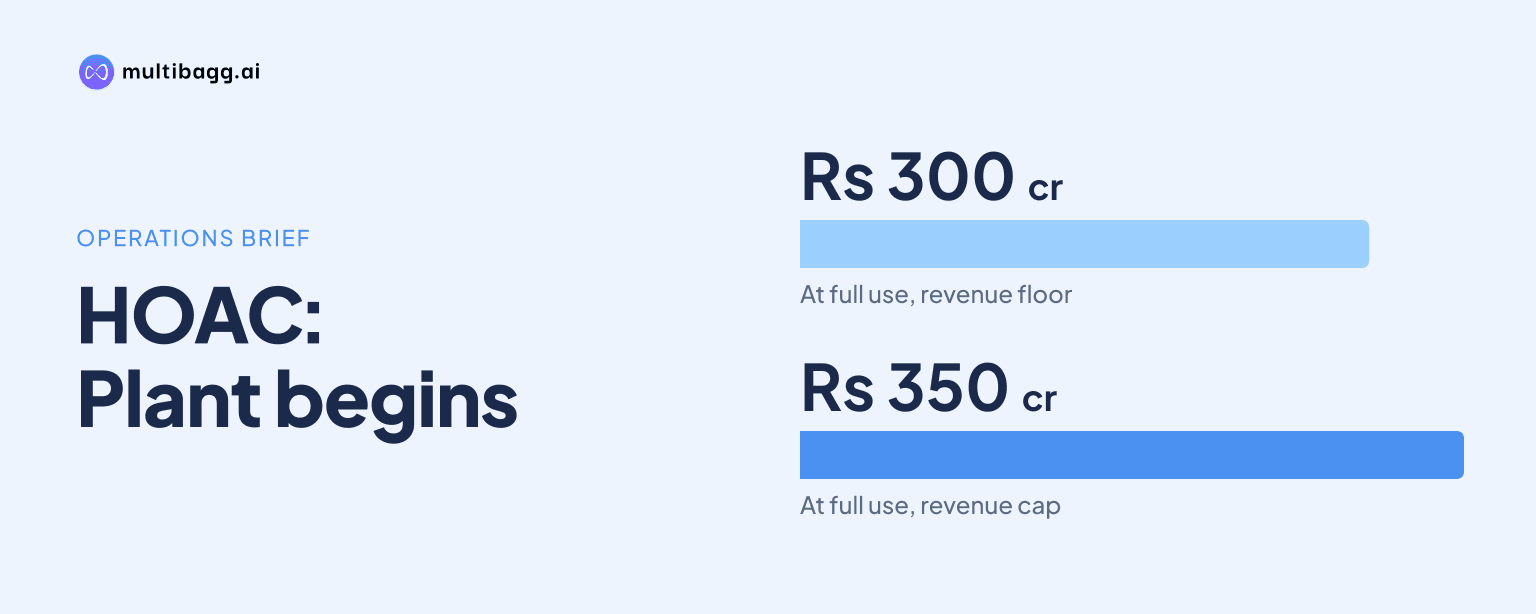
HOAC Foods India Limited began commercial production at its Vidisha facility on November 5, 2025, after machinery trials from November 1 to 4, and management estimates the plant alone can support Rs 300 crore to Rs 350 crore in revenue at full utilization. The site combines automated flour, spices and edible-oil lines.
Know Hoac Foods India inside out
Results, valuation, peers and who's buying, in one view.
Why was HOAC's Vidisha plant delayed?
HOAC said the primary reason for the delay was its decision to add edible-oil machinery, which was not part of the initial plan for Vidisha. Management said oil sales had risen from about 8% of total revenue in the previous year to around 10% to 11% in the current period, prompting it to widen the plant's product scope before commissioning.
Management also cited negotiations for equipment that had become more expensive amid wars, as well as delays in material deliveries. It said machinery trials began on November 1 and finished on November 4, with commercial production starting on November 5. Management apologised for the delay and said the facility was now running.
The added equipment makes Vidisha a facility for flour, spices and edible oils rather than flour and spices alone. This fits HOAC's H1 FY27 product launches, which included sesame, almond and peanut oils alongside makhana flavours, roasted peanuts, dal vadi, pickles and chutneys.
What revenue capacity does HOAC expect from Vidisha?
HOAC management estimates that the Vidisha plant alone can support approximately Rs 300 crore to Rs 350 crore of revenue at full utilisation. It said capacity could be increased mainly by adding shifts, while one or two additional machines could be installed in around 15 to 20 days if needed.
An analyst on the call described HOAC's existing capacity as about Rs 100 crore and the new plant as about Rs 300 crore, implying combined capacity of roughly Rs 300 crore to Rs 400 crore. Management agreed with that characterisation, but its direct estimate for Vidisha was Rs 300 crore to Rs 350 crore rather than a consolidated company revenue forecast.
Management said 95% of capacity was utilised before Vidisha began operations, while the new plant had its full capacity available from November 5. The difference shows the additional production headroom Vidisha provides, though HOAC did not disclose a timetable for reaching a specified plant utilisation level.
What equipment and products will HOAC's Vidisha plant handle?
HOAC said Vidisha has an automated wheat-cleaning line that can handle 4,000 kilograms per hour and an atta milling line with capacity of 2,000 kilograms per hour. Its salt and spice machines have combined processing capacity of 270 to 280 kilograms per hour, while its oilseed-crushing line can process 6,000 to 7,000 kilograms over 24 hours.
The facility supports a portfolio of more than 255 stock-keeping units, or SKUs, according to management. HOAC said it has space to add machinery in phases, giving it flexibility to develop further products across its flour, spices and edible-oil categories.
Management said automation should increase output while maintaining consistency between production batches. It also expects lower labour and electricity use per unit as the plant ramps up, but it did not provide a quantified cost-saving target or a timetable for any effect on operating margins.
Got a follow-up? Ask IRIS
How could Vidisha affect HOAC's costs and capacity use?
HOAC said the Vidisha location should lower labour and electricity costs relative to its earlier production setup. Management chose the Vidisha region in Madhya Pradesh for its central location, which it said can serve Madhya Pradesh, Jaipur, Maharashtra, Mumbai and Delhi, as well as for lower land, labour and electricity costs.
Management said no immediate additional capital expenditure is required because the plant capex has already been invested. It also said 50% of the acquired land remains available for future expansion, providing room for capacity additions if demand requires them.
HOAC expects the oil capacity to be fully utilised over two-and-a-half to three years, according to management. It did not provide annual utilisation targets, revenue guidance for FY27 or FY28, or a separate revenue estimate for the oil line, leaving the pace of demand absorption unresolved.
How does Vidisha fit HOAC's current growth?
HOAC reported revenue from operations of Rs 43.19 crore for the six months ended September 30, 2026, up 99% from Rs 21.73 crore in the corresponding period a year earlier. Gross profit rose 72.3% to Rs 12.42 crore from Rs 7.21 crore, slower than revenue growth, while profit after tax increased 124.5% to Rs 4.38 crore from Rs 1.95 crore.
The capacity expansion coincides with broader customer-channel growth. HOAC said its business-to-consumer customer base reached approximately 1.25 lakh, with around 2,200 customers added each month through stores, and its app crossed 11,000 downloads. It also opened five stores in H1 FY27.
HOAC said its EVERGROW trade brand was generating more than Rs 1 crore in monthly sales across Delhi, Haryana, Uttar Pradesh and Madhya Pradesh. Its export business shipped 26 20-foot containers in H1 FY27, compared with 14 containers in the comparable period, an increase of about 86%.
Conclusion
Vidisha gives HOAC an automated manufacturing base for flour, spices and edible oils, with management estimating Rs 300 crore to Rs 350 crore of revenue capacity for the plant alone. The project was delayed by the addition of oil machinery and supply-related factors, but it began commercial production as HOAC reported 99% revenue growth in the six months ended September 30, 2026.
The next measure is the pace at which HOAC converts the plant's available capacity into production and sales, particularly in the oil segment that management expects to utilise over two-and-a-half to three years. Investors can also watch for any reported cost effect from Vidisha's automation and lower local labour and electricity costs, while management retains 50% of the acquired land and says machinery additions could take 15 to 20 days.