










Homes Services revenue rises 25% as cash deficit widens
Key highlights
- Homes Services' September-quarter 2026 revenue rose 25% year on year to Rs 2,336 crore.
- Homes Services recorded a Rs 1,041.3 crore operating free-cash-flow deficit after Rs 2,181.4 crore of September-quarter capex.
- Homes Services' September-quarter EBITDA margin declined 1.3 percentage points to 48.8%.
- Homes Services' six-month operating free-cash-flow deficit widened 19% to Rs 1,817 crore.
powered by IRIS
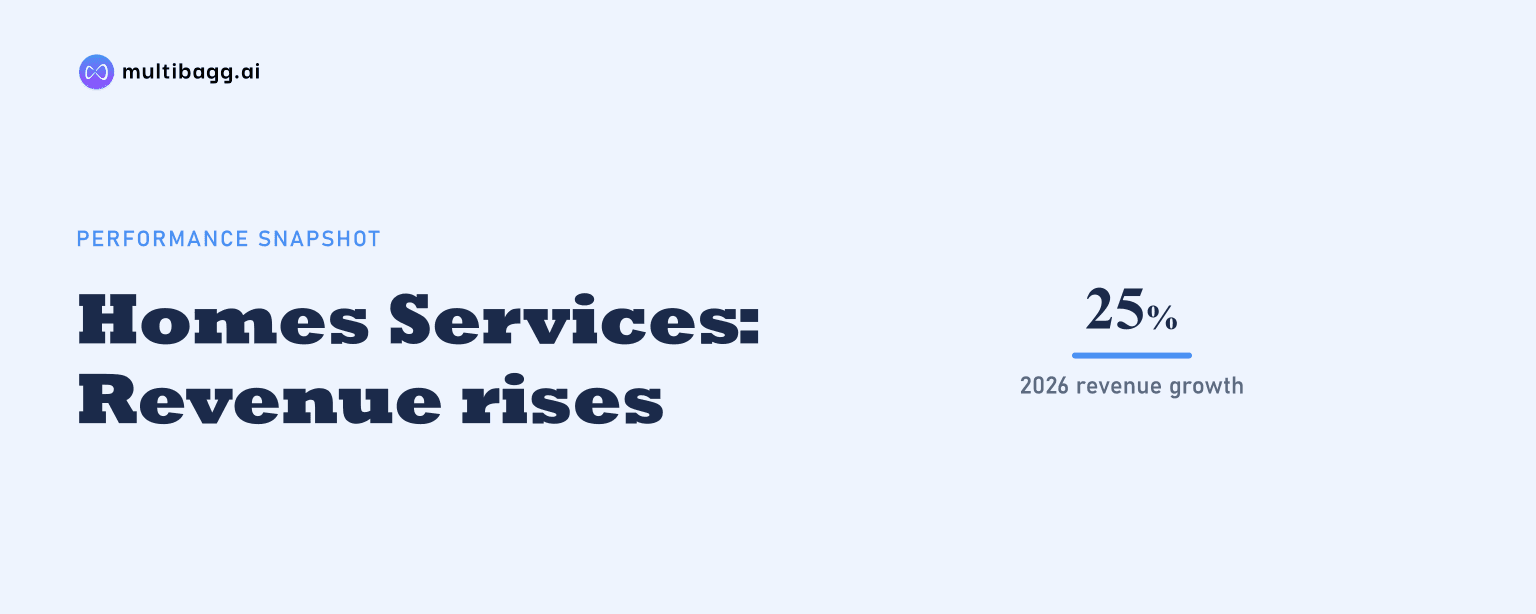
Bharti Airtel Limited's Homes Services reported September-quarter 2026 revenue of Rs 2,336 crore, up 25% year on year, but recorded a Rs 1,041.3 crore operating free-cash-flow deficit as Rs 2,181.4 crore of capital expenditure exceeded Rs 1,140.1 crore of earnings before interest, tax, depreciation and amortisation (EBITDA).
Know Bharti Airtel inside out
Results, valuation, peers and who's buying, in one view.
Why did Homes Services operating free cash flow remain negative?
Homes Services reported negative operating free cash flow because September-quarter 2026 capital expenditure, or capex, of Rs 2,181.4 crore was higher than EBITDA of Rs 1,140.1 crore. The presentation defines operating free cash flow as EBITDA less capex, producing a deficit of Rs 1,041.3 crore for the quarter.
The deficit widened from Rs 927.1 crore in the September-quarter 2025 to Rs 1,041.3 crore in the September-quarter 2026, a reported deterioration of 12%. EBITDA rose 22% from Rs 933.5 crore, while capex increased 17% from Rs 1,860.6 crore; despite the lower percentage increase in capex, spending remained Rs 1,041.3 crore above EBITDA.
Homes Services also reported earnings before interest and tax, or EBIT, of Rs 157 crore for the September-quarter 2026, down 48% from Rs 301.2 crore a year earlier. This differed from the Rs 206.6 crore increase in EBITDA over the same period, with EBIT declining by Rs 144.2 crore.
How fast did Homes Services revenue and EBITDA grow?
Homes Services grew September-quarter 2026 revenue by 25% to Rs 2,336 crore and EBITDA by 22% to Rs 1,140.1 crore. Revenue increased by Rs 471.4 crore from Rs 1,864.6 crore, while EBITDA rose by Rs 206.6 crore from Rs 933.5 crore.
Homes Services' EBITDA margin declined by 1.3 percentage points to 48.8% in the September-quarter 2026 from 50.1% in the September-quarter 2025. The presentation calculates this ratio as EBITDA divided by total revenue, so the segment generated Rs 48.8 of EBITDA for every Rs 100 of revenue, compared with Rs 50.1 a year earlier.
For the six months ended September 2026, Homes Services revenue rose 29% to Rs 4,623.5 crore from Rs 3,582.5 crore in the corresponding period of 2025. Six-month EBITDA increased 26% to Rs 2,264 crore from Rs 1,792.4 crore, while the EBITDA margin declined by 1.1 percentage points to 49.0%.
The six-month growth rates exceeded the quarterly rates, with revenue growth at 29% versus 25% and EBITDA growth at 26% versus 22%. However, margins were below prior-year levels in both periods: 48.8% versus 50.1% for the quarter and 49.0% versus 50.0% for the six months.
Got a follow-up? Ask IRIS
How did Homes Services capex compare with other India and South Asia segments?
Homes Services accounted for 22% of India and South Asia capex in the September-quarter 2026, while contributing 6% of revenue and 4% of EBITDA in the presentation's segment contribution table. Its Rs 2,181.4 crore capex was below Mobile Services' Rs 3,599.9 crore but above Airtel Business' Rs 1,171 crore among those listed segments.
Mobile Services generated Rs 18,873.5 crore of EBITDA and Rs 15,273.6 crore of operating free cash flow in the same quarter, compared with Homes Services' EBITDA of Rs 1,140.1 crore and deficit of Rs 1,041.3 crore. Airtel Business reported Rs 1,354.7 crore of operating free cash flow after Rs 1,171 crore of capex.
Homes Services' cumulative investments stood at Rs 29,222.9 crore as at September 30, 2026, up 24% from Rs 23,486.3 crore a year earlier. It represented 5% of listed India and South Asia cumulative investments, compared with 65% for Mobile Services and 20% for Passive Infrastructure Services.
The segment percentages are calculated before eliminations and other adjustments. In the September-quarter 2026, eliminations and others reduced India and South Asia revenue by Rs 6,136 crore and EBITDA by Rs 1,882.6 crore, which is why the listed segment revenue shares total more than 100%.
What changed for Homes Services in the six months ended September 2026?
Homes Services' six-month operating free-cash-flow deficit widened 19% to Rs 1,817 crore in the six months ended September 2026 from Rs 1,525.4 crore a year earlier. Capex increased 23% to Rs 4,081 crore, exceeding EBITDA of Rs 2,264 crore in both six-month periods.
The increase in six-month capex was Rs 763.2 crore, from Rs 3,317.8 crore in the prior-year period, while EBITDA rose by Rs 471.6 crore from Rs 1,792.4 crore. As a result, the gap between capex and EBITDA increased by Rs 291.6 crore to the reported deficit of Rs 1,817 crore.
Six-month EBIT was Rs 409.7 crore, down 49% from Rs 799.6 crore in the six months ended September 2025. That fall occurred alongside a 29% increase in revenue and a 26% rise in EBITDA, while the EBITDA margin moved from 50.0% to 49.0%.
Homes Services' Rs 4,081 crore of six-month capex represented 21% of India and South Asia capex of Rs 19,605.8 crore in the contribution table. Mobile Services represented 42% of that capex with Rs 8,176.4 crore, while Airtel Business represented 11% with Rs 2,114.9 crore.
Conclusion
Homes Services combined 25% September-quarter revenue growth with a 1.3-percentage-point decline in EBITDA margin and a wider operating free-cash-flow deficit. The segment's Rs 2,181.4 crore capex was nearly twice its Rs 1,140.1 crore EBITDA, while six-month capex of Rs 4,081 crore remained above six-month EBITDA of Rs 2,264 crore.
The unresolved measure to watch is whether Homes Services can narrow the gap between capex and EBITDA after its six-month deficit widened by 19% to Rs 1,817 crore. The presentation does not disclose a segment capex target, customer target or timetable for reducing the deficit, leaving subsequent reported revenue, EBITDA, capex and cash-flow figures as the relevant indicators.