










IGL Spirits Limited Lists on NSE, Gains 296.07% Early
Key highlights
- IGL Spirits Limited listed on November 4, 2026, after the demerger of India Glycols Limited's potable spirits and biofuels businesses.
- NSE data showed IGL Spirits at ₹878 at 09:41, up ₹656.32 or 296.07% from the stated ₹221.68 previous close.
- The reported NSE trading volume was 54,498 shares, while five-day, 10-day and 30-day average volumes were shown as zero.
- IGL Spirits is in the BE Trade-to-Trade series, where intraday trading is not allowed and delivery settlement is compulsory.
powered by IRIS
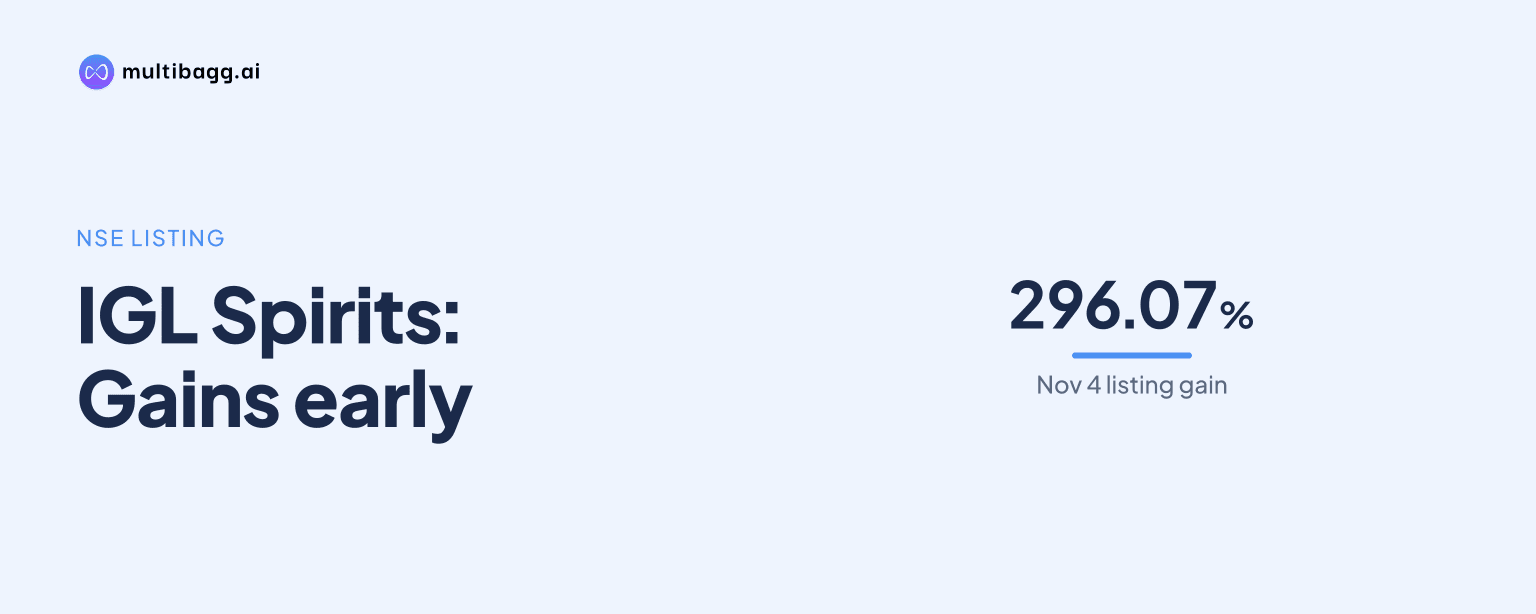
IGL Spirits Limited began standalone trading on November 4, 2026, following the demerger of India Glycols Limited's potable spirits and biofuels businesses, with the cited NSE quote reaching ₹878, or 296.07% above the stated previous close of ₹221.68 at 09:41.
Know IGL Spirits inside out
Results, valuation, peers and who's buying, in one view.
What happened on IGL Spirits' listing day?
IGL Spirits Limited commenced trading on the Bombay Stock Exchange and National Stock Exchange on Wednesday, November 4, 2026, according to the listing information provided. The company was separated from India Glycols Limited, bringing its potable spirits and biofuels operations into a standalone listed entity with an independent balance sheet.
The available market-page data identifies the company with BSE code 545013, NSE symbol IGLSPIRITS and ISIN INE2W6901017. Its shares were shown in the BE series, also referred to as the Trade-to-Trade or T-segment. The listing information classifies the company under the miscellaneous sector and industry.
The separation is significant because the spirits and biofuels operations can now be assessed independently from India Glycols. The source describes IGL Spirits as operating in potable spirits and biofuels, with products spanning whisky, rum, vodka and branded non-IMFL categories.
How did IGL Spirits trade in early NSE data?
The cited NSE data showed IGL Spirits at ₹878 at 09:41 on November 4, compared with a stated previous close of ₹221.68, representing a gain of ₹656.32 or 296.07%. The opening price was also displayed as ₹878, indicating that the available snapshot showed the stock at that level shortly after trading began.
The page reported a volume figure of 54,498, while five-day, 10-day and 30-day average volumes were shown as zero. As a newly listed company, it did not have an established trading history for those rolling-period measures in the data provided. A displayed bid was ₹878.50 for 3,730 shares, although no corresponding offer detail was provided in the excerpt.
What does the demerger business include?
IGL Spirits comprises the potable spirits and biofuels businesses that were previously part of India Glycols Limited. The company has a portfolio that includes whisky, rum and vodka, alongside branded non-IMFL products, according to the supplied company description.
Its manufacturing facilities are located in Uttarakhand and Uttar Pradesh. These operating locations are relevant because the business depends on state-level production, distribution and alcohol-regulation frameworks, while its biofuels activity is part of the same newly independent corporate structure.
The listing changes the corporate form of these operations rather than describing a new product launch or capacity addition. The available information does not provide revenue, profit, production capacity, market share, demerger ratio or future financial targets. Investors therefore have limited financial detail in the material supplied for assessing the standalone business.
Got a follow-up? Ask IRIS
Why is the Trade-to-Trade classification important for investors?
IGL Spirits shares were shown in the BE series, meaning transactions are subject to compulsory delivery settlement and intraday trading is not allowed. Buyers must take delivery of the shares and sellers must deliver them when trades are settled.
This structure can be important for investors reviewing early price and volume data. A compulsory-delivery framework differs from segments that allow intraday square-off activity, so trading behaviour and liquidity should be interpreted in that context. The source does not provide additional details on how long the BE classification will apply.
The supplied pages also contain inconsistent market references. One BSE data section states that IGL Spirits was not listed on BSE and showed no live data, even though the listing text says the shares commenced trading on both BSE and NSE and identifies BSE code 545013. Another page displayed a price of ₹10 as of 12:00 am on November 4. These entries should not be treated as a confirmed closing price alongside the NSE quote of ₹878 at 09:41.
What does the listing mean for the market and the company?
The listing provides a separately traded equity instrument for the demerged spirits and biofuels business. It enables market participants to value IGL Spirits independently of India Glycols, based on future disclosures about its operations, financial performance, debt, capital allocation and regulatory exposure.
The 296.07% movement shown in the early NSE snapshot is a reported comparison against the stated previous close, not a measure of operating performance. Since the available data covers the first day of trading and also contains conflicting price references, it does not establish a reliable longer-term market trend or valuation benchmark.
For customers and production operations, the supplied information identifies no announced change in brands, manufacturing locations or product portfolio. For investors, the immediate practical factors disclosed are the company’s standalone status, its NSE and BSE identifiers, and its compulsory-delivery trading series.
Conclusion
IGL Spirits Limited entered the public market as the standalone potable spirits and biofuels business demerged from India Glycols Limited. Early NSE data showed ₹878 at 09:41, up 296.07% from a reported previous close of ₹221.68, while the BE series required delivery-based settlement rather than intraday trading.
The next key information to watch is the company’s formal standalone financial disclosures and subsequent exchange data, particularly because the supplied pages show conflicting BSE availability and price references. Updates on trading liquidity, settlement classification and operating performance will provide a clearer basis for evaluating the newly listed company.