










IIL says about 95% of revenue is manufactured in-house
Key highlights
- IIL says about 95% of its revenue is manufactured in-house.
- IIL reports 70,000 MT/KL of annual formulation capacity and a 20-stream technical plant.
- IIL has 15,800 MTPA of active-ingredient and intermediate capacity.
- IIL reports about 182 international registrations across 22 countries.
powered by IRIS
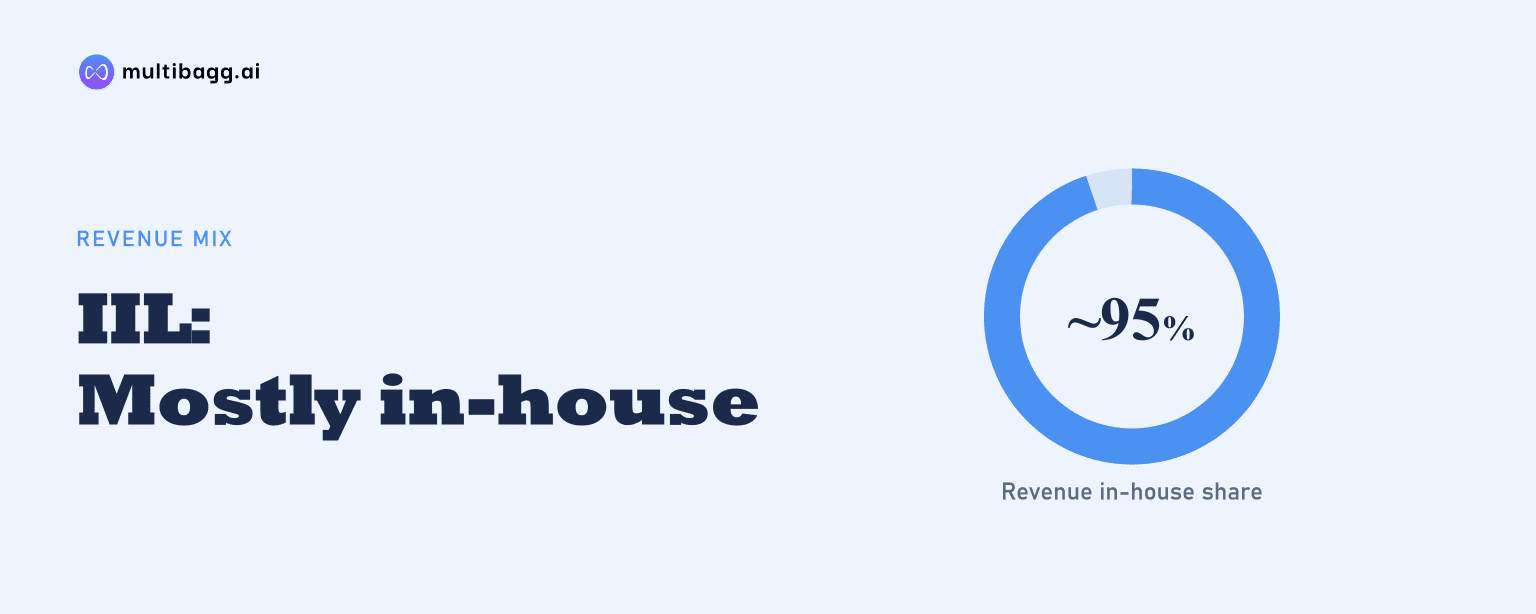
Insecticides (India) Limited says about 95% of its revenue is manufactured in-house, supported by 70,000 MT/KL of annual formulation capacity and a multi-purpose technical plant with 20 streams. IIL lists manufacturing facilities or units at Chopanki, Dahej, Shamli, Samba, Udhampur and upcoming Sotanala.
Know Insecticides India inside out
Results, valuation, peers and who's buying, in one view.
What manufacturing facilities does IIL operate?
IIL lists seven manufacturing-facility entries spanning formulation, technical manufacturing, biological products and exports. The listed network includes a formulation and technical unit at Chopanki, a separate formulation unit at Chopanki, an upcoming unit at Sotanala, a formulation unit covering Samba and Udhampur, and a biological unit at Shamli.
The network also includes a formulation and technical unit at Dahej and an export-oriented unit at Dahej. The presentation says all manufacturing sites are in approved industrial estates. This structure places technical and formulation operations at both Chopanki and Dahej, while Shamli is identified specifically for biological production and Dahej also has the export-focused operation.
The facility descriptions show that IIL’s manufacturing footprint is not confined to a single product category. Its 15,800 metric tonnes per annum, or MTPA, of active-ingredient and intermediate capacity represents the technical side of the network, while granules, liquids and powders account for the formulation side. The biological unit adds another stated manufacturing category, although the presentation does not disclose its individual capacity.
How much formulation capacity does IIL have?
IIL reports annual formulation capacity of 70,000 MT/KL, combining metric tonnes and kilolitres across solid and liquid product formats. The disclosed breakdown comprises 30,000 MTPA of granules, 30,000 kilolitres per annum, or KLPA, of liquids, and 10,000 MTPA of powder, alongside 15,800 MTPA of active ingredients and intermediates.
The capacity mix shows that granules and liquid formulations are each disclosed at 30,000 in their respective annual measures, compared with 10,000 MTPA for powder formulations. Because liquids are measured in kilolitres and the other disclosed categories in metric tonnes, the presentation’s 70,000 MT/KL formulation figure is a combined operational measure rather than a single weight-based total.
IIL also describes its technical facility as a multi-purpose plant with 20 different streams. That figure indicates the number of streams disclosed for technical manufacturing, while the 70,000 MT/KL figure describes the annual formulation base. The presentation does not provide utilisation rates, output by facility, or the proportion of each formulation format produced at Chopanki, Dahej, Samba or Udhampur.
Got a follow-up? Ask IRIS
How integrated is IIL’s manufacturing model?
IIL states that about 95% of revenue is manufactured in-house. The metric is a revenue-based description of internal production rather than a statement that 95% of physical volume, raw materials or product inputs are made internally; the presentation does not provide those additional measures.
The stated integration combines active ingredients and intermediates with formulation capacity. IIL has 15,800 MTPA of technical capacity and 70,000 MT/KL of annual formulation capacity, and management’s strategic roadmap identifies backward integration as a mechanism to pursue cost competitiveness. The roadmap also refers to capacity expansion, productivity improvement, automation and cost optimisation under manufacturing excellence.
This distinction matters because the presentation links manufacturing integration to revenue, but does not quantify the financial effects on margins, working capital or cash generation. Management lists improved operational efficiency and cost optimisation as roadmap objectives, while its long-term shareholder-value section refers to stronger profitability, returns and cash generation without giving a numerical target or timetable.
How is IIL expanding manufacturing and export capability?
IIL identifies expansion space at Dahej and an upcoming plant at Sotanala as its disclosed options for enlarging manufacturing capability. The presentation does not specify the Sotanala unit’s commissioning date, installed capacity, capital expenditure or intended product categories, so the scale and timing of any additional output remain undisclosed.
The Dahej export-oriented unit is specifically described as a 100% export-oriented formulation plant. IIL says it commenced this unit in Dahej, Gujarat, in 2020 to boost global presence. This separates the export plant’s stated role from the domestic formulation, technical and biological facilities listed elsewhere in the manufacturing network.
IIL reports a footprint in 22 countries and about 182 international registrations. It also says it received an Exports Excellence Award in 2023 and a “Company of the Year (Large Scale)” award in 2025. Awards and registrations establish the disclosed export context, but the presentation gives no export-revenue figure or country-level sales split.
Management’s wider roadmap says it intends to expand international presence through new registrations and strategic partnerships. The about 182 registrations are therefore an existing disclosed base, while future expansion remains dependent on additional registrations and partnerships. The source does not state how many registrations are pending or identify the markets targeted next.
Conclusion
IIL’s presentation describes a manufacturing model in which about 95% of revenue is manufactured in-house, supported by 15,800 MTPA of active-ingredient and intermediate capacity, 70,000 MT/KL of annual formulation capacity and a 20-stream technical plant. The model spans technical, formulation, biological and export-oriented activities, with Dahej serving both technical and formulation operations and a dedicated export unit.
The next matters to watch are the planned capacity expansion, the use of available space at Dahej and progress at the upcoming Sotanala plant. Management has also identified automation, backward integration, new international registrations and strategic partnerships as elements of its roadmap, but it has not disclosed a capacity target, commissioning schedule, capital-spending figure or export-revenue target for those initiatives.