










Insecticides India premium B2C mix reaches 58% in FY26 sales
Key highlights
- Premium products represented 58% of Insecticides India B2C sales in FY26, versus 51% in FY22.
- B2C accounted for 73% of FY26 sales, compared with 65% in FY22 and 75% in FY25.
- Gross profit margin rose to 31.5% in FY26 from 23.1% in FY23.
- H1FY27 EBITDA margin was 12.3%, compared with 13.1% in H1FY26.
powered by IRIS
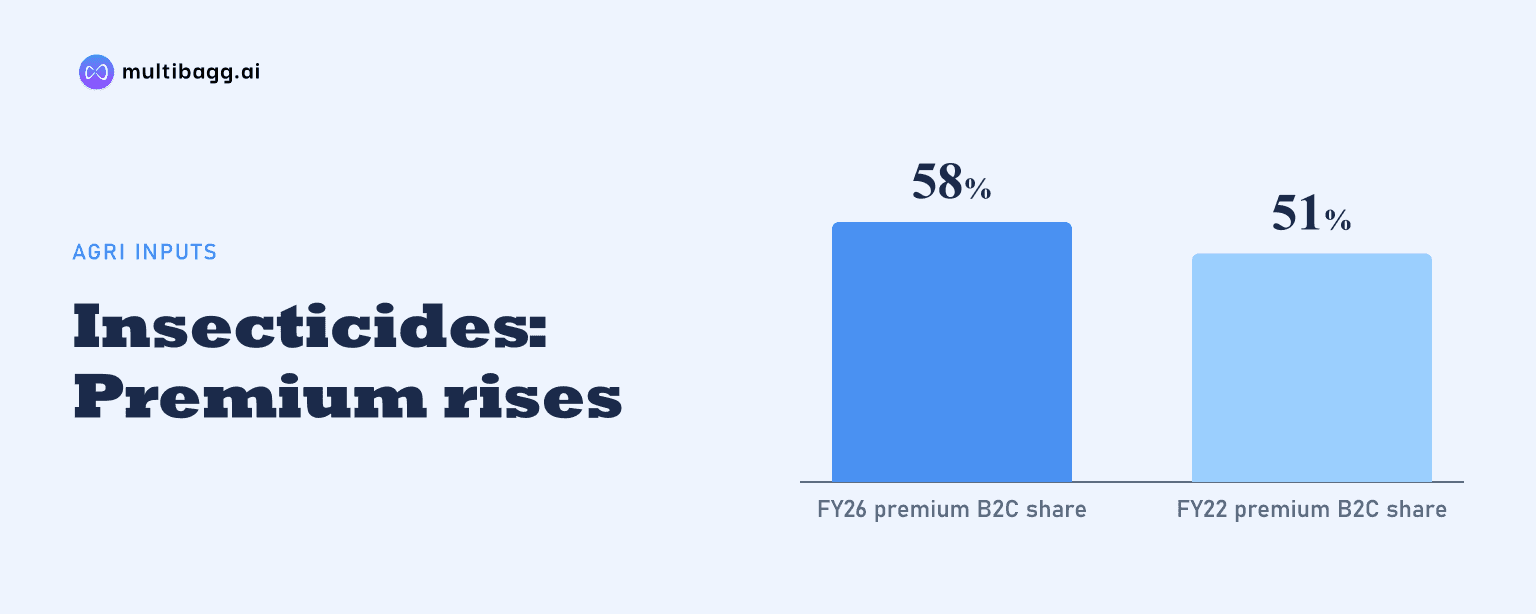
Insecticides (India) Limited reported that premium products accounted for 58% of business-to-consumer (B2C) sales in FY26, up from 51% in FY22, while gross profit margin rose to 31.5% from 23.1% in FY23. The data show a sales mix increasingly led by B2C products alongside a recovery in reported profitability after FY23.
Know Insecticides India inside out
Results, valuation, peers and who's buying, in one view.
How has Insecticides India shifted sales toward B2C?
Insecticides India increased B2C's share of sales to 73% in FY26 from 65% in FY22, although it was below the 75% recorded in FY25. Over the same four-year span, business-to-business (B2B) sales declined from 26% to 22%, while exports fell from 9% to 5%. The reported mix therefore became more weighted to B2C despite the FY26 moderation from FY25.
The change was most pronounced between FY24 and FY25, when B2C rose by 6 percentage points to 75% and B2B fell by 6 percentage points to 20%. In FY26, B2C declined by 2 percentage points and B2B recovered by 2 percentage points, leaving exports unchanged at 5%. The presentation does not provide rupee revenue by B2C, B2B or exports, but total revenue reached Rs 2,140 crore in FY26.
Revenue increased from Rs 1,504 crore in FY22 to Rs 2,140 crore in FY26, a rise of Rs 636 crore across the period. Revenue rose in every reported financial year, but the annual increase slowed from Rs 297 crore in FY23 to Rs 34 crore in FY25, before increasing by Rs 140 crore in FY26. This revenue sequence provides the overall scale against which the B2C sales-share movement occurred.
How has Insecticides India changed premium and category mix?
Insecticides India raised premium products to 58% of B2C sales in FY26 from 51% in both FY22 and FY23, while generic products fell to 42% from 49%. Premium share first increased to 59% in FY24, slipped to 57% in FY25, and recovered by 1 percentage point in FY26. The FY26 premium proportion was therefore 7 percentage points above the FY22 and FY23 level.
The category mix also changed during the period, particularly in fungicides. Fungicides represented 19% of sales in FY24, compared with 11% in FY22 and FY23, before falling to 10% in both FY25 and FY26. Insecticides were 49% in FY26, compared with 53% in FY22, while herbicides were 37% in FY26 versus 33% in FY22. Biological products and plant growth regulators (PGR) represented 4% in FY26.
Insecticides India also reported a standalone freshness index total of Rs 539 crore in FY26, compared with Rs 505 crore in FY25 and Rs 391 crore in FY23. The FY26 total includes Rs 82 crore associated with FY25 and Rs 40 crore associated with FY26 in the presentation's year-wise breakout. The presentation labels these figures as a freshness index but does not define the measure or link it directly to premium-product sales.
Got a follow-up? Ask IRIS
How did Insecticides India margins recover after FY23?
Insecticides India lifted gross profit margin to 31.5% in FY26 from 23.1% in FY23, a gain of 8.4 percentage points, as gross profit rose to Rs 675 crore from Rs 416 crore. Gross margin had been 26.4% in FY22, improved to 25.5% in FY24, and reached 32.0% in FY25 before the 0.5-percentage-point FY26 decline. The FY26 gross-profit percentage remained above the FY23 level.
Earnings before interest, tax, depreciation and amortisation (EBITDA) margin followed a similar recovery pattern, rising to 10.6% in FY26 from 6.8% in FY23. EBITDA increased to Rs 227 crore in FY26 from Rs 122 crore in FY23, but was Rs 221 crore in FY25, meaning FY26 EBITDA rose by Rs 6 crore while margin declined by 0.5 percentage points. Profit after tax was Rs 139 crore in FY26, compared with Rs 63 crore in FY23 and Rs 142 crore in FY25.
Return on capital employed (ROCE) was 16.1% in FY26, up from 10.4% in FY23 but down from 17.8% in FY25. Return on equity (ROE) was 11.4% in FY26, versus 6.9% in FY23 and 13.1% in FY25. Net working-capital days were 168 in FY26, 4 days lower than FY25's 172 days but 6 days above FY22's 162 days.
The more recent half-year results show that the margin recovery remained uneven. For H1FY27, gross profit margin was 32.7%, above 31.7% in H1FY26, but EBITDA margin was 12.3%, below 13.1%, and profit after tax fell 15% to Rs 100.04 crore. Revenue from operations declined 2% to Rs 1,297.84 crore during H1FY27, while gross profit increased 1% to Rs 424.32 crore.
Conclusion
Insecticides India’s historical data show two connected changes: B2C represented 73% of FY26 sales compared with 65% in FY22, and premium products represented 58% of B2C sales compared with 51%. Across the same period, gross profit margin recovered from its FY23 low of 23.1% to 31.5% in FY26, while EBITDA margin rose from 6.8% to 10.6%.
The presentation does not disclose a forward premium-mix target or a scheduled operating update. Subsequent disclosures can show whether premium’s 58% B2C share and B2C’s 73% sales share are maintained, and whether the H1FY27 EBITDA margin of 12.3%, below 13.1% a year earlier, changes alongside the FY26 net working-capital level of 168 days.