










Insecticides India Receivables Rise 48%, Cash Flow Negative
Key highlights
- Insecticides India’s trade receivables rose 48% to Rs 719.10 crore at September 2026 from Rs 486.97 crore at March 2026.
- Insecticides India reported a Rs 210.91 crore working-capital outflow in H1FY27.
- Insecticides India’s net cash from operating activities was negative Rs 73.39 crore in H1FY27.
- Insecticides India’s current borrowings increased to Rs 220.96 crore from Rs 125.50 crore at March 2026.
powered by IRIS
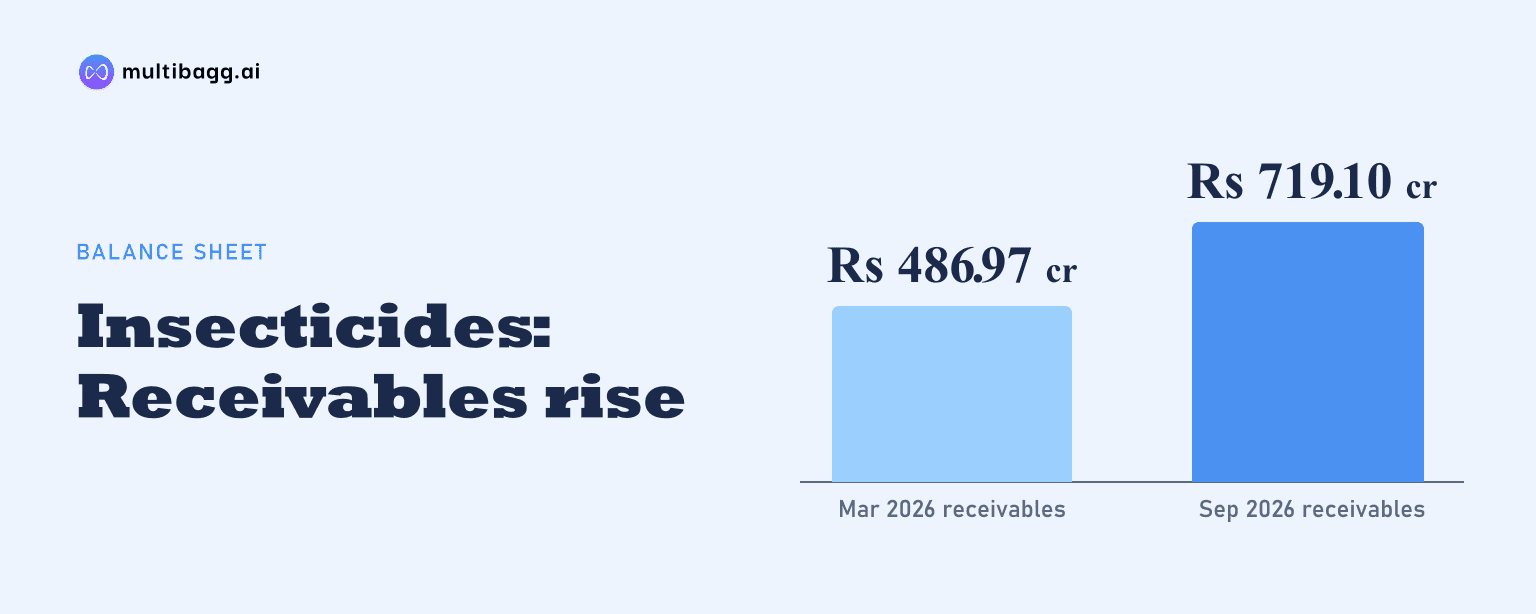
Insecticides (India) Limited reported trade receivables of Rs 719.10 crore at September 2026, 48% above Rs 486.97 crore at March 2026, while net cash from operating activities was negative Rs 73.39 crore in the first half of financial year 2027 (H1FY27). A Rs 210.91 crore working-capital outflow exceeded Rs 169.27 crore of operating profit before working-capital changes.
Know Insecticides India inside out
Results, valuation, peers and who's buying, in one view.
Why did Insecticides India’s operating cash flow turn negative?
Insecticides India’s operating cash flow turned negative because changes in working capital used Rs 210.91 crore in H1FY27. Operating profit before working-capital changes was Rs 169.27 crore, but the working-capital outflow was larger, leaving cash generated from operations at negative Rs 41.64 crore. Direct taxes paid of Rs 31.75 crore then resulted in negative Rs 73.39 crore of net cash from operating activities.
The cash-flow statement for the financial year ended March 2026 (FY26) shows a different outcome, although it is not a like-for-like period comparison with H1FY27. Operating profit before working-capital changes was Rs 236.48 crore in FY26 and working-capital changes used Rs 80.14 crore. That left Rs 156.34 crore of cash generated from operations and Rs 100.25 crore of net operating cash flow after Rs 56.09 crore of direct taxes.
How much did Insecticides India’s receivables increase?
Insecticides India’s trade receivables increased by Rs 232.13 crore over the six months to September 2026, rising from Rs 486.97 crore at March 2026 to Rs 719.10 crore. This was an increase of about 48%. Trade receivable days, calculated by the company as trade receivables divided by revenue and multiplied by the number of days, increased to 100 from 83.
The September 2026 receivables balance was also above Rs 643 crore at September 2025. Trade receivable days were 87 a year earlier, compared with 100 at September 2026. The presentation does not provide a customer-level split, ageing of dues, credit-loss provision detail, or a collection plan to explain the movement in receivables or the additional 17 days versus March 2026.
What happened to Insecticides India’s other working-capital balances?
Insecticides India’s net working capital rose to Rs 1,000 crore at September 2026 from Rs 828 crore at March 2026. Inventory increased by Rs 33.60 crore to Rs 813.81 crore, while trade payables rose by Rs 93.34 crore to Rs 532.60 crore. Since payables are deducted in the company’s calculation, their increase partly offset the rises in inventory and receivables.
Inventory days declined to 168 at September 2026 from 194 at March 2026, while trade payable days changed by one day to 110 from 109. Net working-capital days fell to 158 from 168 even as the reported rupee balance rose by Rs 172 crore. The two measures use different bases: the balance is a point-in-time amount, while the days ratios use the company’s revenue or cost-of-goods-sold calculations.
Got a follow-up? Ask IRIS
How did Insecticides India’s profit compare with cash generation?
Insecticides India reported profit before tax of Rs 134.18 crore in H1FY27, but this did not translate into positive operating cash flow because of the Rs 210.91 crore working-capital use. Profit before tax was 14% below Rs 156.31 crore in H1FY26. Profit after tax declined 15% to Rs 100.04 crore from Rs 117.21 crore, with the margin falling to 7.7% from 8.8%.
Revenue from operations was Rs 1,297.84 crore in H1FY27, 2% below Rs 1,328.83 crore a year earlier. Gross profit nevertheless increased 1% to Rs 424.32 crore and gross margin increased to 32.7% from 31.7%. Earnings before interest, tax, depreciation and amortisation were Rs 160.05 crore, down 8%, while the margin declined to 12.3% from 13.1%.
How did financing and cash balances change at Insecticides India?
Insecticides India recorded Rs 78.77 crore of cash from financing activities in H1FY27, while investing activities used Rs 56.66 crore. Current borrowings rose to Rs 220.96 crore at September 2026 from Rs 125.50 crore at March 2026, an increase of Rs 95.46 crore. Non-current borrowings moved in the opposite direction, declining to Rs 14.63 crore from Rs 18.78 crore.
Cash and cash equivalents ended September 2026 at Rs 35.94 crore, compared with Rs 87.23 crore at March 2026. The cash-flow statement reports a net decrease of Rs 51.28 crore during H1FY27, after beginning cash and cash equivalents of Rs 87.22 crore. Capital work-in-progress increased to Rs 159.22 crore from Rs 118.57 crore, while property, plant and equipment declined to Rs 302.02 crore from Rs 312.09 crore.
What does Insecticides India’s quarterly performance show?
Insecticides India reported revenue from operations of Rs 686.31 crore in Q2FY27, up 8% from Rs 637.70 crore in Q2FY26. Gross profit rose 5% to Rs 231.16 crore, but gross margin declined to 33.7% from 34.5%. Earnings before interest, tax, depreciation and amortisation increased 3% to Rs 92.44 crore, while its margin declined to 13.5% from 14.0%.
Profit before tax in Q2FY27 was Rs 75.36 crore, down 4% from Rs 78.86 crore a year earlier. Profit after tax was Rs 56.17 crore, down 5% from Rs 59.11 crore, and the profit-after-tax margin declined to 8.2% from 9.3%. The quarter’s revenue growth therefore contrasts with the 2% H1FY27 revenue decline and the negative Rs 73.39 crore operating cash flow for the half year.
Conclusion
Insecticides India’s September 2026 disclosures show that the Rs 232.13 crore rise in trade receivables was the main increase among the disclosed inventory, receivables and payables balances. Together with a Rs 33.60 crore inventory increase, partly offset by Rs 93.34 crore more trade payables, the working-capital movement contributed to a Rs 210.91 crore cash outflow despite Rs 134.18 crore of H1FY27 profit before tax.
The next results will clarify whether receivable days move from 100 toward the 83 days reported at March 2026 and whether operating cash flow changes from negative Rs 73.39 crore. The presentation does not disclose receivables ageing, customer concentration, overdue balances or a collection plan, leaving the reason for the rise in receivables unresolved. Current borrowings, which increased by Rs 95.46 crore to Rs 220.96 crore, are another disclosed balance to monitor.