










India Homes posts Rs 7.71 crore H1 profit after pivot
Key highlights
- India Homes reported H1 FY27 profit after tax of Rs 7.71 crore, versus a Rs 4.62 crore loss in H1 FY26.
- Q2 FY27 profit after tax was Rs 4.27 crore on total income of Rs 28.13 lakh.
- Total borrowings fell to Rs 83.30 crore at 30 September FY27 from Rs 91.38 crore at March FY27.
- India Homes said its reported profit after tax includes exceptional items.
powered by IRIS
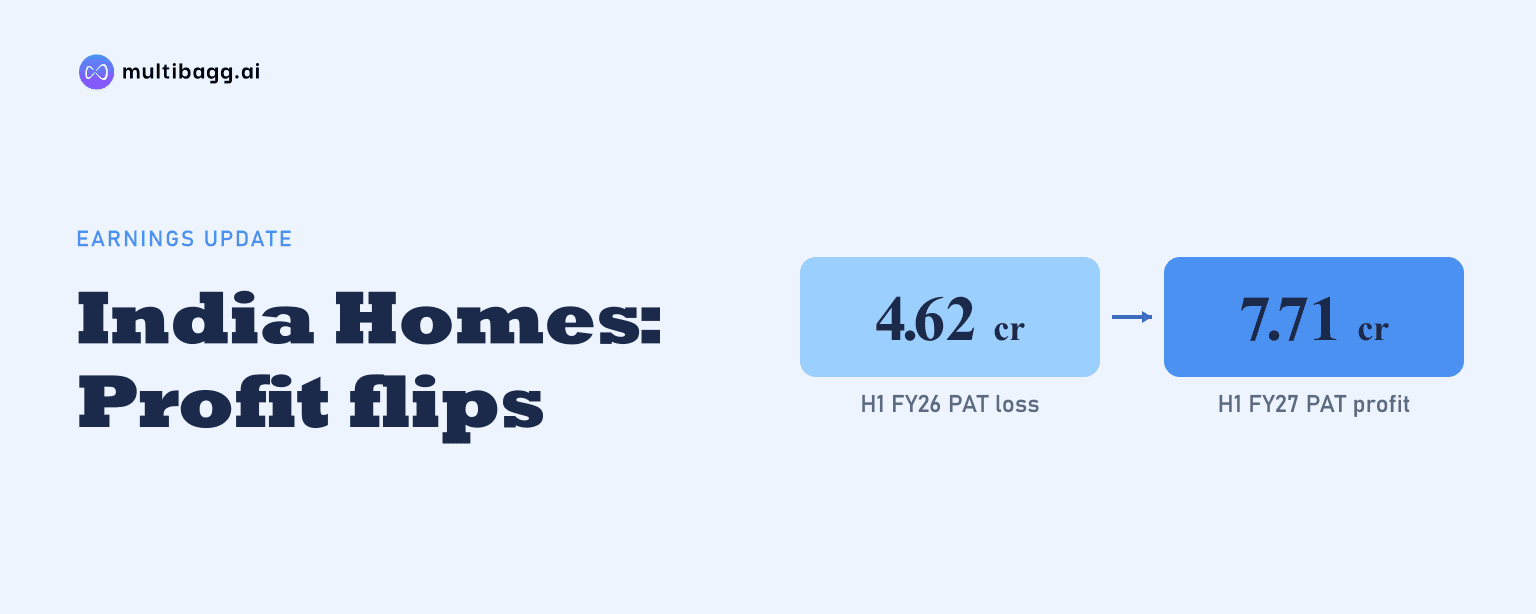
India Homes Limited reported standalone profit after tax of Rs 7.71 crore in H1 FY27, reversing a Rs 4.62 crore loss in H1 FY26, as it advanced its shift from stainless-steel manufacturing to Mumbai-focused real estate redevelopment. India Homes said the reported profit includes exceptional items, which it did not quantify.
Know India Homes inside out
Results, valuation, peers and who's buying, in one view.
What did India Homes report for H1 FY27?
India Homes reported H1 FY27 total income of Rs 51.42 lakh and profit after tax of Rs 7.71 crore, compared with Rs 25.40 lakh of income and a Rs 4.62 crore loss in H1 FY26. Tax expense was nil in both periods shown, meaning profit before tax equalled profit after tax.
Earnings per share, or EPS, were Rs 0.19 in H1 FY27, against a loss per share of Rs 0.12 in H1 FY26. The figures are unaudited standalone results, and India Homes said prior-period comparisons reflect its pivot from stainless-steel manufacturing to real estate.
The half-year result included Rs 4.27 crore of profit after tax in Q2 FY27, covering July to September 2026, after Rs 3.44 crore in Q1 FY27. Q2 total income was Rs 28.13 lakh, compared with Rs 23.30 lakh in Q1 FY27, while management said its focus was on advancing identified redevelopment opportunities and related planning and approvals.
How did India Homes' result change from earlier periods?
India Homes moved from a Rs 4.62 crore H1 FY26 loss to a Rs 7.71 crore H1 FY27 profit, while total income increased by Rs 26.02 lakh to Rs 51.42 lakh. The presentation identifies this as a period of business change, rather than providing a segment-wise bridge between its previous steel operations and real estate activity.
In the quarterly comparison, Q2 FY27 total income of Rs 28.13 lakh was Rs 16.20 lakh higher than the Rs 11.93 lakh reported in Q2 FY26. Profit after tax changed from a Rs 3.15 crore loss in Q2 FY26 to a Rs 4.27 crore profit in Q2 FY27.
Q2 FY27 also exceeded Q1 FY27 income by Rs 4.83 lakh and profit after tax by Rs 82.50 lakh. However, India Homes specifically stated that profit after tax includes exceptional items, so the presentation does not establish how much of the reported improvement came from recurring operating activity.
FY26 total income was Rs 27.65 crore and profit after tax was Rs 18.66 crore, figures materially larger than H1 FY27 income of Rs 51.42 lakh and profit of Rs 7.71 crore. India Homes did not disclose the nature or amount of exceptional items, or give a revenue and profit split for steel, the Khopoli development arrangement, or Mumbai redevelopment opportunities.
What business changes did India Homes make in FY26?
India Homes set out five milestones in its move from stainless-steel manufacturing to real estate, beginning with a May 2025 memorandum of understanding with the Lloyds Group to jointly develop its land at Khopoli. In July 2025, it executed a development agreement with Lloyds IHL LLP, identified in the presentation as the joint venture for the Khopoli project.
In September 2025, India Homes said it repaid its entire outstanding borrowings with Kotak Mahindra Bank. The presentation describes this as freeing the balance sheet, but it does not disclose the amount repaid or identify the financing source for that repayment.
The company was renamed India Homes Limited in November 2025, when its board also approved the real estate roadmap. The stated strategy is a Mumbai-focused redevelopment platform, while the company overview identifies four pipeline projects across four Mumbai micro-markets: Matunga, Wadala, Chembur and Dadar.
In March 2026, India Homes reached a one-time settlement with J.C. Flowers ARC, or asset reconstruction company, to resolve remaining secured borrowings. The presentation says the payout under that settlement was pending, so it does not confirm completion of the payment by 30 September 2026.
Got a follow-up? Ask IRIS
What do India Homes' balance sheet and cash flows show?
India Homes reported total assets of Rs 384.27 crore at 30 September FY27, down from Rs 397.14 crore at March FY27. Net worth rose to Rs 52.72 crore from Rs 45.01 crore, while total borrowings declined to Rs 83.30 crore from Rs 91.38 crore.
The Rs 8.08 crore reduction in borrowings occurred after the September 2025 repayment of Kotak Mahindra Bank borrowings and the March 2026 J.C. Flowers ARC settlement agreement. India Homes did not provide a maturity schedule, interest-cost figure, settlement payout amount, or reconciliation between financing cash flows and closing borrowings.
Operating cash flow was Rs 11.13 crore in H1 FY27, compared with Rs 20.29 crore in H1 FY26. Financing cash flow was an outflow of Rs 11.33 crore, against an outflow of Rs 20.28 crore a year earlier, while the presentation showed no investing cash flow in either half-year period.
What is India Homes planning in Mumbai redevelopment?
India Homes is planning an asset-light Mumbai redevelopment platform and says it is taking identified projects forward through project-readiness work, planning and approval processes. Managing Director Varun S. Gupta said the company would seek a scalable portfolio through disciplined project selection, capital allocation and execution planning.
The company overview describes redevelopment of legacy assets into residential and mixed-use developments in land-scarce urban locations. It says the promoter group has more than 20 years of combined Mumbai redevelopment experience, while its disclosed pipeline covers four projects in four Mumbai micro-markets.
India Homes has not disclosed a construction start date, project value, number of homes, expected revenue, funding requirement or completion timetable for the Khopoli project or Mumbai opportunities. The presentation therefore sets out the platform and process but does not give a financial target against which development execution can be measured.
Management said it would continue to enhance project readiness and pursue opportunities aligned with its strategic priorities. That statement is forward-looking, and the presentation cautions that actual outcomes may differ from forward-looking statements because of business, competitive, regulatory and other conditions.
Conclusion
India Homes' H1 FY27 figures show a reported return to profit during a restructuring that combined a Khopoli joint-development arrangement, repayment of Kotak Mahindra Bank borrowings, rebranding and a settlement agreement with J.C. Flowers ARC. Income also increased from H1 FY26, but the inclusion of unquantified exceptional items means the presentation does not separate recurring performance from exceptional gains or costs.
The next disclosed developments to watch are the pending payout under the March 2026 J.C. Flowers ARC one-time settlement and progress on Mumbai projects through planning, approvals and project readiness. Management has stated an asset-light redevelopment plan, but India Homes has not disclosed launch dates, project values, funding needs or quantified financial targets for the pipeline.