










India Homes reports Rs 88.87 crore debt fully in default
Key highlights
- India Homes disclosed Rs 88.87 crore of financial indebtedness, with both reported categories shown as fully in default.
- The Rs 64.19 crore category was Rs 39.51 crore larger than the Rs 24.68 crore first category.
- The reviewer said current liabilities exceeded current assets and operations had substantially ceased at the balance-sheet date.
- The reviewer said Rs 7.30 crore of settlement income was overstated because a Rs 25 crore payment due by July 31, 2026 had not been made.
powered by IRIS
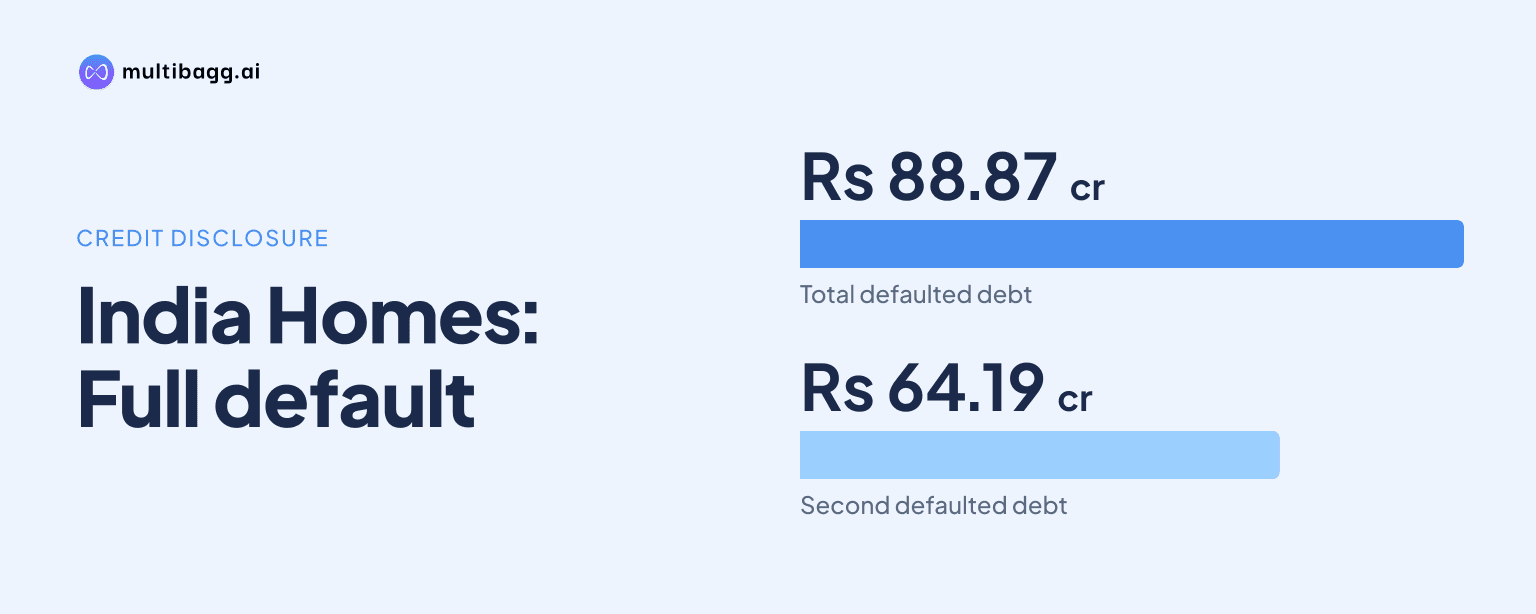
India Homes Limited reported Rs 88.87 crore of financial indebtedness as in default as of the reporting date, with the disclosed default amounts of Rs 24.68 crore and Rs 64.19 crore matching the outstanding balances in both categories. The page 9 disclosure therefore shows defaults equal to the total financial indebtedness stated by India Homes.
Know India Homes inside out
Results, valuation, peers and who's buying, in one view.
What debt default did India Homes disclose?
India Homes disclosed total financial indebtedness, including short-term and long-term debt, of Rs 88.87 crore in the table on page 9. The table reported Rs 24.68 crore outstanding in its first stated category and Rs 64.19 crore in a second category whose text refers to unlisted debt securities, including non-convertible debentures and non-convertible redeemable preference shares.
India Homes reported Rs 24.68 crore in default against the Rs 24.68 crore outstanding balance in the first category. It also reported Rs 64.19 crore in default against Rs 64.19 crore outstanding in the category referring to unlisted debt securities. The table is denominated in lakh, and the figures have been converted to crore.
The Rs 88.87 crore total is the sum of the two reported balances, and the two category-level defaults also sum to Rs 88.87 crore. The supplied page 9 disclosure does not identify creditors, repayment dates, interest rates, collateral, or the individual instruments included in either category.
How is India Homes' default divided between categories?
India Homes' Rs 64.19 crore category was Rs 39.51 crore larger than the Rs 24.68 crore first category. Based on the disclosed Rs 88.87 crore total, the larger category accounted for about 72% of financial indebtedness, while the first category accounted for about 28%.
India Homes' page 9 table includes wording on unlisted debt securities alongside the Rs 64.19 crore category, with examples of non-convertible debentures and non-convertible redeemable preference shares. However, the disclosure does not provide separate balances for those examples, so it does not establish how much of Rs 64.19 crore relates to each instrument type.
The Rs 24.68 crore category has no further debt-type description in the supplied table. India Homes therefore does not state on page 9 whether that balance comprises bank borrowing, another loan form, or a different financial liability category.
The filing permits a comparison between the two categories at the reporting date, but not a comparison with an earlier period. India Homes did not provide a preceding quarter, half-year, or financial-year default balance in the supplied page 9 disclosure, so no increase or decrease in total defaults can be calculated from this filing.
What did the reviewer say about India Homes' financial position?
India Homes' independent reviewer said current liabilities exceeded current assets at the balance-sheet date, operations had substantially ceased, and continuing operating losses had created acute liquidity constraints. In its report dated November 4, 2026, CGCA Associates LLP said it could not determine whether use of the going-concern basis of accounting was appropriate.
The reviewer said management had assessed the going-concern assumption and explained future cash-flow projections and operational-viability plans. But CGCA Associates LLP said sufficient appropriate audit evidence supporting those plans was unavailable, preventing it from assessing the accounting basis and any resulting effect on asset and liability carrying values or classifications.
India Homes recorded inventory of Rs 136.90 crore that the reviewer said had not been measured at the lower of cost and net realisable value, as required under Indian Accounting Standard 2. The reviewer said work-in-progress of Rs 106.02 crore and raw materials of Rs 18.68 crore appeared realisable mainly at scrap values.
The report also said records were insufficient to determine carrying values or recoverable amounts for finished goods, stock-in-trade, and stores and spares aggregating Rs 12.20 crore. The reviewer cited unavailable quantitative stock registers, cost-allocation sheets, ageing analyses, and supporting documentation for these inventory lines.
Got a follow-up? Ask IRIS
Which other accounting matters remain unresolved at India Homes?
India Homes recognised Rs 7.30 crore as exceptional income from settling a Rs 32.30 crore loan liability that had been assigned from Dombivli Nagari Sahakari Bank Limited to J.C. Flowers Asset Reconstruction Private Limited. The settlement agreement set Rs 25 crore as the settlement amount, subject to payment on or before July 31, 2026.
CGCA Associates LLP said India Homes had not made the Rs 25 crore payment by the date of the November 4, 2026 review report. The reviewer said the conditions to recognise the Rs 7.30 crore settlement gain had not been met, leaving exceptional income and profit before tax overstated by Rs 7.30 crore and borrowings or financial liabilities understated by the same amount.
India Homes also recognised insurance-claim receivables of Rs 11.20 crore in non-current assets and Rs 16.73 crore in current assets, for a combined Rs 27.93 crore. The reviewer said the claims remained outstanding without formal approval, adjudication, or admission by insurers or relevant authorities.
The reviewer further said India Homes had not conducted impairment assessments for property, plant and equipment, investments, financial assets, and other non-financial assets as required under Indian Accounting Standard 36. It also reported insufficient evidence on legal claims, pending litigation, disputed statutory liabilities, and contingent obligations under Indian Accounting Standard 37.
India Homes recognised Rs 1.67 crore of work-in-progress acquired from a director within current assets. The reviewer said the documentation indicated that the amount substantially comprised accumulated indirect overheads and administrative expenses from previous periods, and it lacked independently verifiable evidence regarding the asset's nature, recoverability, future economic benefit, or basis for capitalisation.
Conclusion
India Homes disclosed Rs 88.87 crore of financial indebtedness, split between Rs 24.68 crore and Rs 64.19 crore, with the outstanding balance in each reported category also recorded as in default. The September 30, 2026 standalone financial-results review adds uncertainty over the company's liquidity, inventory measurement, insurance receivables of Rs 27.93 crore, and the accounting for a Rs 7.30 crore settlement gain.
The disclosed settlement plan required payment of Rs 25 crore by July 31, 2026, but the reviewer said that condition remained unmet as of November 4, 2026. The next matters to watch are evidence supporting management's cash-flow and operational-viability plans, along with any financial-statement adjustments arising from inventory valuation, impairment testing, insurance-claim recovery, and liability assessments.