










India Homes Limited faces going-concern uncertainty over liquidity
Key highlights
- India Homes reported current liabilities of Rs 268.0443 crore against current assets of Rs 159.2351 crore at September 30, 2026.
- India Homes disclosed total financial indebtedness of Rs 88.8687 crore, including Rs 24.6828 crore and Rs 64.1859 crore reported in default.
- The auditor questioned valuation evidence for Rs 13.68968 crore of India Homes inventory.
- The auditor said India Homes overstated exceptional income by Rs 7.3005 crore from an unfulfilled loan-settlement condition.
powered by IRIS
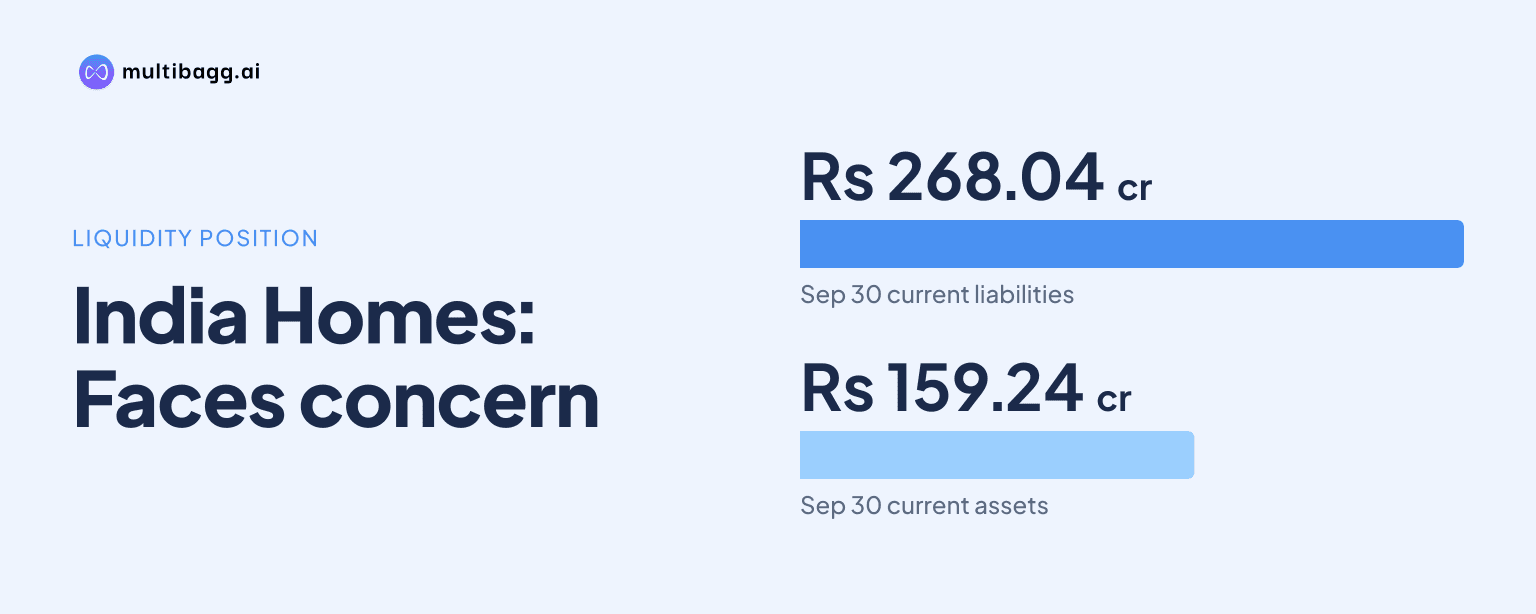
India Homes faces going-concern uncertainty at September 30, 2026, after current liabilities of Rs 268.0443 crore exceeded current assets of Rs 159.2351 crore, while operating activities had substantially ceased and sustained losses created acute liquidity constraints. The auditor also questioned evidence supporting management’s future cash-flow and viability plans.
Know India Homes inside out
Results, valuation, peers and who's buying, in one view.
What did the auditor say about India Homes’ going-concern basis?
The auditor said it could not determine whether India Homes’ use of the going-concern basis of accounting was appropriate for the quarter and half year ended September 30, 2026. It cited the excess of current liabilities over current assets, substantially ceased operating activities and continuous operating losses that impaired the company’s ability to discharge liabilities in the ordinary course of business.
India Homes’ management performed a going-concern assessment and explained future cash-flow projections and operational viability to the auditor. However, the review report dated November 4, 2026 said sufficient appropriate audit evidence supporting those plans was unavailable, preventing the auditor from assessing consequential effects on the carrying amounts and classification of assets and liabilities.
The report was issued under Regulation 33 of the Securities and Exchange Board of India, or SEBI, Listing Obligations and Disclosure Requirements Regulations, 2015. It described the engagement as a limited review under Standard on Review Engagements 2410, which provides moderate assurance and is less extensive than an audit.
How did India Homes’ current asset and liability position change?
India Homes’ reported current position moved from a surplus at March 31, 2026 to a deficit at September 30, 2026. Current assets fell by Rs 0.2043 crore to Rs 159.2351 crore, while current liabilities increased by Rs 174.6701 crore to Rs 268.0443 crore, producing a current-liability excess of Rs 108.8092 crore.
This balance-sheet change provides a quantified context for the auditor’s September 30, 2026 liquidity warning. India Homes operates in one reportable segment, real estate activities, but its results note that project operations had yet to commence, consistent with the auditor’s statement that operating activities had substantially ceased.
What debt and settlement pressures did India Homes disclose?
India Homes reported total financial indebtedness of Rs 88.8687 crore, including short-term and long-term debt, in its default disclosure. Of this, Rs 24.6828 crore in one reported debt category and Rs 64.1859 crore in unlisted debt securities were each reported as outstanding and in default; the unlisted debt category was Rs 39.5031 crore larger than the first category.
A Rs 32.3005 crore loan originally due to Dombivli Nagari Sahakari Bank Limited had been assigned to J.C. Flowers Asset Reconstruction Private Limited. India Homes agreed to settle the liability for Rs 25 crore, subject to agreement conditions including payment by July 31, 2026, but the auditor said that payment had not been made as of its November 4, 2026 report.
India Homes recognised the Rs 7.3005 crore difference between the assigned liability and agreed settlement amount as exceptional income. The auditor said the conditions for recognising that gain had not been fulfilled because the stipulated payment was outstanding, and said exceptional income and profit before tax were overstated by Rs 7.3005 crore while borrowings or financial liabilities were understated by the same amount.
Got a follow-up? Ask IRIS
Why did the auditor question India Homes’ inventory valuation?
The auditor said India Homes had inventories of Rs 13.68968 crore that were not valued at the lower of cost and net realisable value, or NRV, as required by Indian Accounting Standard 2, or Ind AS 2. Restrictions on management access to physical stock prevented comprehensive verification, systematic identification of obsolete or non-moving stock, and formal NRV assessments.
Management records indicated that work-in-progress, or WIP, of Rs 10.60241 crore and raw materials of Rs 1.86767 crore appeared realisable primarily at scrap values. The auditor also lacked quantitative stock registers, cost-allocation sheets, ageing analyses and supporting records for finished goods, stock-in-trade and stores and spares of Rs 1.2196 crore.
India Homes’ September 2026 exceptional items also included a Rs 7.04 crore gain from settlements with operational creditors and Rs 64.84 lakh of excess expenses incurred on full and final settlements. The auditor’s specific settlement-gain concern, however, related to the Rs 7.3005 crore gain on the assigned bank loan rather than the operational-creditor settlements.
What other balances and evidence did the auditor question?
India Homes recorded insurance-claim receivables of Rs 11.2027 crore as non-current assets and Rs 16.7279 crore as current assets at September 30, 2026. The auditor said these claims remained outstanding without formal approval, adjudication or admittance by insurance underwriters or relevant authorities, leaving their recoverability unverified.
India Homes also recognised Rs 1.67 crore of WIP acquired from a director under current assets. The auditor said the documentation supplied indicated that the amount substantially comprised accumulated indirect overheads and administrative expenses from earlier periods, rather than an independently identifiable tangible asset, and did not provide independently verifiable support for its recoverability, future economic benefit or legal basis for capitalisation.
The auditor further said India Homes had not performed impairment assessments required by Ind AS 36 for property, plant and equipment, investments, financial assets and other non-financial assets as at September 30, 2026. It also cited unavailable evidence for legal claims, litigation, statutory liabilities and contingent obligations, as well as absent balance confirmations for trade balances, loans, advances and customer advances.
India Homes said its factory premises were in the possession of J.C. Flowers Asset Reconstruction Private Limited after Dombivli Nagari Sahakari Bank Limited assigned debt to the asset reconstruction company. The possession arrangement is relevant to the inventory finding because the auditor linked restricted physical-stock access to the absence of comprehensive inventory verification.
Conclusion
India Homes’ September 30, 2026 filing combines a Rs 108.8092 crore current-liability excess, substantially ceased activities, reported debt defaults and unresolved evidence gaps affecting inventory, insurance claims, WIP and impairment. The auditor’s inability to obtain adequate support for management’s projections means the appropriateness of the going-concern basis and the carrying values of several reported balances remain unresolved.
The next disclosed matters to watch are whether India Homes pays, extends or renegotiates the Rs 25 crore settlement with J.C. Flowers Asset Reconstruction Private Limited after the July 31, 2026 deadline, and whether the Rs 7.3005 crore gain is adjusted. Further disclosures on stock access, NRV assessments, insurance-claim outcomes, impairment testing and management’s cash-flow plans would address the evidence gaps identified in the November 4, 2026 review report.