










India Pesticides Limited H1 profit falls 38% as margins contract
Key highlights
- IPL’s H1 FY27 PAT fell 38.1% year on year to Rs 41 crore.
- H1 FY27 total income declined 15.9% to Rs 487 crore, while EBITDA fell 32.5% to Rs 73 crore.
- IPL’s H1 FY27 gross margin rose to 50.0% from 44.7%, but EBITDA margin fell to 14.9% from 18.6%.
- Q2 FY27 revenue was split 51% Technicals plus APIs and 49% formulations.
powered by IRIS
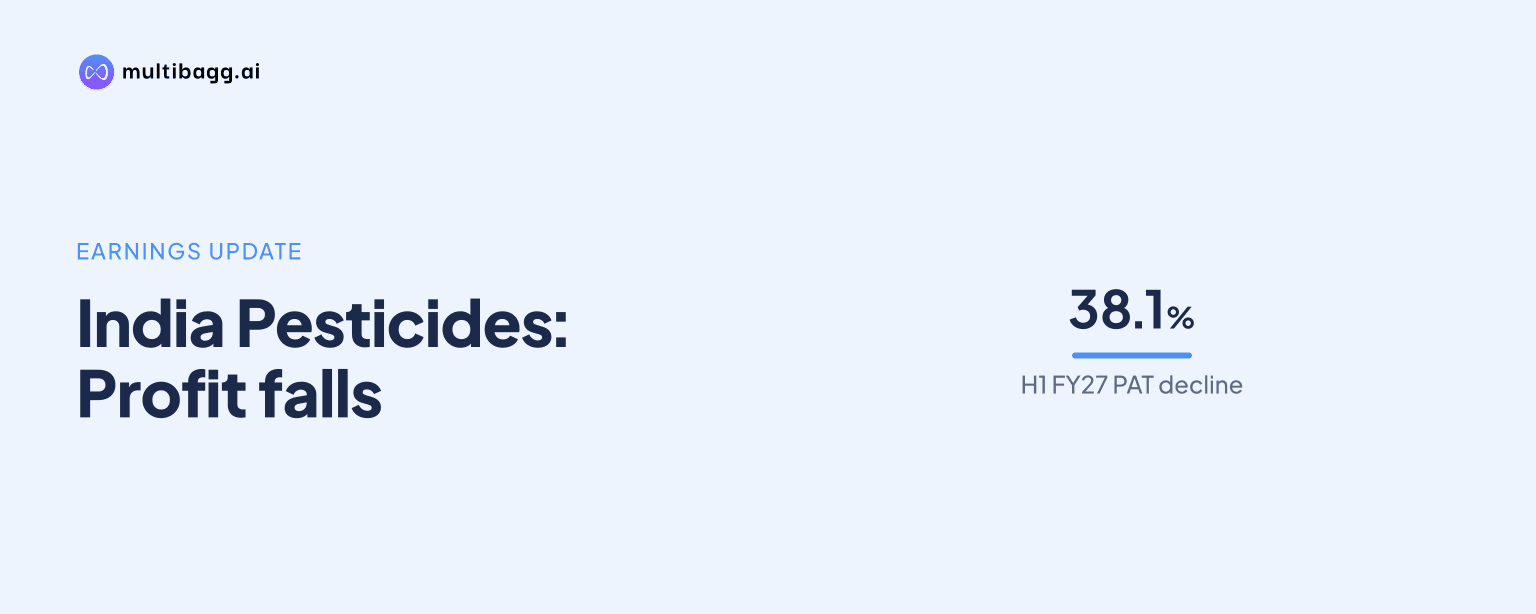
India Pesticides Limited reported H1 FY27 profit after tax of Rs 41 crore, down 38.1% year on year, as total income declined 15.9% to Rs 487 crore and EBITDA margin narrowed to 14.9% from 18.6%, despite gross margin increasing to 50.0% from 44.7%.
Know India Pesticides inside out
Results, valuation, peers and who's buying, in one view.
Why did IPL’s H1 FY27 profit fall?
IPL’s H1 FY27 profit fell because lower income and a lower operating margin outweighed the gain in gross margin. Profit after tax, or PAT, declined to Rs 41 crore from Rs 67 crore in H1 FY26, while earnings before interest, tax, depreciation and amortisation, or EBITDA, fell 32.5% to Rs 73 crore from Rs 108 crore.
Total income declined by Rs 92 crore to Rs 487 crore in H1 FY27 from Rs 579 crore a year earlier. Gross profit fell by a smaller Rs 15 crore to Rs 244 crore from Rs 259 crore, lifting gross margin by 5.3 percentage points to 50.0%. However, EBITDA margin decreased by 3.7 percentage points to 14.9%, limiting the benefit of the higher gross-profit ratio.
The decline extended below EBITDA. Earnings before interest and tax, or EBIT, fell 37.4% to Rs 61 crore from Rs 97 crore, and EBIT margin narrowed to 12.5% from 16.8%. PAT margin decreased to 8.5% from 11.5%, while earnings per share fell 38.2% to Rs 3.57 from Rs 5.78.
How did higher gross margin fail to support IPL earnings?
IPL said lower sales, higher employee expenses and volatility in key raw-material prices weighed on profitability despite the higher H1 FY27 gross margin. EBITDA decreased by Rs 35 crore, more than twice the Rs 15 crore reduction in gross profit, showing that the margin improvement at the gross-profit level did not carry through to operating profit.
For every Rs 100 of H1 FY27 total income, IPL reported Rs 50.0 of gross profit, compared with Rs 44.7 in H1 FY26. EBITDA per Rs 100 of income nevertheless declined to Rs 14.9 from Rs 18.6, while PAT per Rs 100 declined to Rs 8.5 from Rs 11.5. The gap between the gross-margin and EBITDA-margin movements is consistent with the cost pressures identified by management.
Management described Q2 FY27 as a challenging period marked by geopolitical uncertainty, softer overseas demand and raw-material-price volatility. It also cited deficient and erratic rainfall in several agricultural states, which disrupted cropping cycles and reduced herbicide application. Q2 FY27 total income was Rs 231 crore, down 21.6% from Rs 295 crore in Q2 FY26.
Got a follow-up? Ask IRIS
What changed in IPL’s second quarter and revenue mix?
IPL’s Q2 FY27 income declined both year on year and sequentially, while Technicals plus active pharmaceutical ingredients, or APIs, accounted for 51% of revenue. Total income of Rs 231 crore was lower than Rs 295 crore in Q2 FY26 and Rs 256 crore in Q1 FY27; formulations represented the remaining 49% of Q2 revenue.
The quarter had a domestic majority, with domestic revenue contributing 62% and exports contributing 38%. IPL reported Rs 115 crore of Q2 FY27 revenue from Technicals plus APIs and Rs 111 crore from formulations. These separately disclosed revenue categories do not exactly match the Rs 231 crore total-income figure in the presentation.
Q2 profitability declined faster than income. Gross profit fell 11.2% year on year to Rs 117 crore, while EBITDA fell 38.0% to Rs 33 crore and PAT fell 41.7% to Rs 18 crore. Gross margin rose to 50.5% from 44.6%, but EBITDA margin declined to 14.4% from 18.2% and PAT margin declined to 8.0% from 10.7%.
Sequentially, Q2 FY27 EBITDA was Rs 33 crore against Rs 39 crore in Q1 FY27, and the EBITDA margin declined to 14.4% from 15.4%. PAT fell to Rs 18 crore from Rs 23 crore, with PAT margin reducing to 8.0% from 8.9%. Management said it had secured a good export order for the coming quarter, without disclosing its value or delivery timing.
What operating and expansion markers did IPL disclose?
IPL reported H1 FY27 export turnover of Rs 177 crore, cash flow from operations of Rs 48 crore and debt-to-equity of 0.1 times. Its H1 FY27 snapshot also showed return on capital employed of 13.1% and return on equity of 7.9%, alongside total income of Rs 487 crore.
Customer concentration increased in the first half. The top 10 customers contributed 48% of H1 FY27 revenue, compared with 40% in FY26 and 43% in FY25. IPL said it has relationships with more than 60 international customers and is focused on broadening its customer base and reducing revenue concentration.
At Hamirpur, two of 10 blocks were operational as of September 30, 2026, providing 600 metric tonnes per annum, or MTPA, of Technicals capacity and 1,000 MTPA of formulations capacity. IPL plans to make two additional blocks operational in FY2027. The site has permitted capacity of 30,000 MTPA for Technicals and 6,000 MTPA for formulations.
Across Dewa Road, Sandila and Hamirpur, IPL reported capacity of 28,800 MTPA for Technicals and 11,000 MTPA for formulations as of September 30, 2026. During Q2 FY27, it received Technical Equivalence approval for an insecticide in the United Kingdom and herbicide registration in Argentina. Management said these approvals support customer engagement and product commercialisation in additional geographies.
Conclusion
IPL’s first-half figures show that a 5.3-percentage-point increase in gross margin did not offset the effect of Rs 92 crore lower income and the reduction in operating profitability. Gross profit declined 5.8%, while EBITDA declined 32.5% and PAT declined 38.1%, indicating that the pressure was concentrated beyond the gross-profit line.
The next disclosed markers are execution of the export order for the coming quarter and the planned commissioning of two more Hamirpur blocks in FY2027. Management is also pursuing regulated-market registrations, process optimisation and backward integration, but the presentation gives no revenue target or timetable for contributions from the United Kingdom and Argentina approvals.