










India Pesticides retains Hamirpur expansion amid product review
Key highlights
- India Pesticides has two of 10 planned Hamirpur blocks operating and expects two more blocks early next year.
- Hamirpur has permitted capacity of 30,000 metric tons of technicals and 6,000 metric tons of formulations.
- More than 65% of India Pesticides’ raw materials are sourced in India, while about 20% are sourced from China.
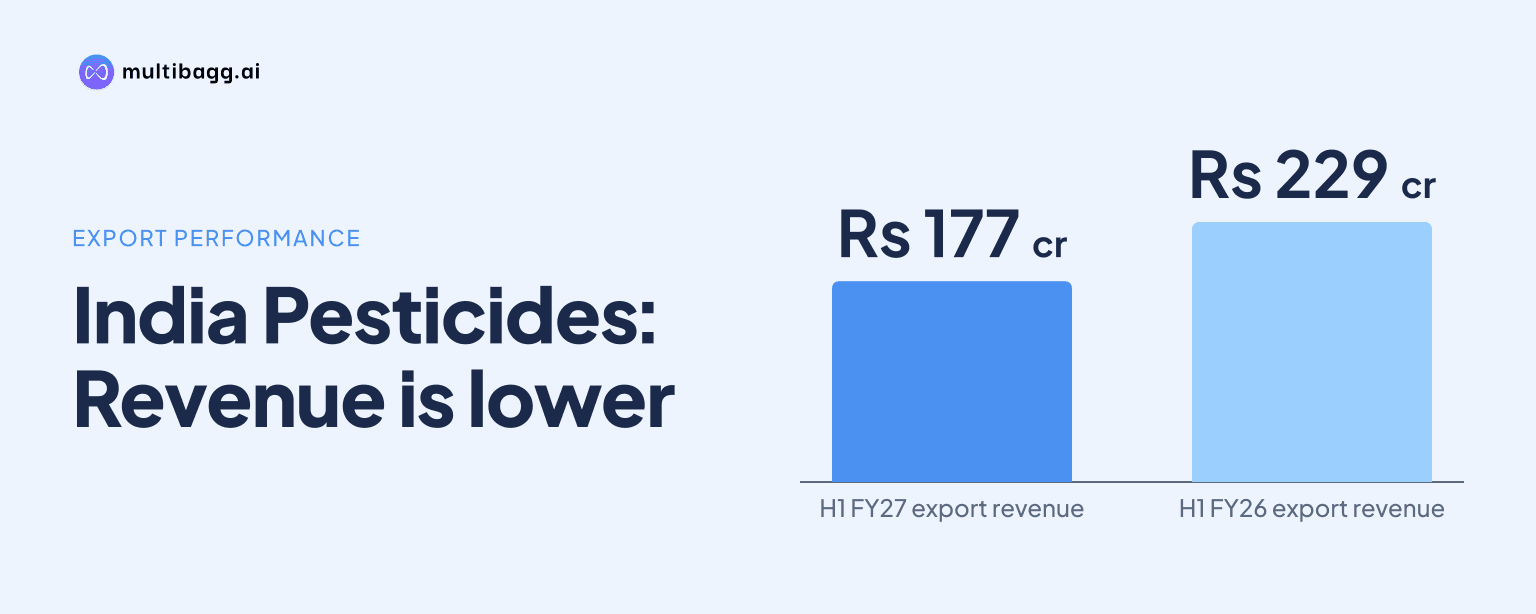
- H1 FY27 export revenue was Rs 177 crore, compared with Rs 229 crore in H1 FY26.
powered by IRIS
India Pesticides Limited is retaining Hamirpur’s permitted 30,000-metric-ton technicals expansion while reviewing its product portfolio for supply-chain conditions, with two of 10 planned blocks operating and two more expected early next year. Management disclosed the review during its November 5, 2026 Q2 and H1 FY27 earnings call.
Know India Pesticides inside out
Results, valuation, peers and who's buying, in one view.
Why is India Pesticides reviewing the Hamirpur product portfolio?
India Pesticides is reviewing Hamirpur’s product portfolio because geopolitical conditions, supply-chain disruptions, raw-material volatility and freight-cost increases have altered the operating environment. Management said it needed to revisit the complete portfolio, especially for new products, while describing the physical project as progressing according to its earlier plan.
The company did not name products that may be added, removed or rescheduled, nor did it disclose a revised volume or revenue target for the mix. The call therefore supports a portfolio reassessment rather than a disclosed change to Hamirpur’s permitted capacity of 30,000 metric tons of technicals and 6,000 metric tons of formulations.
Raw-material sourcing is one reason for the flexibility. More than 65% of India Pesticides’ raw materials are sourced in India, about 20% from China and the remainder from other countries. Management cited erratic input prices, supply-chain issues and sudden freight increases as recent challenges affecting manufacturing economics.
Demand conditions also provide context for the review. H1 FY27 export revenue declined to Rs 177 crore from Rs 229 crore in H1 FY26 as overseas herbicide demand remained softer. In India, deficient and erratic rainfall disrupted agricultural activity and reduced herbicide application across several crop-growing regions.
What Hamirpur capacity is operating and what comes next?
India Pesticides has two of 10 planned Hamirpur blocks in operation and expects two further blocks to become operational early next year. Roads, boilers and chillers have already been installed as central infrastructure, enabling the company to commission the plant in phases.
The two operating blocks account for 20% of the planned 10-block facility. Management said the remaining blocks would be brought into operation gradually in the coming year, but it did not provide commissioning dates for each of the six blocks beyond the next two expected to start.
Hamirpur adds to manufacturing sites at Dewa Road and Sandila, which have installed capacity of 28,300 metric tons of technicals and 10,200 metric tons of formulations. Hamirpur’s permitted technicals capacity exceeds the existing technicals base, while its formulations capacity is lower than the installed formulations capacity at the other two sites.
Got a follow-up? Ask IRIS
How does backward integration shape India Pesticides’ choices?
India Pesticides is using backward integration to reduce imported-intermediate dependence as it reviews Hamirpur’s product slate. Management said almost 75% of its products are backward integrated, reflecting its effort to manufacture products from a basic stage and make intermediates that were previously imported.
Management cited an intermediate for the herbicide Pretilachlor as an example. India Pesticides has begun domestic production of that intermediate, and management said its import had more or less totally stopped. The company has also developed backward-integrated intermediate production for two more molecules, without naming them or disclosing their output.
The disclosed benefit is operational rather than a quantified financial outcome. Management said its intermediate plant supports supply reliability and cost competitiveness at a time of geopolitical uncertainty, but it did not quantify cost savings from the Pretilachlor project or forecast a margin contribution from Hamirpur.
India Pesticides supports this work through two Department of Scientific and Industrial Research-recognised research and development centres with 25 scientists. Their work includes developing molecules and intermediates, improving yields and optimising raw-material consumption, while the engineering team takes processes from laboratory development through pilot testing and commercial production.
What does the review mean for India Pesticides’ FY27 performance?
India Pesticides did not issue revised FY27 guidance, although management said it aims to maintain revenue achieved last year despite difficult conditions. Q2 FY27 revenue was Rs 231 crore, down 22% from Rs 295 crore in Q2 FY26, while earnings before interest, tax, depreciation and amortisation fell to Rs 33 crore from Rs 54 crore.
For H1 FY27, revenue declined 15.9% to Rs 487 crore from Rs 579 crore in H1 FY26. Profit after tax was Rs 41 crore, compared with Rs 67 crore a year earlier, while the earnings before interest, tax, depreciation and amortisation margin declined to 14.9% from 18.6%.
Q2 FY27 revenue from technicals and active pharmaceutical ingredients was Rs 115 crore, compared with Rs 111 crore from formulations. Management attributed the lower quarterly margin partly to higher employee expenses and lower foreign-exchange income, alongside the demand and input backdrop described on the call.
Management said it had received orders for the current and next quarter covering existing molecules in technical-grade material and bulk formulations. It identified water-dispersible granules and emulsifiable concentrates among the formulations and said bulk formulations provide somewhat more margin overall, although no order value was disclosed.
The company also received technical-equivalence approval for an insecticide in the United Kingdom and registration for a herbicide in Argentina during the quarter. These followed a European Union approval in the previous quarter, and management said they create opportunities for additional market access without providing a revenue contribution estimate.
Conclusion
India Pesticides is retaining Hamirpur’s phased capacity plan while reconsidering which products best fit a period of volatile input costs, supply-chain disruption and softer export demand. The project’s two operating blocks, shared infrastructure and 30,000-metric-ton technicals permission show that the expansion remains part of the manufacturing strategy rather than a project placed on hold.
The next disclosed milestones are the expected start-up of two further Hamirpur blocks early next year and execution of export orders received for the current and following quarter. Management’s aim to recover the H1 FY27 shortfall over the remaining six months, along with any future disclosure of Hamirpur product selections, will clarify the commercial effect of the portfolio review.