










India Pesticides Limited lowers FY27 subsidiary capex plan
Key highlights
- India Pesticides reduced FY27 subsidiary capex to Rs 80-90 crore from Rs 120-130 crore.
- India Pesticides' separate Rs 40-45 crore capex guidance remains on track.
- About Rs 65 crore of subsidiary assets were capitalised in September and are under stabilisation.
- India Pesticides reported about Rs 100 crore of export orders from Europe and Australia.
powered by IRIS
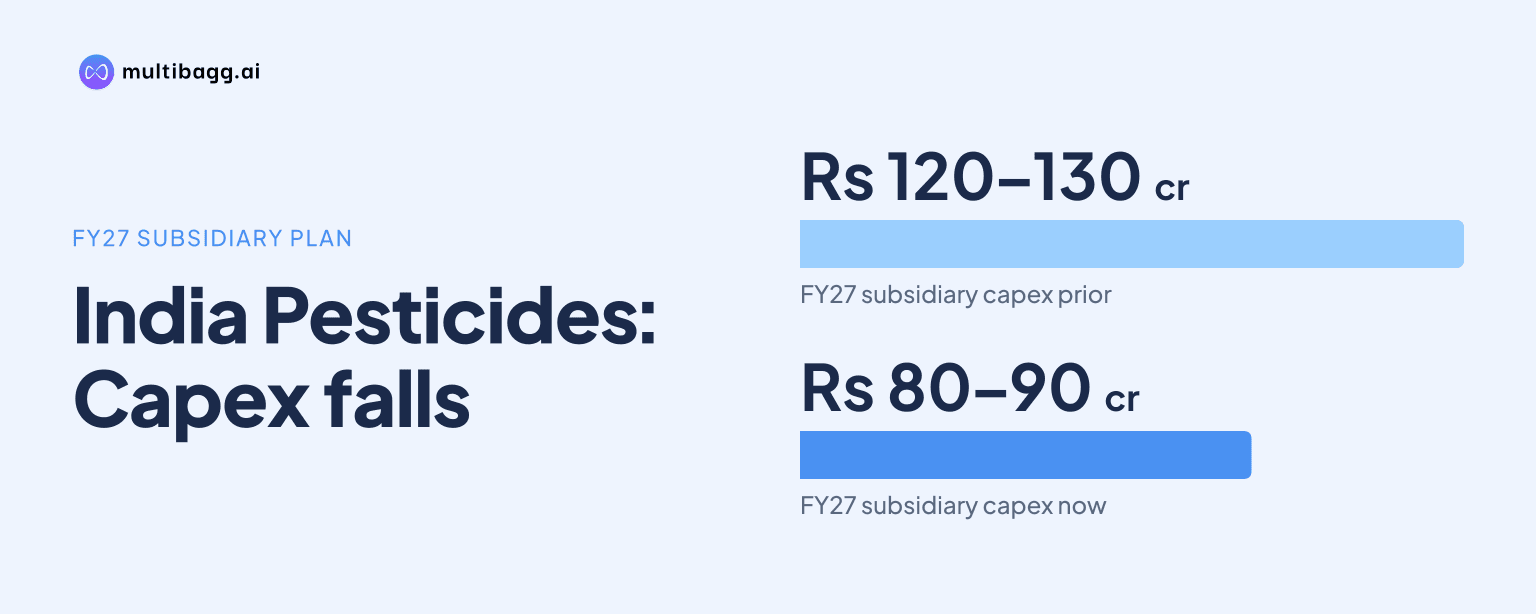
India Pesticides Limited reduced its FY27 subsidiary capital-expenditure plan to Rs 80 crore to Rs 90 crore from Rs 120 crore to Rs 130 crore, as management revisits the second expansion phase and planned product portfolio. The company said the expansion process remains in place and spending could step up next year.
Know India Pesticides inside out
Results, valuation, peers and who's buying, in one view.
Why did India Pesticides reduce its FY27 subsidiary capex?
India Pesticides reduced the subsidiary’s FY27 capex because management is reassessing the second phase rather than abandoning expansion. S.P. Gupta said the company had projected Rs 80 crore to Rs 90 crore for the subsidiary and was revisiting phase two, with funding to be deployed as the need arises. When an analyst asked whether spending would therefore fall below the previous Rs 120 crore to Rs 130 crore range, Gupta confirmed the Rs 80 crore to Rs 90 crore range.
Management linked the portfolio review to changing operating conditions rather than to an approval bottleneck. D.K. Jain said geopolitical developments had made some raw materials harder to obtain, caused price fluctuations and changed demand patterns. India Pesticides is therefore reassessing the complete product portfolio planned particularly for the subsidiary, while keeping its expansion process in place.
The revision moderates the current subsidiary spending plan but does not mean the facility will be left idle. Jain said the plant can accommodate the originally planned products if demand returns because it has flexibility to adapt to different products. The company is selecting alternatives from its existing product basket, rather than describing a move into entirely new products that would require a new development programme.
How much capex does India Pesticides now plan for FY27?
India Pesticides now plans Rs 80 crore to Rs 90 crore of FY27 capex for its subsidiary, while its separate capex guidance of Rs 40 crore to Rs 45 crore remains on track. The revised subsidiary range is Rs 40 crore below the earlier range at both the lower and upper ends. Management did not state a revised combined capex total for India Pesticides and the subsidiary.
The difference between the two lines matters because management discussed them separately. Gupta identified Rs 40 crore to Rs 45 crore as capex guidance for India Pesticides and Rs 80 crore to Rs 90 crore as the subsidiary projection under review. The lower Rs 80 crore to Rs 90 crore figure therefore does not replace the company’s stated Rs 40 crore to Rs 45 crore plan.
The company also disclosed that some earlier investment has entered operations. In September, subsidiary blocks worth about Rs 65 crore were capitalised after becoming operational and were in a stabilisation stage. Management expects those blocks to generate additional subsidiary turnover of about Rs 40 crore to Rs 50 crore during the second half of the current year.
Got a follow-up? Ask IRIS
What does the portfolio review mean for the subsidiary plant?
The portfolio review means India Pesticides may manufacture a different approved product at the subsidiary plant when market conditions favour it. Jain described the choice as substituting product B for product A where product B has a better opportunity, rather than introducing completely new products. He said the company already has a good number of approved products from which it can select.
Management said the change should not require a materially different approval process because the products under consideration are from the existing approved basket. This is separate from India Pesticides’ regulated-market registration programme, under which it recently obtained registrations in the United Kingdom and Argentina. The company has also filed four products for equivalent registrations in Europe, while data generation is under way for another four products.
The manufacturing configuration is central to the reassessment. Jain said the plants are multipurpose and can accommodate both the earlier and revised product choices with very minor changes. He also said demand for the original product could return within six months, in which case it could be accommodated in the same plant.
The registration programme could broaden the markets available to the company’s product basket. Management said the eight-product stream under filed or preparatory registration work could be directed to countries including Australia, Europe, Brazil and Canada. Jain said the purpose was to increase geographical reach and attract new customers, although the call gave no revenue target for those registrations.
When could India Pesticides increase capex again?
Management said India Pesticides’ capex could step up again next year, but it did not provide a rupee target or timetable for restarting the subsidiary’s second phase. Jain told the analyst that spending would increase next year, while Gupta had said the company would fund the second phase as needs arise. The disclosed plan establishes the direction of spending but not the size of a next-year outlay.
The company provided a revenue target for part of the assets already capitalised. Gupta said that, after excluding infrastructure cost, incremental capex would be about Rs 40 crore and management was targeting an asset turnover of 2 next year. On that basis, it expects at least Rs 80 crore of additional revenue next year from the incremental investment.
Near-term demand and utilisation are also relevant to the spending decision. India Pesticides said it had export orders of about Rs 100 crore from Europe and Australia, with some already executed and the remainder due in coming months. Management also said it was aiming for second-half revenue similar to, or slightly higher than, the prior year’s second half after seeking to partly recover the first-half shortfall.
Inventory is another operating measure management expects to improve before the fiscal year closes. Some export orders expected in the second quarter were deferred to the third quarter, while the company received inquiries for a rice herbicide that had lower sales in the first quarter. Management said it was hopeful that inventory would normalise by the fourth quarter of the current year.
Conclusion
India Pesticides has reduced the subsidiary capex range by Rs 40 crore at each end while retaining its separate Rs 40 crore to Rs 45 crore company-level guidance. The decision reflects a revision of product choices in response to raw-material availability, prices and demand patterns, while management continues to describe the expansion process as active.
The next points to watch are whether the Rs 65 crore of subsidiary assets capitalised in September delivers the indicated Rs 40 crore to Rs 50 crore of second-half turnover, and whether the company reaches its target of at least Rs 80 crore of additional revenue next year from about Rs 40 crore of incremental capex. Management’s indicated next-year capex step-up remains tied to needs and the progress of the revised second phase.