










Indian equity market outperforms Asia as Nifty gains 6.9%
Key highlights
- The NSE Nifty 50 Index gained about 6.9% so far this week, while the Nasdaq 100 Index fell 6.2%.
- The Nifty 50 rose as much as 1.2% on Friday as other major Asian markets traded in the red.
- The Nifty 50 gained nearly 9% over the last month amid rotation away from AI-linked markets.
- The Nifty IT sector gauge was nearing a 20% gain since the start of October.
powered by IRIS
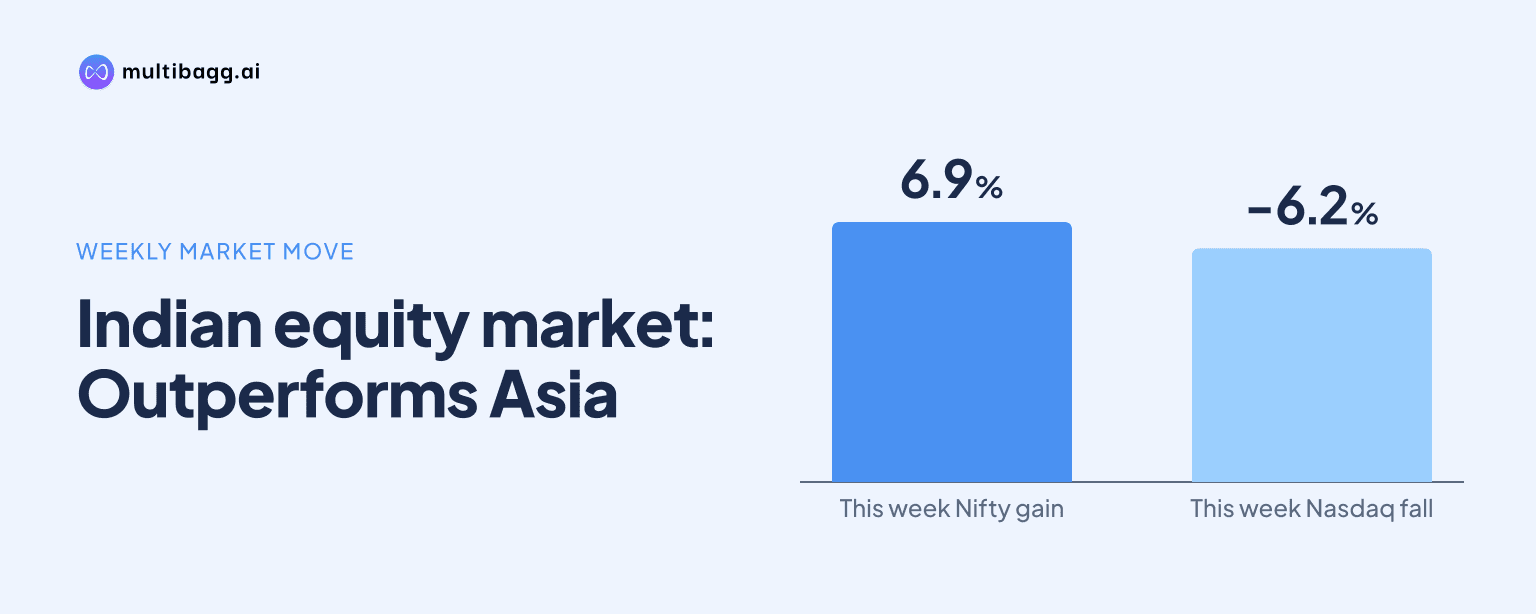
The Indian equity market outperformed Asian peers as the NSE Nifty 50 Index gained about 6.9% so far this week, while the Nasdaq 100 Index fell 6.2% amid an unwind in artificial-intelligence-linked trades. India benefited from lower AI exposure, returning global funds, falling oil prices and a better earnings outlook.
Why are Indian equities outperforming Asian markets?
India is outperforming because investors are reducing exposure to technology-heavy markets with greater links to the artificial intelligence trade. Concerns over a possible slowdown in AI-related investment and data-centre spending triggered a sharp selloff in US technology stocks, which flowed into other AI-exposed Asian markets.
India had been among Asia's weaker markets earlier because of its relatively low exposure to the AI rally. That same positioning has become supportive as global portfolios rotate away from crowded AI-linked investments. The Nifty 50 rose as much as 1.2% on Friday while other major Asian markets were in the red, putting domestic equities on course for their strongest weekly performance in more than five years.
What is driving the rotation into India?
The rotation into India reflects a combination of lower AI exposure, overseas buying, cheaper oil and an improving corporate earnings outlook. Global funds have returned as investors reassess markets that can offer diversification from North Asian technology shares and US AI names.
The market's domestic demand story has also been cited as an advantage over other relatively less AI-exposed markets. Charlie Hong, founder and chief investment officer at LOGOS Asset Management, said India has a very high possibility of outperforming other Asian markets in the short term. He added that medium-term outperformance will depend on whether earnings continue to recover.
How important are earnings and foreign flows for India?
Earnings recovery and renewed foreign institutional investor buying are central to India's relative resilience. Better-than-expected July-September quarter earnings have added momentum, while improving macroeconomic prospects and the move away from AI-linked stocks have encouraged foreign investors to turn net buyers.
Lower global oil prices and a drop in US Treasury yields have also supported the case for India. These factors have helped narrow year-to-date losses in Indian equities. Goldman Sachs attributed the recent recovery partly to global portfolio rotation away from North Asian markets, where exposure to AI-linked stocks is greater.
Got a follow-up? Ask IRIS
Can India remain insulated from a global technology selloff?
India may remain relatively resilient, but it is not insulated from broader global risk aversion. Hariselvan Radhakrishnan of HST Wealth said immediate pressure could be concentrated in IT and other globally sensitive shares, while prolonged global deleveraging could eventually affect domestic sectors through foreign selling.
There are already signs that market performance can be uneven. Midcap and smallcap indices fell as much as 2% amid rising crude oil prices, inflation concerns and the global technology selloff. Stable crude prices, contained foreign selling and Bank Nifty maintaining its recent breakout were identified as factors that could limit downside pressure, but near-term weakness cannot be ruled out.
What does the AI trade reversal mean for Indian IT stocks?
India's IT shares have emerged among the relative winners during the AI-driven market retreat. The Nifty IT sector gauge is nearing a 20% gain since the start of October, despite the sector having earlier lost close to $150 billion in market value as investors questioned how companies would respond to AI disruption.
According to the reported discussion, IT companies have focused on reducing costs, preparing their workforce for AI and partnering with major AI players rather than attempting to compete through heavy resource spending. This positioning has helped support the sector as investors reassess the effects of a deceleration in the global AI trade.
Conclusion
India's outperformance reflects a reversal in market leadership rather than immunity from global volatility. Its lower exposure to the AI trade, improving earnings picture, foreign inflows, domestic-demand support and lower oil prices have made it a relative destination while technology-heavy markets face selling pressure.
The next test is whether corporate earnings keep recovering, as highlighted by LOGOS Asset Management's Charlie Hong. Investors will also watch foreign flows, oil prices and the depth of the global technology selloff, particularly for its potential effect on Indian IT and other globally sensitive sectors.