










Nifty 50's 8.78% monthly rise masks uneven market breadth
Key highlights
- Nifty 50 rose 8.78% over one month, compared with a 5.7% gain in Nifty 500.
- Nifty 50 closed at 24,536.60 on 5 November, up 6.44% from the 30 October close.
- 2,116 of 2,623 NSE main-board stocks rose through 5 November, while 499 fell.
- 447 Nifty 500 stocks rose through 5 November, and the median stock gained 5.9%.
powered by IRIS
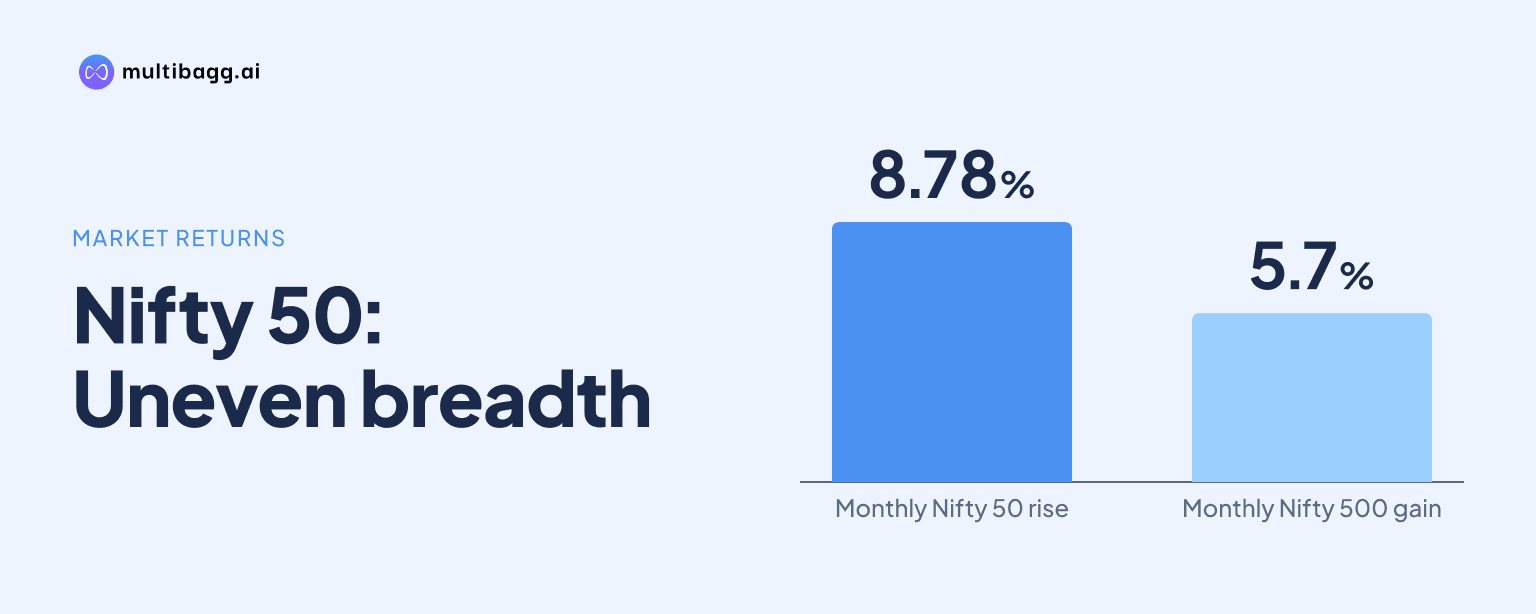
Nifty 50 rose 8.78% over the past month, while the Nifty 500 gained 5.7%, showing that the benchmark's advance was stronger than the broader large-, mid- and small-cap universe measured by the wider index. The available data also shows breadth changed sharply across periods, with a broad November rally through 5 November.
Why did Nifty 50 outperform the broader market over one month?
Nifty 50 outperformed because its 8.78% one-month return was 3.08 percentage points above the Nifty 500's 5.7% return in the supplied market data. That gap indicates that the 50-stock benchmark delivered a stronger aggregate move than the wider 500-stock index over the same stated period.
The contrast matters because an index does not measure every listed share equally. Nifty 50 reflects the performance of its largest constituents, whereas breadth measures how many shares are participating in a move. The social-media discussion around a sharp index gain alongside weak breadth therefore points to a familiar market question: whether gains are concentrated in a smaller set of influential stocks or shared more widely.
What does the November advance-decline data show?
The November data through the NSE close on 5 November shows broad participation, with 2,116 of 2,623 NSE main-board stocks rising and 499 falling over four sessions. Within the Nifty 500, 447 stocks rose and 50 declined, while the median Nifty 500 stock gained 5.9%.
These readings differ from a claim that a majority of NSE shares fell during the same measurement window. The supplied context does not provide a dated, like-for-like calculation showing 61% of NSE stocks declining over the one-month period. It instead includes multiple breadth series with different universes and time frames, so they should not be treated as interchangeable.
On 5 November alone, 361 of the Nifty 500's 500 stocks advanced and 139 declined. The Nifty 50 had 39 advances and 11 declines that day. That session-level breadth supports the view that buying was widespread at the close, even though one-month index returns still show Nifty 50 ahead of Nifty 500.
Why can index returns and market breadth tell different stories?
Index returns and market breadth can diverge because they answer different questions: Nifty 50 tracks the price movement of benchmark constituents, while breadth counts the number of stocks rising or falling. A strong index can coexist with weak participation if gains are concentrated, and a broad rally can occur without the benchmark posting the largest return.
The breadth source in the discussion says it uses the 1,000 most-traded NSE stocks each month and counts them equally. It is therefore designed to reflect mid-sized and smaller companies more than a large-cap benchmark. Its own explanation notes that the two can disagree for months, and that the disagreement can itself be informative.
One reading in the supplied context showed 3,720 advances and 2,537 declines, but it was presented alongside a description of a broader historical breadth page rather than a clearly matched one-month calculation. Investors should first establish the stock universe, the observation date and whether the figure is a daily, weekly or monthly comparison before drawing a conclusion about participation.
Got a follow-up? Ask IRIS
Which sectors and stocks shaped the recent market move?
Recent trading commentary identified renewed foreign investor buying, stronger corporate earnings, attractive valuations and lower crude prices as factors supporting sentiment. On a reported positive session, Nifty Realty rose 2%, while Nifty FMCG and Nifty Consumer Durables gained more than 1%; Nifty IT moved lower.
The Nifty 50's short-term advance was substantial. It stood at 24,536.60 as of the 5 November NSE close, up 1,483.50 points, or 6.44%, from the 30 October close. Nifty Next 50 rose 6.00% over that four-session period, Nifty 500 gained 6.07%, and Nifty Bank added 5.64%.
There were still pockets of weakness. Infosys was the largest Nifty 50 loser in November through 5 November, down 1.5%, followed by Power Grid Corporation of India at minus 1.4% and Apollo Hospitals Enterprise at minus 0.9%. In the Nifty 500, MTAR Technologies was down 16.1%, illustrating that a strong aggregate market reading did not eliminate stock-specific declines.
What should investors take from the breadth divergence?
Investors should treat the Nifty 50's 8.78% monthly gain and the Nifty 500's 5.7% gain as evidence of relative benchmark leadership, not as proof that every segment performed equally. The November four-session figures, however, show that the rally had broadened considerably by 5 November, with most main-board and Nifty 500 stocks advancing.
The key issue is consistency of measurement. A claim about the percentage of declining stocks needs to specify the relevant universe and exact period, particularly when comparing a 50-stock, market-cap-weighted index with an equal-count breadth measure covering up to 1,000 actively traded stocks. Without that alignment, apparently conflicting figures may simply describe different parts of the market.
Conclusion
Nifty 50's 8.78% one-month gain exceeded the Nifty 500's 5.7% return, signalling stronger performance by the benchmark than by the wider index. Yet the available November figures through 5 November show substantial participation, including 2,116 advances among 2,623 NSE main-board stocks and 447 advances in the Nifty 500.
Investors should watch whether this broad participation persists after the sharp four-session rise, particularly in the Nifty 500 and the 1,000-stock breadth measure. The next comparable daily and monthly advance-decline readings will clarify whether benchmark leadership is widening into a sustained broader-market move or becoming more selective again.