










NIFTY50 Index Nears 25,000 After 7.6% Six-Session Rebound
Key highlights
- NIFTY50 gained 1,743.35 points, or 7.6%, in six sessions to 24,442.20 on November 5.
- Bernstein cut its December 2026 NIFTY50 target to 25,000 from 26,000 and retained a neutral stance.
- NIFTY50's forward 12-month price-to-earnings multiple fell to 16.6 times, a nearly six-year low.
- Midcaps fell 5% and smallcaps declined 7% in October despite NIFTY50's recovery toward flat returns.
powered by IRIS
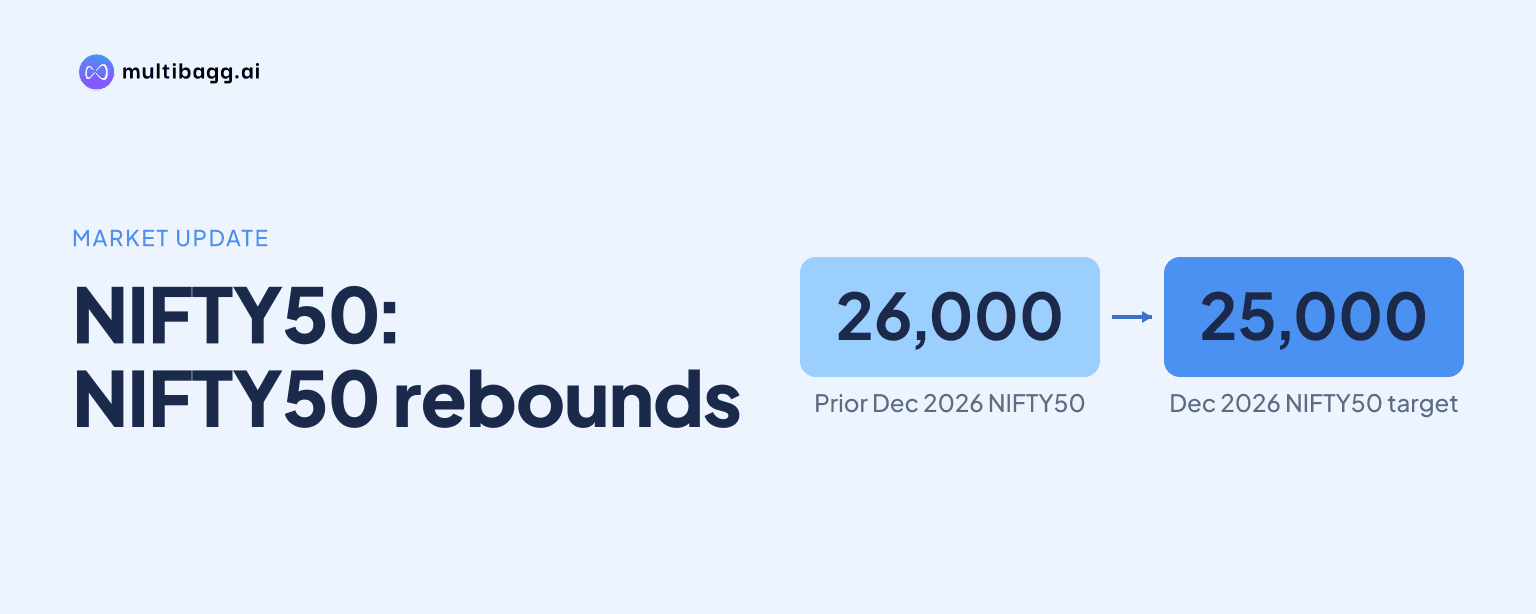
NIFTY50 index climbed 7.6%, or 1,743.35 points, across six consecutive sessions to a one-month high of 24,442.20 on November 5, bringing Bernstein's 25,000 December 2026 target into focus. The index has not yet reached 25,000, and the brokerage continues to see only limited scope for a sustained advance without better earnings growth.
How far has NIFTY50 recovered from its October low?
NIFTY50 has recovered sharply from its late-October closing level, rising from 22,698.85 on October 28 to 24,442.20 on November 5. The six-session gain followed an extended period of weakness, including eight straight weekly declines into early October, described as the index's longest weekly losing streak in 25 years.
The recent rise has improved the near-term market mood, but it does not erase the scale of the earlier retreat. NIFTY50 closed at 22,231.80 on October 8, its lowest close of the year, and was 15.6% below its January record at that point. The broader correction was a slow nine-month decline rather than a single sharp market fall.
Can NIFTY50 reach the 25,000 target?
NIFTY50 can reach 25,000 under Bernstein's base target, but the brokerage characterises the likely move as a modest recovery rather than the beginning of an earnings-led upcycle. Bernstein cut its December 2026 target to 25,000 from 26,000 and retained a neutral stance on Indian equities.
The target is based on an 18-times multiple of FY28 earnings and an assumed 9% earnings increase over FY27. Bernstein said the revised target implies about 8% upside from the level referenced in its assessment. Its view allows for mean reversion after the correction, but it does not assume that lower valuations alone can support a lasting rally.
Why are lower valuations not enough for a sustained rally?
NIFTY50's forward 12-month price-to-earnings multiple has fallen to 16.6 times, the lowest level in nearly six years, but Bernstein says Indian equities remain expensive relative to global peers. The brokerage expects valuation-led upside to remain constrained unless the earnings outlook improves or India's valuation premium narrows.
Bernstein estimates that a further 4-5% market rise could push the forward multiple closer to its recent average of 18.2 times. That would make valuations less comfortable without a corresponding improvement in corporate profit expectations. Weak earnings revisions are therefore central to the brokerage's cautious view, despite the market's recent rebound.
Got a follow-up? Ask IRIS
What market factors could support or interrupt the recovery?
Stable Brent crude prices, continued foreign institutional investor buying and wider participation across stocks could help NIFTY50 hold its recovery, according to HST Wealth founder and chief executive Hariselvan Radhakrishnan. A pullback in US Treasury yields has also been identified as supportive because lower yields have historically aided foreign inflows into Indian equities.
The risks are equally clear in the current discussion. Rising crude prices remain a cost concern for import-heavy India, while rupee pressure and inflation risks can weaken the macro backdrop. Renewed geopolitical uncertainty or a failure to defend the 24,000 level could lead to consolidation after the initial surge, Radhakrishnan said.
Why have midcaps and smallcaps lagged NIFTY50?
Midcap and smallcap shares remained under pressure even as NIFTY50 recovered to near-flat returns in October. Midcaps declined 5% in October and smallcaps fell 7%, indicating that the improvement in the benchmark did not translate evenly across the market.
That divergence matters because broader participation is one of the conditions cited for sustaining the NIFTY50 recovery. A benchmark rally led by a narrower group of stocks may be more vulnerable if foreign flows slow or global risk sentiment deteriorates. The available data therefore point to an improved index trend, but not yet to a fully broad-based market recovery.
Conclusion
NIFTY50's 7.6% gain in six sessions has taken the benchmark close to 25,000, but the available evidence supports caution over calling it a complete reversal after the prolonged decline. The index is recovering from depressed levels, while valuations have become cheaper, yet earnings revisions, crude prices and the rupee remain constraints.
The next markers are whether NIFTY50 can hold above 24,000, whether foreign investor buying continues and whether corporate earnings expectations improve. Bernstein's 25,000 December 2026 target rests on an 18-times FY28 earnings multiple and a 9% earnings increase over FY27, making earnings delivery the key unresolved factor.