










IndiGrid Infrastructure Trust says yields and tax drove NAV decline
Key highlights
- IndiGrid said about 50% of its Q2 FY27 NAV impact came from the risk-free rate rising to 7.2% from 6.8%.
- IndiGrid attributed about 25% to 30% of the NAV impact to changed SPV-level tax assumptions.
- IndiGrid reported Q2 FY27 NAV of about Rs 138.5 per unit and distribution of Rs 4.12 per unit.
- IndiGrid generated Rs 380 crore of NDCF in Q2 FY27, up 4.7% from Rs 363 crore a year earlier.
powered by IRIS
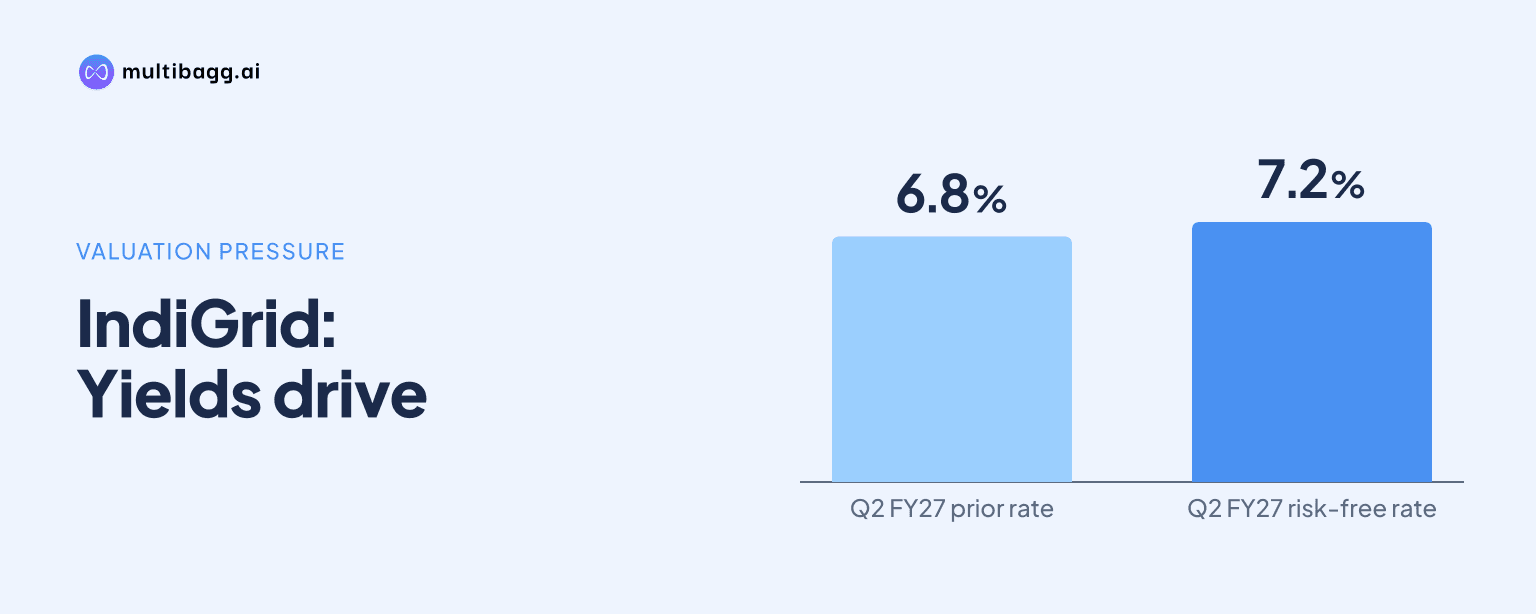
IndiGrid Infrastructure Trust said its Q2 FY27 net asset value (NAV) fell to about Rs 138.5 per unit chiefly because the risk-free rate rose to 7.2% from 6.8%; management estimated higher government-security yields caused about 50% of the impact and special purpose vehicle (SPV) tax changes another 25% to 30%.
Know IndiGrid Infrastructure Trust inside out
Results, valuation, peers and who's buying, in one view.
Why did IndiGrid's NAV decline in Q2 FY27?
IndiGrid's NAV declined principally because valuation inputs changed, rather than because management identified a broad deterioration in its operating portfolio. An analyst on the November 6, 2026 call referred to NAV moving from Rs 148 to Rs 138, while IndiGrid reported Q2 FY27 NAV of about Rs 138.5 per unit and cited the higher risk-free rate and a changed tax rate at SPV level.
The risk-free rate used in valuation increased by 40 basis points to 7.2% from 6.8%, based on the analyst's question. Harsh Shah said a rise in the government-security, or G-sec, rate reduces the fair value of assets, while a fall in that rate would lift NAV. He described this interest-rate effect as a market movement in the current value of assets, rather than underlying NAV growth.
How much did yields and tax changes affect IndiGrid's NAV?
IndiGrid said approximately 50% of the NAV reduction reflected the higher G-sec rate, and about 25% to 30% reflected the tax-rate change at SPV level. Management did not provide a rupee-per-unit allocation for either item, but said the two factors together represented roughly three quarters to four fifths of the total movement.
The SPV tax effect was non-cash because it affected deferred-tax implications, according to management. IndiGrid said it follows a consistent valuation standard and reflects changes in assumptions, including tax and interest rates, in NAV. Shah said the remaining movement included some effect from distributions and from future asset values moving closer over time, making the reported NAV change a net result of several factors.
IndiGrid paid Rs 4.12 per unit for Q2 FY27, up 3% from Rs 4.00 per unit in Q2 FY26. The payment comprised Rs 3.19 per unit of interest and Rs 0.93 per unit of capital repayment. Management said the composition is largely determined by income received from subsidiaries and tax rules, limiting IndiGrid's ability to redesign it for different unit-holder tax positions.
Did IndiGrid's operating performance weaken in Q2 FY27?
IndiGrid's disclosed operating measures did not move in line with the NAV decline in Q2 FY27. Solar generation reached 562.3 million units at a 22% capacity utilisation factor, while weighted average revenue-basis availability across the transmission network was 99.37%. Management said all transmission assets other than GPTL were above their availability targets.
The two operating battery energy storage system projects, KBPL and GBPL, recorded weighted average availability of 97.71%, above their 95% requirement, and round-trip efficiency of 88.56%, above the 85% requirement. Solar availability averaged 96.7%, although inverter breakdowns at Maharashtra projects lowered the figure. IndiGrid said bad weather, lightning, thunderstorms, insulator failures and a small number of relay maloperations accounted for most network trips.
Financial measures also increased from Q2 FY26 as acquisitions across transmission and solar added to the portfolio. Reported revenue rose 59% to Rs 1,315 crore from Rs 827 crore, while earnings before interest, tax, depreciation and amortisation (EBITDA) increased 18.3% to Rs 858 crore from Rs 725 crore. On an operational basis, revenue grew 8.4% and EBITDA grew 7.9%.
Net distributable cash flow (NDCF) was Rs 380 crore in Q2 FY27, 4.7% above Rs 363 crore a year earlier. The quarter's Rs 392 crore distribution was Rs 12 crore above NDCF generated, requiring use of reserves. The NDCF reserve balance was about Rs 510 crore after the payment, which management said covered almost one and a half quarters of distributions.
Got a follow-up? Ask IRIS
What could change IndiGrid's NAV and distribution outlook?
IndiGrid said NAV could rise through the addition of projects at a better cost of capital, while market rates would continue to affect reported fair value. Shah said lower risk-free rates would mechanically increase NAV, but management does not treat that as true growth. It considers project development or acquisition on accretive terms to be the route to underlying NAV expansion.
EnerGrid is executing about Rs 12,000 crore of signed projects that IndiGrid expects to acquire over the next three to four years. Management said current NAV reflects the value of existing assets and does not incorporate an increase from these projects. Some assets are expected to be acquired in FY27, with others arriving in subsequent years rather than all at the end of the three-to-four-year period.
IndiGrid also plans to add assets worth almost Rs 2,000 crore from EnerGrid during FY27, while pursuing greenfield and brownfield opportunities in transmission, battery storage and renewables. As of September 30, average debt cost was 7.46%, net debt to assets under management was 60.4%, and 86% of Rs 21,500 crore of gross borrowing was at fixed rates. Management said there was no immediate plan to raise capital, noting it has typically approached markets when leverage was around 64% to 65%.
Management continues to work toward FY27 distribution-per-unit guidance of Rs 16.48, following the Rs 4.12 Q2 payment. Shah said the board would decide in Q4 whether to raise guidance for the following year, while adding that Rs 16.48 should most likely be maintained. IndiGrid's FY27 refinancing requirement was Rs 850 crore, and its cash balance was Rs 1,568 crore as of September 30.
Conclusion
IndiGrid's Q2 FY27 NAV movement was primarily a non-cash valuation outcome: management assigned about half of the decline to higher G-sec yields and another 25% to 30% to SPV tax changes. That explanation differs from the quarter's operating and cash-flow measures, which included 99.37% transmission availability, 97.71% battery-storage availability and NDCF of Rs 380 crore, up from Rs 363 crore a year earlier.
The next disclosed milestones are the Q4 board decision on distribution guidance beyond FY27, the planned addition of almost Rs 2,000 crore of EnerGrid assets during FY27, and the staged acquisition of about Rs 12,000 crore of signed EnerGrid projects over three to four years. Future risk-free rates, project timing and funding costs remain relevant to the path of reported NAV.