










IndiGrid Stops Aggressive BESS Bids While Holding 12%-13% IRR
Key highlights
- IndiGrid targets a 12%-13% IRR for BESS projects and expects more than 13% for under-construction assets.
- IndiGrid said it has stopped bidding in aggressively priced utility-scale BESS tenders.
- IndiGrid’s net debt-to-assets-under-management ratio was 60.4% on September 30, 2026.
- IndiGrid paid Rs 4.12 per unit in Q2 FY27, 3% above Rs 4 a year earlier.
powered by IRIS
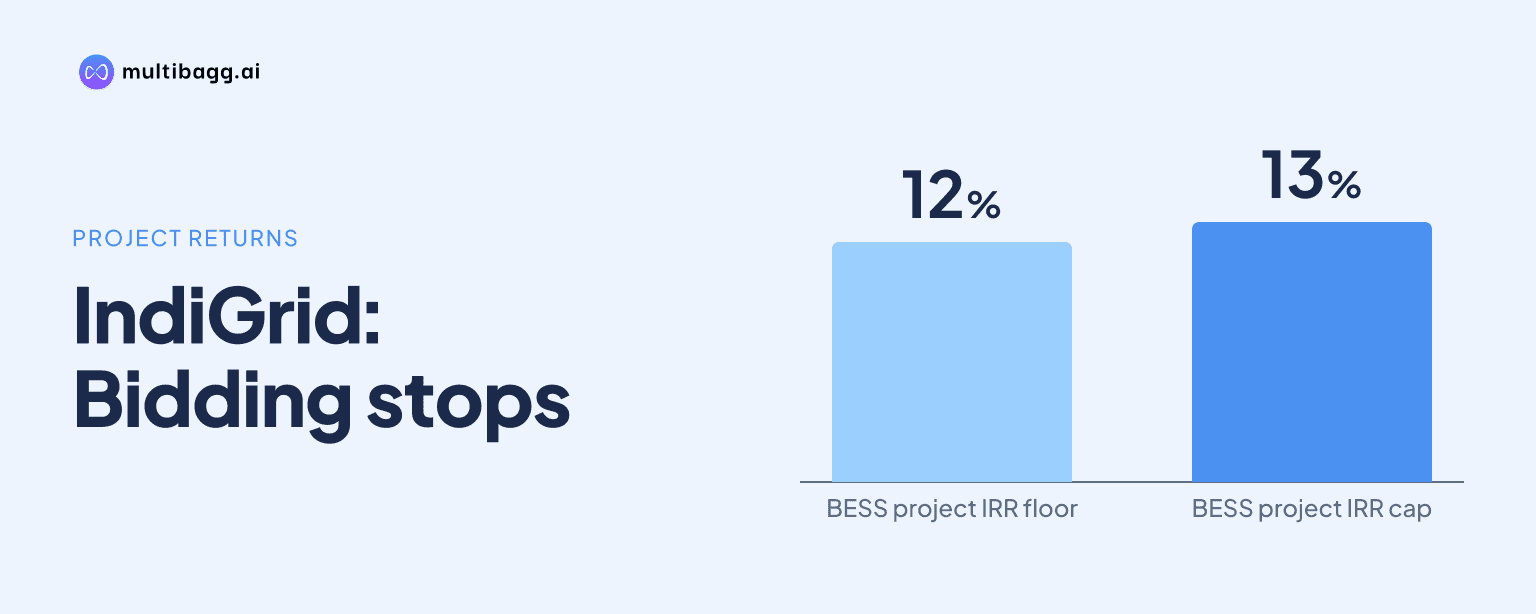
IndiGrid Infrastructure Trust said on November 6, 2026, it had stopped bidding in aggressively priced utility-scale battery energy storage system tenders while retaining a 12%-13% internal rate of return target, because it requires large projects with long-term contracted cash flow rather than lower-return or merchant-risk opportunities.
Know IndiGrid Infrastructure Trust inside out
Results, valuation, peers and who's buying, in one view.
Why has IndiGrid stopped bidding aggressively for battery projects?
IndiGrid has stepped out of utility-scale battery energy storage system, or BESS, bids where management considers pricing too aggressive. Chief Executive Officer Harsh Shah said on November 6 that IndiGrid wants to undertake projects at a reasonable return and is prepared to let other bidders pursue opportunities priced below its required level.
The decision rests on scale, returns and the opportunity set available, according to management. Shah said an investment of Rs 100 crore or Rs 200 crore would not be economical for IndiGrid relative to its size, so a storage project must be large enough to justify its development and operating attention.
IndiGrid also does not want revenue linked to the price paid by an end consumer, which management described as merchant risk. Its existing portfolio has limited or effectively no merchant risk, while distributed applications such as electric-vehicle charging can carry development, technology-dependence and obsolescence risks that do not fit its current contracted-infrastructure model.
What return does IndiGrid require from BESS projects?
IndiGrid targets a 12%-13% internal rate of return, or IRR, from BESS projects, the same threshold management said it applies to transmission investments. Shah said an under-construction storage asset would probably need an IRR above 13% because construction adds execution risk before contracted operations begin.
The BESS projects IndiGrid has already won have generated more than 13%, according to management. Shah attributed that outcome partly to bids made before battery prices declined, as well as execution measures including hedging battery costs and the United States dollar; he said battery prices had subsequently risen again.
The stated target does not require IndiGrid to bid for every battery tender. Management’s decision to stay out of aggressively priced utility-scale projects shows that BESS expansion depends on achieving the 12%-13% range, even though the trust continues to identify battery energy as an area for greenfield development and acquisitions.
How are IndiGrid’s current BESS projects paid?
IndiGrid’s current BESS portfolio uses take-or-pay annuity contracts with BRPL, GUVNL and NVVN, under which payment depends on meeting contracted availability and round-trip efficiency, or RTE. Management said this arrangement is closer to transmission than solar because payment is not determined by the customer’s actual use of every available battery cycle.
A concession agreement can require availability for one four-hour cycle or two two-hour cycles. Shah said IndiGrid receives its planned payment even when a customer uses zero cycles rather than one, or one cycle rather than two, provided the project maintains its agreed availability and RTE.
BESS has limited residual value after a concession, which can run for 12 or 15 years depending on contractual terms and battery use. Management said the residual value is not zero because batteries contain recyclable metals and other equipment, but it remains a relatively small component of the project economics.
This contract design separates IndiGrid’s utility-scale assets from storage opportunities at factories and electric-vehicle charging sites. Management said some such activities may not qualify as infrastructure under the harmonised list of the Department of Economic Affairs and Ministry of Finance, while their scale and long-term operating cash flows have not yet met IndiGrid’s requirements.
Got a follow-up? Ask IRIS
How does BESS discipline fit IndiGrid’s FY27 plan?
IndiGrid plans to add assets worth almost Rs 2,000 crore from EnerGrid during FY27, while considering greenfield and brownfield opportunities in transmission, batteries and renewables. Management said the expansion plan remains tied to disciplined capital deployment and its FY27 distribution per unit, or DPU, guidance of Rs 16.48.
As of September 30, 2026, IndiGrid’s net debt-to-assets-under-management ratio was 60.4%, and its average cost of debt was 7.46%. Shah said IndiGrid had no immediate plan to access capital markets, noting that it has generally raised capital when leverage reached the 64%-65% range.
IndiGrid paid a Q2 FY27 distribution of Rs 4.12 per unit, 3% above Rs 4 in the corresponding quarter a year earlier. Trust-level net distributable cash flow, or NDCF, was Rs 380 crore against a Rs 392 crore distribution, requiring a Rs 12 crore reserve draw and leaving about Rs 510 crore, equivalent to almost one and a half quarters of distribution, according to management.
What does the bid pullback mean for IndiGrid’s portfolio?
IndiGrid’s pullback means storage growth will be determined by contract quality and achievable returns rather than the volume of battery tenders. Management did not disclose the number or value of BESS bids it has skipped, but it said its current utility contracts with BRPL, GUVNL and NVVN meet its availability, efficiency and take-or-pay requirements.
The storage strategy sits within a wider acquisition programme that includes about Rs 12,000 crore of EnerGrid projects under signed agreements. Shah said IndiGrid expects to acquire those assets over the next three to four years, although some projects are due to be acquired during FY27 and others in subsequent years.
IndiGrid’s net asset value was about Rs 138.50 per unit in Q2 FY27, compared with Rs 148 previously. Management attributed about 50% of the decline to the risk-free rate rising to 7.2% from 6.8%, and about 25%-30% to a corporate-tax-rate change at special purpose vehicle level; it described these as non-cash valuation effects.
Conclusion
IndiGrid is continuing to pursue BESS, but only where a utility-scale project provides long-term contracted revenue, sufficient scale and a 12%-13% IRR. That approach distinguishes its current take-or-pay contracts from merchant or distributed-storage models and explains why management has chosen not to match aggressive tender prices.
The next indicators are the planned addition of almost Rs 2,000 crore of EnerGrid assets in FY27, the timing of acquisitions from the Rs 12,000 crore signed EnerGrid pipeline, and the Board’s Q4 decision on the next DPU guidance. Management said Rs 16.48 per unit is most likely to be maintained, while any increase will be considered only at the Q4 Board meeting.