










Indo Count ESG score reaches 78, above 31 sector average
Key highlights
- Indo Count reported a 2025 S&P Global ESG Score of 78 out of 100, up from 45 over two years.
- Indo Count’s 2025 ESG score was 47 points above the stated Textiles, Apparel & Luxury Goods industry average of 31.
- Indo Count’s Gagan, Avani and Prithvi programmes reach 30,468 farmers across 132,658 acres.
- Indo Count reported approximately 30,000 metric tons of greenhouse-gas reductions through Project Gigaton.
powered by IRIS
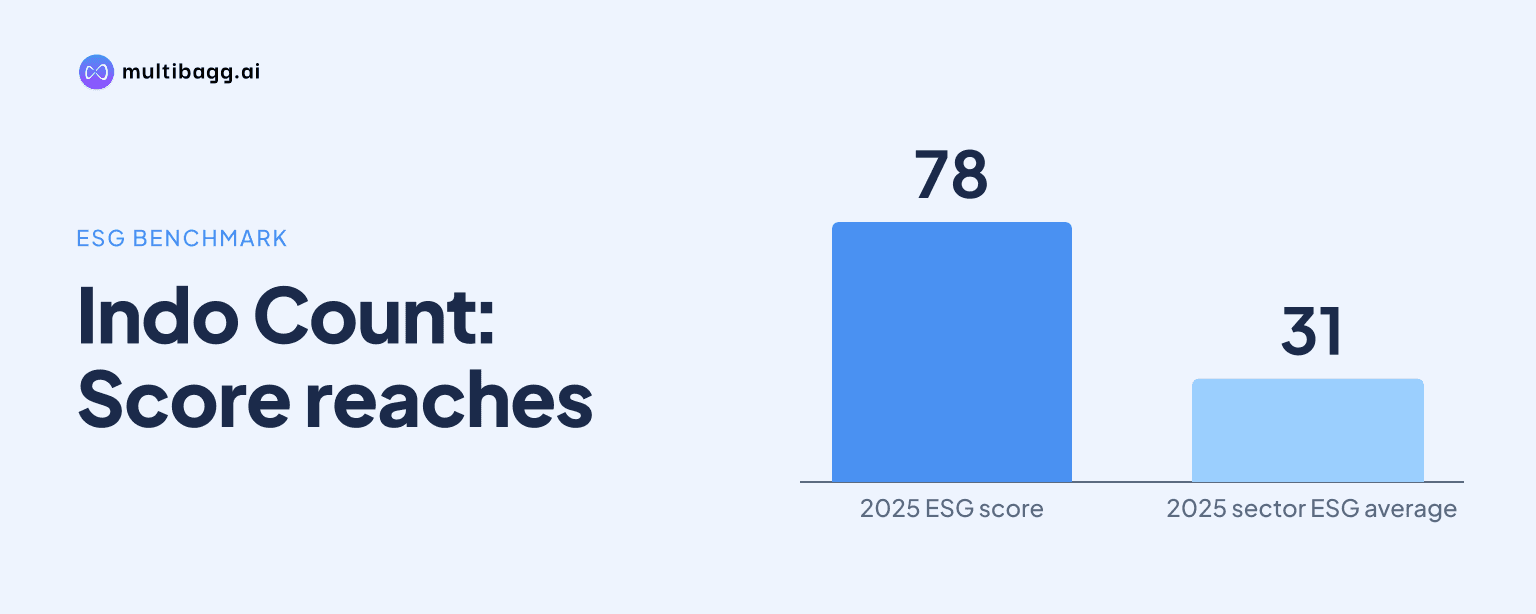
Indo Count reported an S&P Global ESG Score of 78 out of 100 for 2025, up from 45 over two years and 47 points above the 31 global industry average in Textiles, Apparel & Luxury Goods. Indo Count said the result placed it in the top 3 percentile globally within its industry.
Know Indo Count Industries inside out
Results, valuation, peers and who's buying, in one view.
How did Indo Count’s ESG score change?
Indo Count’s S&P Global ESG Score increased by 33 points, from 45 to 78 out of 100 over the last two years. Its 2025 score was also 47 points higher than the global industry average of 31 for the Textiles, Apparel & Luxury Goods sector disclosed in the presentation.
Indo Count said its 2025 result ranked it in the top 3 percentile globally in the Textile, Apparel & Luxury Goods industry. The assessment is conducted through S&P Global’s Corporate Sustainability Assessment, or CSA, a rules-based process that combines company-disclosed data, public-domain information and modelling approaches.
Indo Count attributed the improvement to progress in supply-chain practices, product stewardship, safety, customer engagement and human-capital development. It also cited continuing momentum in governance and climate strategy, although the presentation does not disclose individual category scores, their weightings or scores for the intervening years.
What sustainable cotton programmes does Indo Count operate?
Indo Count discloses three cotton programmes reaching a combined 30,468 farmers across 132,658 acres. Project Gagan is the largest, covering 26,849 farmers and 115,082 acres across Chandrapur, Amravati, Buldhana, Aurangabad and Parbhani districts in Maharashtra.
Project Gagan promotes alternatives to conventional agricultural practices, including more judicious use of water, pesticides and fertilisers. Indo Count links the programme to Better Cotton Initiative practices and says its purpose includes raising farm productivity and farmer income through responsible cotton cultivation.
Project Avani reaches 2,000 farmers across 9,404 acres in Yavatmal, Maharashtra. The organic-cotton programme focuses on biodiversity conservation, natural-resource management and social infrastructure for farming communities, making it smaller than Gagan by 24,849 farmers and 105,678 acres.
Project Prithvi covers 1,619 farmers and 8,172 acres in Botad and Amreli, Gujarat, in partnership with Shree Ram Cotton Industries. Its stated model includes direct procurement and cultivation of regenerative cotton, with soil health, soil and water conservation, greenhouse-gas emission reduction and local-ginner partnerships among its stated mechanisms.
Indo Count’s Business Plan 2030 targets support for more than 75,000 farmers and coverage of 290,000 acres. Relative to the 30,468 farmers and 132,658 acres disclosed for the three current programmes, the targets imply further expansion before 2030; no annual milestones are provided.
Got a follow-up? Ask IRIS
How does Indo Count report climate and facility performance?
Indo Count reported a B rating from the Carbon Disclosure Project, or CDP, compared with an average C rating for companies across Asia. It also reported a score above 92 on the third-party verified Higg Index vFEM, or Facility Environmental Module, which assesses environmental performance at facilities.
Indo Count says it is reducing its carbon footprint through renewable-energy adoption and sustainability measures across manufacturing units and the supply chain. It has joined the Science Based Targets initiative, or SBTi, and says it has set greenhouse-gas reduction targets through 2030 aligned with a well-below 2°C pathway under the Paris Agreement.
Through Project Gigaton, Indo Count reported an approximate reduction of 30,000 metric tons of greenhouse gases across various suppliers. The company said it has received the “Giga Guru” title for seven consecutive years, while the broader Project Gigaton programme works with suppliers to prevent 1 billion metric tons of greenhouse gases by 2030.
Indo Count also identifies a product-level supply-chain initiative in its Pure Earth bed-linen collection. The collection uses plant-based dyes in organic cotton made from non-edible by-products and residues from almond shells, saw palmetto, cotton plants, beetroot and bitter oranges, while retaining edible portions for food consumption.
What broader sustainability framework has Indo Count disclosed?
Indo Count is an active member of the United Nations Global Compact, or UNGC, which was launched in 2000. Its Business Plan 2030 sets out six sustainability pillars and aligns operational performance with nine Sustainable Development Goals, or SDGs, including clean energy, responsible consumption and production, climate action, water and sanitation, decent work and partnerships.
The company’s community programmes include Mobile Health Vans that have treated more than 100,000 patients across 96 villages in Kolhapur. Indo Count also says it supports more than 138 schools with e-learning facilities, benefiting more than 51,400 students in Kolhapur and Bhilad.
In water and sanitation, Indo Count says reverse-osmosis water units across Kagal, Gokul Shirgaon and schools in Bhilad serve more than 148,000 people. Its environmental programme has maintained and expanded green cover to more than 50,000 trees in Kolhapur and Bhilad, with estimated annual carbon sequestration of about 500 tons.
What water-management recognition did Indo Count receive?
Indo Count received the Confederation of Indian Industry National Award for Excellence in Water Management on 7 October 2026 in New Delhi. The award recognised water stewardship, water conservation, wastewater recycling and water-management practices across the company’s operations.
The recognition sits outside the 2025 S&P Global ESG scorecard but relates to resource management initiatives cited in the presentation. Indo Count does not disclose water-intensity figures, recycling rates, the volume of wastewater recycled or period-on-period water-use data alongside the October 2026 award.
Conclusion
Indo Count’s 2025 score of 78 is the presentation’s central external ESG measure, standing 33 points above its score two years earlier and 47 points above the stated sector average of 31. The company links this performance to supply-chain, product, workforce, governance and climate initiatives, including cotton programmes covering 30,468 farmers and 132,658 acres.
The next disclosures to watch are Indo Count’s progress toward its 2030 targets of supporting more than 75,000 farmers and covering 290,000 acres, as well as its SBTi-aligned greenhouse-gas reduction targets through 2030. The presentation sets out those plans but does not provide interim targets, quantified emissions-reduction goals or annual programme-expansion schedules.