










IndoStar expects legacy loans to reach 10% of AUM by year-end
Key highlights
- IndoStar's pre-January 2025 book was about Rs 1,850 crore, or 24% of AUM, at September 30, 2026.
- Management expects the legacy book to decline to around 10% of AUM by year-end.
- Q2 FY27 impairment and credit cost was Rs 96 crore, compared with Rs 81 crore in the preceding quarter.
- Gross Stage 3 improved to 4.5% from 4.8%, while net Stage 3 improved to 2.4% from 2.5%.
powered by IRIS
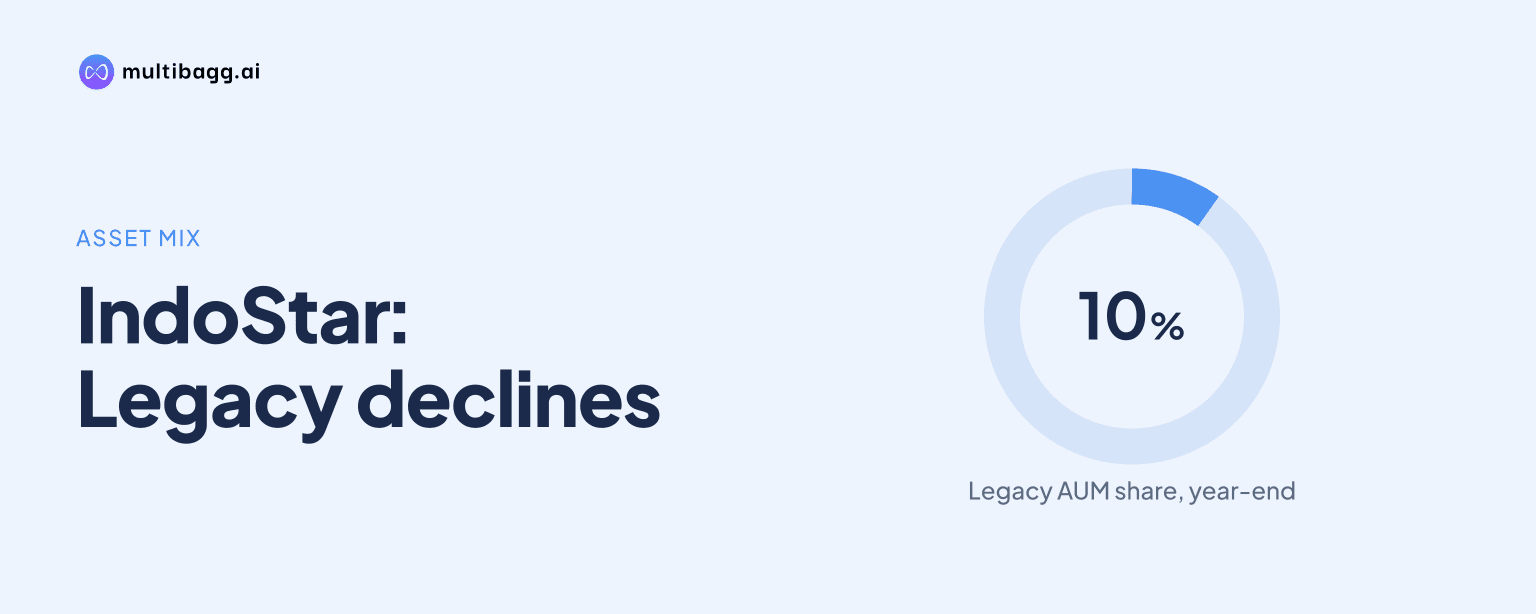
IndoStar Capital Finance Limited expects its pre-January 2025 loan book to decline from 24% of assets under management, or AUM, equal to about Rs 1,850 crore at September 30, 2026, to around 10% by year-end. Management said credit costs should begin falling significantly from Q4 as this older portfolio runs down.
Know Indostar Capital Finance inside out
Results, valuation, peers and who's buying, in one view.
Why will IndoStar's legacy book fall to 10% of AUM?
IndoStar says the pre-January 2025 portfolio was about 24% of AUM as of September 30, 2026, and carried higher delinquencies than loans originated under its tightened underwriting norms. Of the Rs 1,850 crore older book, about 27% was more than 30 days past due, leaving some loans that could still move into later-stage delinquency and require provisions.
Management said the older portfolio should decline to around 10% of AUM by the end of the year. Quarterly impairment and credit cost remained near Rs 100 crore, including Rs 96 crore in Q2 FY27, but management expects a significant reduction from Q4 as the legacy pool and its potential forward flows reduce.
Why have higher disbursements not translated into similar AUM growth?
IndoStar attributed the gap between disbursements and AUM growth to a Rs 132 crore direct-assignment transaction and write-offs of highly delinquent loans, primarily from the older book. An analyst cited about Rs 1,400 crore of disbursements against about Rs 200 crore of sequential AUM accretion, illustrating the effect of run-off and portfolio actions on the balance sheet.
Management said AUM grew 12% year on year while disbursements increased more than 50% in Q2 FY27, and expects those rates to converge as write-offs decline. In a separate exchange, it said the pre-tightening vehicle-finance book had fallen from about Rs 3,000 crore in Q4 FY26 to Rs 1,850 crore in Q2 FY27, mainly through write-offs of higher-delinquency loans.
The difference does not indicate lower originations: management said newer loans are growing while the older impaired pool is being written off or amortised. IndoStar expects the more than 50% disbursement growth to translate into better AUM accretion as write-offs reduce from the levels that held AUM growth to 12% year on year.
How is the legacy run-off expected to affect credit costs and profit?
IndoStar reported impairment and credit cost of Rs 96 crore in Q2 FY27, compared with Rs 81 crore in the preceding quarter, even after releasing a Rs 49 crore management overlay on the vehicle-finance portfolio. The overlay was created in Q4 FY26 for possible effects from the West Asia crisis and higher fuel prices, but management said six months of portfolio performance showed that the expected stress had not materialised.
The expected credit loss, or ECL, percentage of the total book declined to 4% from 5%. Profit after tax was Rs 13 crore in Q2 FY27, compared with Rs 11 crore in the corresponding quarter a year earlier, while H1 FY27 profit after tax was Rs 25 crore on net total income of Rs 465 crore; management linked the limited profit conversion to legacy provisioning.
For FY28, management guided to normalised credit cost of 2% to 2.5%, citing the new book's underwriting performance and early delinquency signals. Management also targets return on average assets, or ROAA, of 2% from H2 FY28, when it expects most of the old book to have run off; both measures are targets rather than reported outcomes.
Got a follow-up? Ask IRIS
What supports management's view that the new book has lower risk?
IndoStar said the underwriting changes introduced from January 2025 have altered its customer mix. Borrowers with a CIBIL score of 725 or above accounted for almost 85% in Q2 FY27, compared with 62% in Q2 FY24, while new-to-credit borrowers represented about 4%, down from 14% in the old book.
Management said almost 95% of the Q2 FY27 portfolio had a CIBIL score above 700. At the company level, gross Stage 3 loans improved to 4.5% from 4.8% in the preceding quarter, while net Stage 3 loans improved to 2.4% from 2.5%, supporting management's distinction between new-cohort performance and residual stress in loans written before the underwriting changes.
IndoStar is also seeking to reduce product concentration in vehicle finance. Management said none of its five verticals, Micro LAP, commercial vehicles, farm equipment, passenger vehicles and construction equipment, is expected to exceed 35% to 40% of the portfolio, compared with a historical medium-and-heavy commercial-vehicle concentration above 50%.
What could affect the pace of IndoStar's turnaround?
The remaining older portfolio still has 27% of balances more than 30 days past due, so further forward flows and provisions remain possible before the expected Q4 reduction. Management said corporate security-receipt recoveries remain in line with its April 2026 expectation of recoveries beginning in 18 to 24 months, while it expects recovery of retail security-receipt carrying value within 12 to 18 months and said relevant retail provisions have already been made.
Borrowing costs are another variable. Management said about Rs 3,900 crore of borrowings were floating-rate or due within one year, including about Rs 1,000 crore linked to the repo rate, Treasury bills or one- and three-month marginal cost of funds based lending rate. It also said Rs 1,300 crore of borrowings carrying interest above 10.5% were due for repayment over the next three to six months and could be refinanced at lower rates.
Management said IndoStar had started October well and retained its 35% compound annual growth rate guidance. It also plans to add about 100 branches over the next three years, a 7% to 10% increase in the branch network, while Micro LAP is targeted to reach 10% to 15% of the portfolio over the same period.
Conclusion
The central change is the declining weight of a Rs 1,850 crore pre-January 2025 portfolio that has restrained AUM conversion, credit costs and earnings despite disbursement growth above 50%. IndoStar's 12% year-on-year AUM growth and Rs 13 crore Q2 FY27 profit show that the near-term drag remains, while gross Stage 3 loans declining to 4.5% and the improved borrower-score mix support management's outlook.
The next measure to watch is whether credit cost declines visibly from Q4, as management indicated, while the old portfolio approaches 10% of AUM by year-end. Investors can also monitor whether reduced write-offs narrow the gap between disbursement growth and AUM growth, and whether IndoStar progresses towards management's FY28 normalised credit-cost target of 2% to 2.5%.