










Ola Electric to stabilise 6 GWh before 20 GWh equity
Key highlights
- Ola plans to stabilise its 6 GWh cell plant before seeking external equity for 20 GWh capacity.
- Ola said NMC yields are in the mid-70s and should reach the mid-80s over the next couple of months.
- Ola expects about 30% of its Auto business to use NMC cells and 70% to use LFP cells.
- Management estimated capex below Rs 400 crore per GWh at a fully scaled 20 GWh plant.
powered by IRIS
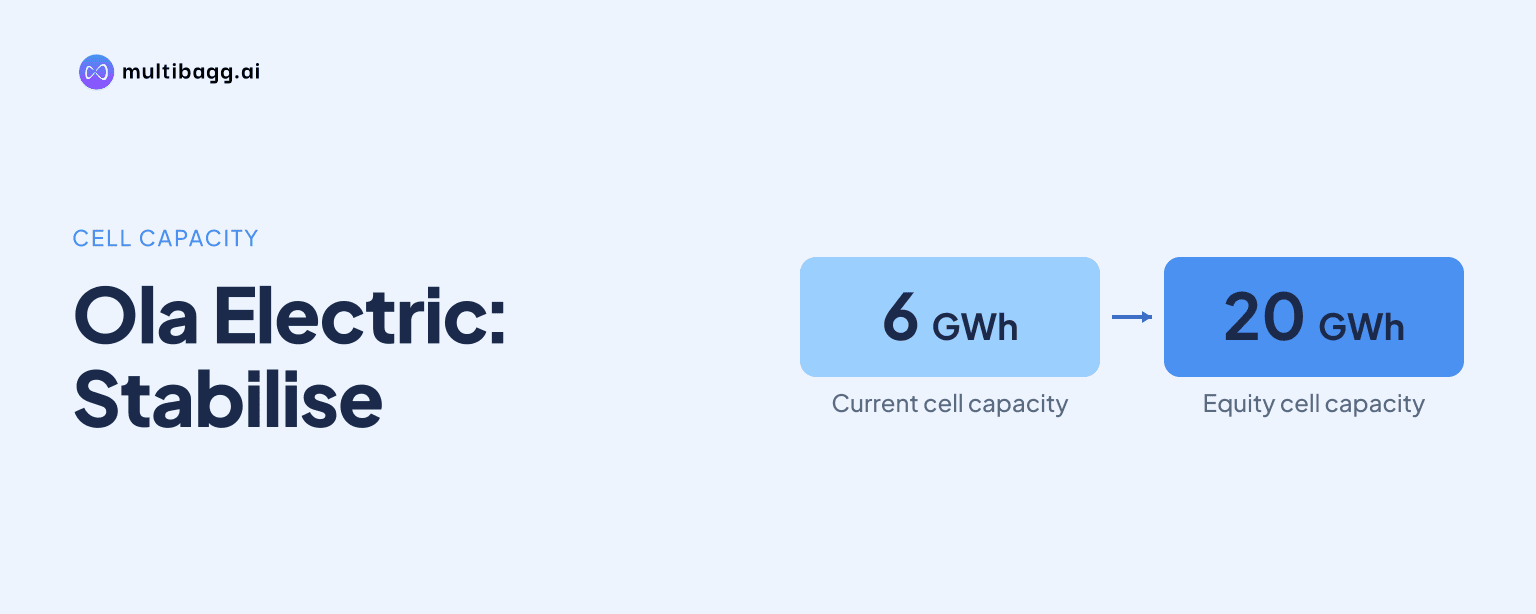
Ola Electric plans to stabilise its commissioned 6 gigawatt-hour (GWh) cell plant over the next couple of quarters before seeking external equity for a 20 GWh expansion. Management said nickel manganese cobalt (NMC) cell yields were in the mid-70s, expected to reach the mid-80s in the next couple of months, while the larger expansion would not begin in the next couple of quarters.
Know Ola Electric Mobility inside out
Results, valuation, peers and who's buying, in one view.
What is Ola's plan for its 6 GWh cell plant?
Ola's immediate priority is to ramp and stabilise the 6 GWh Gigafactory rather than start the 20 GWh expansion. Management said all equipment had been commissioned and production was being ramped up, compared with the prior year when only one-third of the plant had been commissioned. It said capacity utilisation, yield improvement and raw-material cost reduction must advance together.
The production sequence begins with Ola's Auto business and then moves to its Shakti portfolio. Management said NMC cells would first be integrated into Auto products, producing a meaningful increase in cell output in Q3. It also expects a meaningful rise in cell-company revenue in Q3, although that revenue would initially come from internal supplies to the Auto business.
Ola expects to begin ramping its own lithium iron phosphate (LFP) cell production in the following quarter. Those cells are expected to enter vehicles toward the end of Q4 or early Q1, with management's planned mix of about 30% NMC cells and 70% LFP cells across the Auto business. This makes the initial 6 GWh ramp principally an internal vehicle-supply programme rather than an immediate third-party cell-sales business.
When will Ola seek equity for 20 GWh capacity?
Ola said it will consider external equity for its cell company only after stabilising the 6 GWh plant over the next couple of quarters. Management described 20 GWh as part of its mid- to long-term roadmap, confirmed that it has production-linked incentive (PLI) coverage up to 20 GWh, and said the expansion would not occur in the next couple of quarters.
Management's rationale is that the Gigafactory building and associated setup were designed for 20 GWh from the outset. It said incremental capital expenditure, or capex, from 6 GWh to 20 GWh should therefore be much lower than the investment required to build the first 6 GWh. At a fully scaled 20 GWh plant, management estimated capex at below Rs 400 crore per GWh.
The funding sequence also comes after a period of plant construction. Ola reported consolidated operating cash flow of about negative Rs 188 crore, and management said the difference between operating and free cash flow was largely Gigafactory capex. It said this capex was nearing completion after commissioning, with some tail-end payments remaining and project finance from State Bank of India backing the facility.
How quickly can Ola improve NMC cell yields?
Ola said NMC yields were in the mid-70s and should rise to the mid-80s over the next couple of months, with a longer-term target of 90%. Management did not give a six-month, eight-month or one-year deadline for reaching 90%, saying instead that its cell work had been under way since the company began in 2020.
Management attributed the expected improvement to an itemised engineering and manufacturing roadmap. It said it knew which machines needed changes and which quality tests could track production improvement. The distinction is material because rising plant utilisation alone would not meet the ramp objective without simultaneous gains in yields and reductions in raw-material costs.
Ola also gave an indication of the internal demand that could support cell production. For FY28, management asked investors to assume average battery capacity of about 5 kilowatt-hours (kWh) per vehicle, compared with about 3.8 kWh currently. At projected consumption of 2 GWh to 3 GWh, it said that level would correspond to roughly 400,000 to 500,000 orders in FY28.
Got a follow-up? Ask IRIS
When will Ola use LFP cells in its vehicles?
Ola expects its LFP cells to enter vehicles toward the end of Q4 or early Q1 after production starts ramping in the following quarter. Management said the intended Auto-business mix is about 70% LFP cells and 30% NMC cells, following the initial NMC integration into vehicles in Q3.
The company linked LFP integration with the Gen 4 platform, which management said would arrive from Q4 onwards. It said those changes would structurally reduce the bill of materials even as the industry faced a cyclical upswing in commodities. Management had said Ola's bill of materials was perhaps 15% to 20% below competitors despite higher functionality, battery capacity and range.
Management estimated that in-house cells could provide about a 20% cost advantage at the appropriate scale of production. That was a scale-dependent estimate, not a disclosed current saving: Ola did not provide battery-pack cost per kWh for currently used 2170 cells or a projected per-kWh cost for its LFP cells.
What could Ola's 20 GWh plant supply beyond vehicles?
Ola said the longer-term 20 GWh roadmap could support both Auto demand and grid-storage products through Mahashakti. Management said its partnership with Axis Energy concerned Mahashakti, which had not yet launched, and that Axis Energy had expressed interest in using the product when it becomes available.
Management also cited a policy announced in the prior week requiring domestic grid-scale battery installations to have 40% domestic value addition. It said Indian-made cells would eventually be necessary to meet that threshold and that Mahashakti would use Ola's own Indian cells. No external sales volume, customer contract or revenue target was disclosed for Mahashakti or Axis Energy.
The near-term sequencing remains focused on the Auto business. Q3 cell-company revenue is expected to come from NMC cells supplied internally, while the LFP ramp is due to start in the next quarter. Third-party grid-storage demand is therefore a potential later use for expanded cell capacity, rather than the stated driver of the current 6 GWh production ramp.
Conclusion
Ola is putting manufacturing execution ahead of its next capacity build. The company has commissioned its 6 GWh plant and plans to improve NMC yields from the mid-70s toward the mid-80s, integrate NMC cells into Auto products in Q3, and follow with LFP vehicle integration around the end of Q4 or early Q1. The 20 GWh plan remains part of management's roadmap, but outside equity is intended only after the smaller plant is stabilised.
The next disclosed milestones are Q3 results, when management expects meaningful increases in cell production and cell-company revenue, and the following-quarter start of LFP production ramp-up. Management also plans to stabilise the 6 GWh facility over the next couple of quarters before considering the external-equity route to 20 GWh capacity.