










Ola Electric Q2 revenue falls as adjusted operating loss widens
Key highlights
- Ola Electric reported Q2 FY27 revenue of Rs 421 crore, down from Rs 455 crore in Q1 FY27.
- Ola Electric’s Q2 FY27 adjusted operating EBITDA loss widened to Rs 246 crore from Rs 195 crore sequentially.
- Ola Electric reported a 29.93% consolidated gross-margin percentage and Rs 35,000 gross margin per unit in Q2 FY27.
- Industry electric two-wheeler volumes rose to 600,000 units in Q2 FY27, while EV penetration reached 11.18%.
powered by IRIS
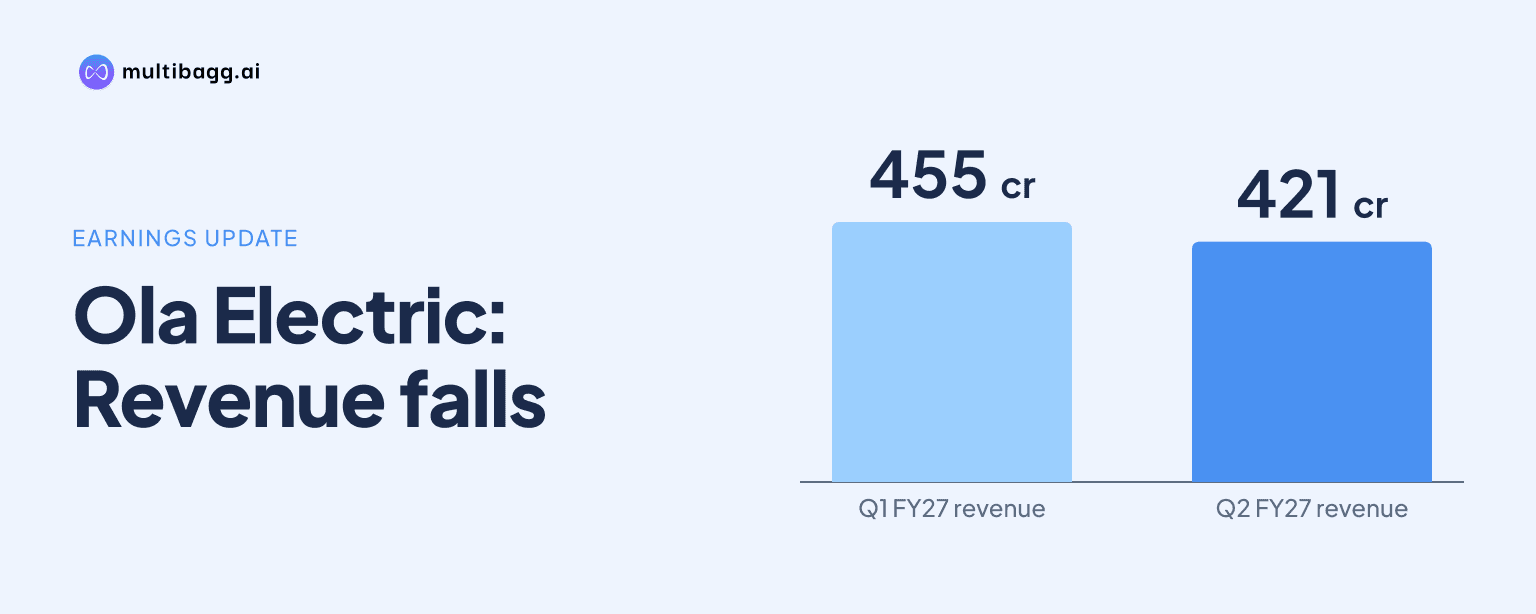
Ola Electric reported Rs 421 crore of revenue from operations in Q2 FY27, down Rs 34 crore sequentially, while its adjusted operating EBITDA loss widened to Rs 246 crore from Rs 195 crore despite a 29.93% consolidated gross-margin percentage. Higher consolidated operating expenses and lower gross margin in rupee terms accompanied the wider loss.
Know Ola Electric Mobility inside out
Results, valuation, peers and who's buying, in one view.
Why did Ola Electric’s Q2 FY27 revenue decline?
Ola Electric’s consolidated revenue from operations declined 7% sequentially to Rs 421 crore in Q2 FY27 from Rs 455 crore in Q1 FY27. Revenue had been Rs 265 crore in Q4 FY26 and Rs 690 crore in Q2 FY26, placing the latest quarter below the comparable quarter a year earlier. The Automotive segment contributed Rs 420 crore, or nearly all of Q2 FY27 consolidated revenue.
Average selling price, or ASP, rose to Rs 1.21 lakh per unit in Q2 FY27 from Rs 1.14 lakh in Q1 FY27. The presentation does not disclose Ola Electric’s vehicle volumes for either quarter, so it does not identify the direct reason for the revenue reduction. Industry electric two-wheeler volumes increased from 526,000 units in Q1 FY27 to 600,000 units in Q2 FY27, while electric-vehicle penetration rose from 9.23% to 11.18%.
What widened Ola Electric’s adjusted operating loss?
Ola Electric’s adjusted operating EBITDA loss increased by Rs 51 crore to Rs 246 crore in Q2 FY27, alongside a Rs 36 crore rise in operating expenses to Rs 369 crore and a Rs 13 crore reduction in gross margin to Rs 126 crore. EBITDA means earnings before interest, tax, depreciation and amortisation. The presentation defines adjusted operating EBITDA as operating EBITDA excluding other income and including lease expenses.
The adjusted operating EBITDA margin moved to negative 58.5% from negative 42.8% in Q1 FY27. Operating EBITDA before that adjustment was a loss of Rs 218 crore, compared with a loss of Rs 165 crore, while profit after tax was negative Rs 362 crore against negative Rs 336 crore in Q1 FY27.
Automotive operating expenses decreased to Rs 269 crore from Rs 280 crore, but Automotive gross margin declined to Rs 125 crore from Rs 139 crore. The segment’s adjusted operating EBITDA loss therefore rose to Rs 145 crore from Rs 141 crore. In the Cell segment, operating expenses moved to Rs 40 crore from negative Rs 21 crore, while adjusted operating EBITDA changed to a loss of Rs 38 crore from positive Rs 22 crore.
How stable was Ola Electric’s gross margin in Q2 FY27?
Ola Electric’s consolidated gross-margin percentage was 29.93% in Q2 FY27, compared with 30.5% in Q1 FY27, while consolidated gross margin per unit remained Rs 35,000 in both periods. The presentation’s graph shows a slightly different Q2 percentage of 29.3%, but both measures place the reported margin close to 30%.
The Automotive segment recorded a 29.76% gross-margin percentage, versus 30.5% in Q1 FY27, with segment gross margin declining by Rs 14 crore to Rs 125 crore. Consolidated gross margin excluding the production-linked incentive, or PLI, was 26.5% in Q2 FY27, compared with 23.3% in the preceding quarter.
The Q2 FY27 margin percentage was below the 38.5% recorded in Q4 FY26, when consolidated revenue was Rs 265 crore and gross margin was Rs 102 crore. ASP was Rs 1.21 lakh in Q2 FY27, below Rs 1.31 lakh in Q4 FY26, while gross margin per unit was Rs 35,000 against Rs 50,000.
Got a follow-up? Ask IRIS
What do Ola Electric’s cash flow and Cell figures show?
Ola Electric reported negative Rs 188 crore of cash flow from operations in Q2 FY27, compared with negative Rs 215 crore in Q1 FY27. Free cash flow was negative Rs 371 crore, worsening from negative Rs 351 crore. The presentation does not provide a bridge for the Rs 20 crore sequential movement in free cash flow.
The Cell segment generated Rs 3 crore of revenue and Rs 2 crore of gross margin in Q2 FY27, but reported a Rs 38 crore adjusted operating EBITDA loss. In Q1 FY27, the segment reported Rs 5 crore of revenue, Rs 1 crore of gross margin and Rs 22 crore of adjusted operating EBITDA. Its Q2 FY27 cash flow from operations was negative Rs 14 crore and free cash flow was negative Rs 170 crore.
Management said its Gigafactory achieved scheduled commercial operations date for 6 gigawatt-hours of cell capacity ahead of schedule. It said nickel manganese cobalt, or NMC, cell yields were 70% to 75% and expected 80% to 85% by the end of Q3 FY27. Management also said lithium iron phosphate, or LFP, production began ramping in Q3 FY27; these are plans and expectations, not Q2 FY27 financial results.
What operating indicators should readers track next?
Ola Electric’s presentation shows industry electric two-wheeler volumes rose by 74,000 units sequentially to 600,000 in Q2 FY27, as penetration increased 1.95 percentage points to 11.18%. Those industry movements contrast with Ola Electric’s Rs 34 crore sequential revenue decline. The company did not disclose Q2 FY27 registrations or deliveries, which would be needed for a direct company-volume comparison.
Management said dealer-channel inventory was about 15 days at the time of the presentation, and less than one week in many early-opening dealer markets. Wholesale orders were 3,955 vehicles in September and 13,505 in October, while management forecast 16,000 in November and 20,000 in December. November actuals shown in the presentation covered only November 1 to 11.
Management expected production of about 25,000 vehicles in December, after 14,092 vehicles in October and a 20,000-vehicle forecast for November. It attributed the constraint to supplier capacity rather than the company’s own manufacturing capacity. Whether those production plans, dealer inventory levels and paid-order backlog change revenue and cash-flow trends remains unresolved in the Q2 FY27 tables.
Conclusion
Ola Electric’s Q2 FY27 results combine a near-30% reported gross-margin percentage and unchanged Rs 35,000 gross margin per unit with lower sequential revenue, a larger adjusted operating loss and more negative free cash flow. Automotive remained the main revenue source, while the Cell segment’s Rs 38 crore adjusted operating EBITDA loss added to the consolidated outcome.
The next disclosed milestones are management’s expectation of PLI incentives from the next quarter, NMC yields of around 90% in Q4 FY27 and integration of its own LFP cells into vehicles in Q4 FY27. Management also plans December production of about 25,000 vehicles, making output, dealer inventory and Cell-segment progress key disclosed developments to watch.