










Ola Electric first-half loss Rs 698 crore as revenue drops 42%
Key highlights
- Ola Electric’s revenue from operations fell 42% to Rs 876 crore in the six months ended September 30, 2026.
- Ola Electric’s first-half loss before tax narrowed to Rs 698 crore from Rs 846 crore a year earlier.
- Ola Electric used Rs 403 crore of net cash in operating activities, compared with Rs 343 crore in the prior-year period.
- Ola Electric received about Rs 600 crore of application money from a post-period rights issue of about Rs 1,000 crore.
powered by IRIS
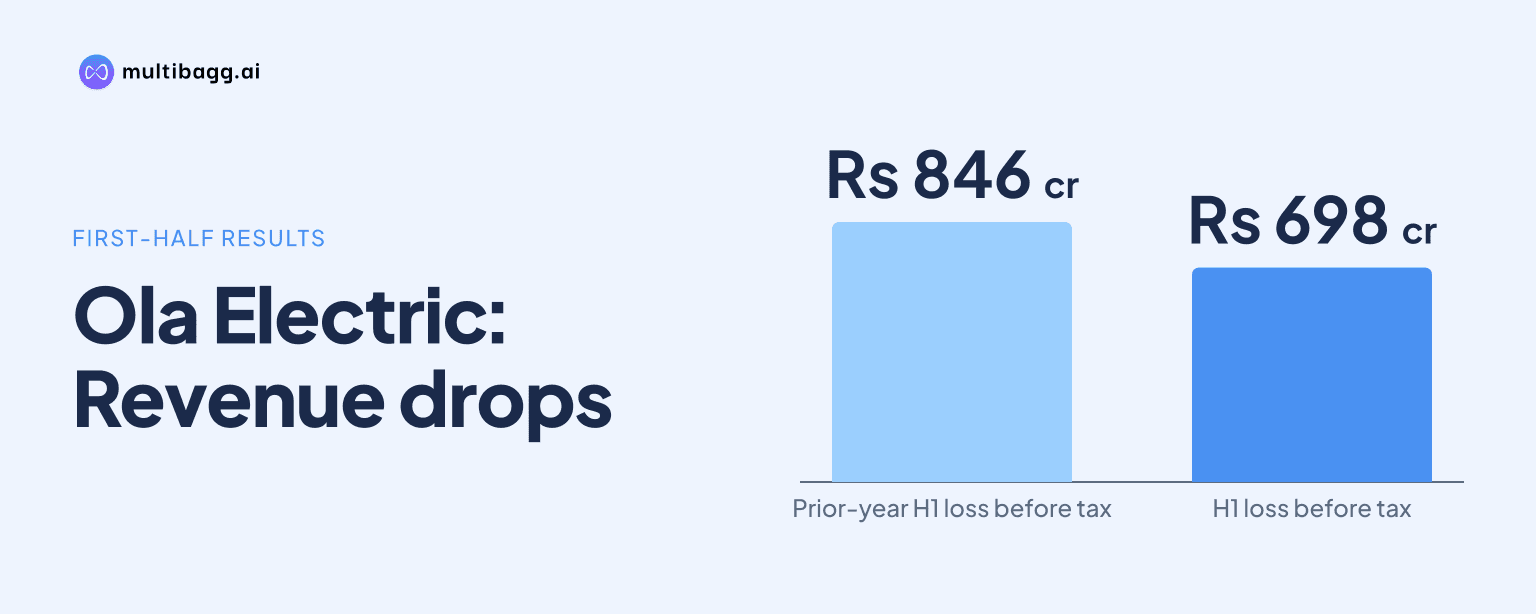
Ola Electric Mobility Limited reported a consolidated loss of Rs 698 crore for the six months ended September 30, 2026, as revenue from operations fell 42% year on year to Rs 876 crore from Rs 1,518 crore. The loss was Rs 148 crore lower than the prior-year period, aided by lower finance costs and depreciation and amortisation.
Know Ola Electric Mobility inside out
Results, valuation, peers and who's buying, in one view.
What drove Ola Electric’s first-half revenue decline?
Ola Electric’s revenue from operations fell by Rs 642 crore, or about 42%, to Rs 876 crore in the six months ended September 30, 2026. The decline continued in the September quarter, when revenue was Rs 421 crore, compared with Rs 455 crore in the June 2026 quarter and Rs 690 crore in the September 2025 quarter.
The Automotive segment accounted for nearly all reported revenue. Its six-month segment revenue was Rs 875 crore, down from Rs 1,514 crore a year earlier, while the Cell segment recorded Rs 8 crore of revenue before inter-segment eliminations. Total segment revenue was Rs 883 crore and inter-segment eliminations were Rs 7 crore, producing consolidated revenue of Rs 876 crore.
Other income declined to Rs 56 crore in the first half from Rs 134 crore a year earlier, taking total income to Rs 932 crore from Rs 1,652 crore. In the September 2026 quarter, other income was Rs 27 crore, below both Rs 29 crore in the preceding quarter and Rs 66 crore in the September 2025 quarter.
How did costs and losses change at Ola Electric?
Ola Electric’s loss before tax narrowed to Rs 698 crore from Rs 846 crore, while its loss before finance costs, depreciation, amortisation and tax increased to Rs 327 crore from Rs 306 crore. The lower reported loss therefore reflected reduced finance costs and depreciation and amortisation rather than an improvement in that earlier loss measure.
Total expenses declined to Rs 1,259 crore from Rs 1,958 crore. Cost of materials consumed fell by Rs 203 crore to Rs 752 crore, employee benefits expense declined to Rs 115 crore from Rs 144 crore, and other expenses reduced to Rs 532 crore from Rs 723 crore. Changes in inventories reduced expenses by Rs 173 crore, compared with an expense of Rs 101 crore in the prior-year period.
Finance costs fell to Rs 136 crore from Rs 203 crore and depreciation and amortisation declined to Rs 235 crore from Rs 337 crore. Ola Electric revised the estimated useful lives of certain intangible assets, vehicles and tools during the six months, reducing depreciation expense by Rs 62 crore, including Rs 38 crore in the September 2026 quarter.
The Automotive segment reported a loss before tax of Rs 435 crore for the first half, compared with Rs 494 crore a year earlier. The Cell segment’s loss before tax was Rs 110 crore against Rs 148 crore, while unallocated expenses were Rs 152 crore, lower than Rs 204 crore in the comparable period.
Got a follow-up? Ask IRIS
What do Ola Electric’s balance sheet and cash flow show?
Ola Electric used Rs 403 crore of net cash in operating activities during the six months ended September 30, 2026, compared with Rs 343 crore used a year earlier. Management attributed the negative operating cash flow to continued operating losses, lower-than-expected sales-volume growth and increased material costs.
Cash and cash equivalents were Rs 123 crore on September 30, 2026, compared with Rs 421 crore at March 31, 2026. Bank balances other than cash equivalents fell to Rs 627 crore from Rs 1,121 crore, while inventories increased to Rs 406 crore from Rs 269 crore and trade receivables rose to Rs 86 crore from Rs 31 crore.
Total assets declined to Rs 7,246 crore from Rs 7,788 crore over the six-month period. Property, plant and equipment increased to Rs 2,712 crore from Rs 1,956 crore, while capital work-in-progress fell to Rs 39 crore from Rs 496 crore. Total equity rose to Rs 3,428 crore from Rs 3,351 crore, and total liabilities declined to Rs 3,818 crore from Rs 4,437 crore.
Investing activities generated Rs 234 crore, aided by Rs 1,370 crore of proceeds from interest-bearing deposits against Rs 871 crore invested in such deposits. Financing activities generated Rs 204 crore, including Rs 780 crore from issuing equity shares, partly offset by Rs 270 crore paid to debenture holders and Rs 225 crore of net payments on current borrowings.
Why did the auditor qualify Ola Electric’s review?
Ola Electric received a qualified limited-review conclusion from B S R & Co. LLP for the quarters ended June 30 and September 30, 2026. The qualification concerned Ola Cell Technologies Private Limited’s accounting for liquidated damages tied to an investment-milestone condition under a Ministry of Heavy Industries incentive scheme.
Ola Cell Technologies had recognised a provision aggregating Rs 57 crore as of March 31, 2026. During the June 2026 quarter, it reversed that provision and did not recognise a further Rs 11 crore provision after seeking an extension and waiver; the ministry subsequently issued a conditional waiver letter dated August 11, 2026.
The auditor said the Rs 57 crore provision should have remained until the September quarter, the additional Rs 11 crore provision should have been recorded in June, and the full provision should then have been reversed in September after the letter was received. Apart from this matter, the auditor said nothing had come to its attention indicating the financial statement contained a material misstatement.
Management assessed Ola Electric as a going concern after considering available cash and bank balances, business projections, credit limits and rights-issue proceeds. After September 30, Ola Electric allotted partly paid rights shares at Rs 27 each for about Rs 1,000 crore and had received about Rs 600 crore in application money by the date of the results.
Conclusion
Ola Electric’s first-half results show lower revenue, principally in the Automotive segment, alongside a narrower loss before tax. Lower material, employee, other, finance and depreciation costs reduced the reported loss by Rs 148 crore year on year, but the loss before finance costs, depreciation, amortisation and tax widened by Rs 21 crore to Rs 327 crore.
The next disclosures will show whether revenue and operating cash flow improve following the about Rs 600 crore in rights-issue application money received. Management’s going-concern assessment also depends on business expansion, new-product launches, operational efficiencies and available credit limits, while the Ministry of Heavy Industries investment milestone and extended-producer-responsibility guidance remain matters to watch.