










Ola Electric targets 10-15% cell cost savings at 85% yield
Key highlights
- Ola says 85% cell yield can deliver about 10-15% savings versus outside purchases.
- Ola expects 2-3 GWh of FY28 automotive cell consumption, matching its stated fixed-cost break-even range.
- Ola targets 80-85% NMC yield by end-Q3 FY27 and around 90% in Q4 FY27.
- Ola achieved SCOD for 6 GWh of cell capacity ahead of schedule.
powered by IRIS
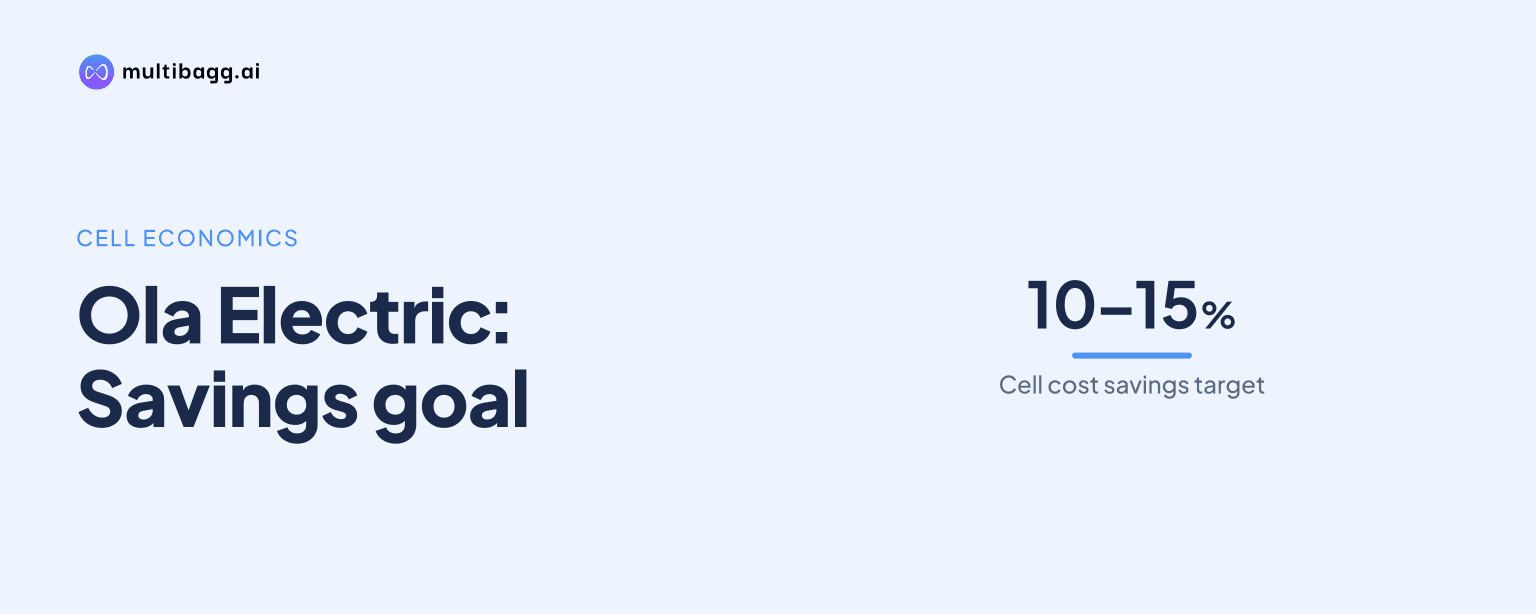
Ola Electric says its 6 GWh cell plant can save about 10-15% against outside purchases at an 85% yield, while 2-3 GWh of consumption is its stated threshold for fixed and operating costs to break even. Ola targets 80-85% nickel manganese cobalt, or NMC, yield by end-Q3 FY27 and around 90% in Q4 FY27.
Know Ola Electric Mobility inside out
Results, valuation, peers and who's buying, in one view.
How can Ola's own cells cost less?
Ola says its own cells reach gross-margin break-even with outside purchases at about 70% yield and deliver about 10-15% savings at 85% yield. The comparison is explicitly at the cell gross-margin level, before the Cell business's fixed and operating costs, so it does not represent segment-level profitability.
The 85% threshold is 10-15 percentage points above Ola's disclosed NMC yield of 70-75% at the time of the presentation. Ola expects raw-material buying costs to decline as consumption rises from current low levels to 2-3 GWh over the next few quarters, linking lower input costs to greater production scale as well as yield improvement.
Ola separates direct cell economics from the total cost of running the Cell segment. It says fixed and operating costs also break even versus outside purchases only at 2-3 GWh of consumption, meaning the 70% yield threshold alone does not cover the plant's broader cost base.
When will Ola use NMC and LFP cells in vehicles?
Ola expects to integrate its own lithium iron phosphate, or LFP, cells into vehicles in Q4 FY27, after ramping LFP production during Q3 FY27. Its FY28 automotive cell requirement is expected to be about 30% NMC and 70% LFP, making LFP the larger planned in-house chemistry by consumption.
For NMC, Ola reported yields of 70-75% and targets 80-85% by the end of Q3 FY27, followed by around 90% in Q4 FY27. If that timetable is met, the 85% level used in Ola's 10-15% saving illustration would be reached in Q3 FY27, before the Q4 FY27 target exceeds it.
LFP has a later manufacturing schedule. Ola says its technology is ready, expects LFP yields of around 70% by the end of Q4 FY27 and plans vehicle integration in that quarter; the target is around 90% LFP yield in Q1 FY28. The 70% LFP target corresponds to the company's stated cell gross-margin break-even level versus outside purchases.
The product rollout is tied to this LFP timetable. Ola said the S1Z will reach customers in Q4 FY27 with an LFP cell, while existing products will gradually receive LFP cells from the same quarter. Management said this integration should reduce bill of materials costs, although it did not disclose a rupee saving per vehicle.
Got a follow-up? Ask IRIS
What scale does Ola need to cover cell costs?
Ola says 2-3 GWh of consumption is the point at which Cell fixed and operating costs break even against buying cells from outside. Its Auto business is expected to consume about 2-3 GWh in FY28, positioning captive vehicle demand as the planned volume base for reaching that threshold.
The company achieved the scheduled commercial operations date, or SCOD, for 6 GWh of cell capacity ahead of schedule and is ramping output and yields. The stated 2-3 GWh break-even range would therefore absorb only part of that 6 GWh capacity, leaving additional capacity dependent on the planned Shakti rollout.
Ola says capacity beyond the first 2-3 GWh will go to Shakti. Its Gen 2 product is ready for launch in Q4 FY27, and management expects it to grow into remaining capacity over FY28. This makes both the Auto business and Shakti demand relevant to utilisation of the 6 GWh plant.
Reported Cell segment figures show the operation was still small during Q2 FY27. Cell revenue from operations was Rs 3 crore in Q2 FY27, down from Rs 5 crore in Q1 FY27, while operating EBITDA was negative Rs 32 crore compared with positive Rs 28 crore in Q1 FY27. Q1 FY27 Cell operating expenses were negative Rs 21 crore, versus Rs 40 crore in Q2 FY27.
What support and demand does Ola expect for its cells?
Ola says the government extended its Advanced Chemistry Cell production-linked incentive, or ACC PLI, programme to calendar year 2031, and management expects incentives to begin from the next quarter. Ola says it is ahead of its PLI milestones, but it did not disclose the potential incentive amount or its effect on Cell profitability.
Management also cited a minimum 40% domestic-content requirement for grid-scale storage under a recently approved storage scheme. Ola says the requirement creates demand for domestic cells, alongside higher grid and home energy-storage demand, while a government-approved lithium-refining scheme and potential component incentives could support the local supply chain.
The nearer-term demand plan remains Ola's own vehicles. The electric two-wheeler industry recorded 599,317 units in Q2 FY27, up 82.7% year on year, with electric penetration reaching 11.2% of the two-wheeler market. Ola also expects to produce about 25,000 vehicles in December as its supplier capacity ramps.
Ola's financial results provide a separate measure of the current operating backdrop. Consolidated revenue from operations declined to Rs 421 crore in Q2 FY27 from Rs 455 crore in Q1 FY27, while operating EBITDA widened to negative Rs 218 crore from negative Rs 165 crore. The company presents Cell as a near-term growth area, but its stated economics depend on yield targets, consumption reaching 2-3 GWh and demand for capacity beyond that level.
Conclusion
Ola's cell strategy rests on two linked milestones: about 85% yield for a stated 10-15% saving at the cell gross-margin level, and 2-3 GWh of consumption for fixed and operating costs to break even against outside purchases. The planned FY28 Auto requirement of about 2-3 GWh could supply that initial demand, while the 6 GWh plant requires additional absorption over time.
The next disclosed markers are NMC yield of 80-85% by end-Q3 FY27, around 90% NMC yield in Q4 FY27, LFP vehicle integration in Q4 FY27 and around 90% LFP yield in Q1 FY28. Investors can also watch whether PLI incentives begin in the next quarter as management expects and whether Gen 2 Shakti demand grows through FY28 to use capacity beyond 2-3 GWh.