










Ola Electric raises Rs 1,380 crore via QIP and rights issue
Key highlights
- Ola Electric raised Rs 780 crore through a QIP in the six months ended September 30, 2026.
- Ola Electric received about Rs 600 crore from a subsequent Rs 1,000 crore partly paid rights issue.
- Operating cash flow was negative Rs 403 crore in the six months ended September 30, 2026, versus negative Rs 343 crore a year earlier.
- Ola Electric had Rs 136 crore of unutilised net IPO proceeds at September 30, 2026.
powered by IRIS
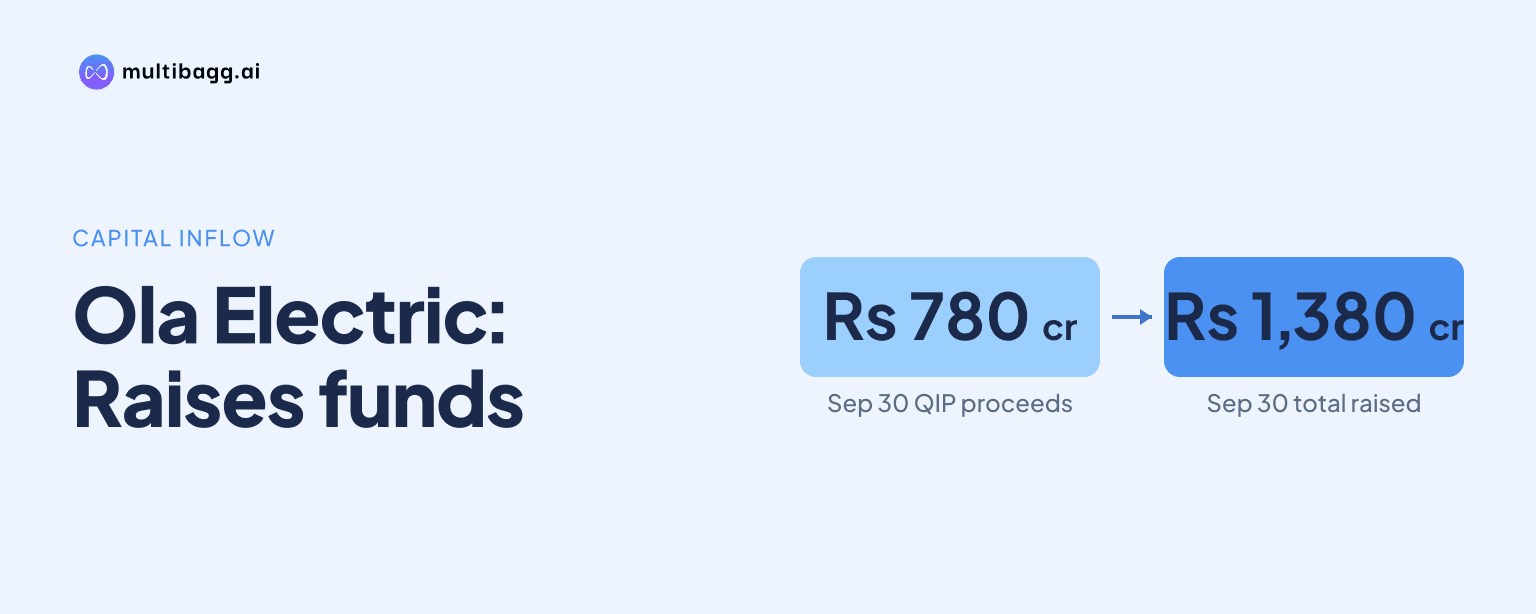
Ola Electric Mobility Limited raised Rs 780 crore through a qualified institutions placement during the six months ended September 30, 2026, and had received about Rs 600 crore from a subsequent Rs 1,000 crore partly paid rights issue, adding equity capital as operating cash outflow reached Rs 403 crore.
Know Ola Electric Mobility inside out
Results, valuation, peers and who's buying, in one view.
How did Ola Electric raise Rs 1,380 crore?
Ola Electric raised Rs 780 crore through a Qualified Institutions Placement (QIP) during the six months ended September 30, 2026. Ola Electric allotted 21,75,78,428 equity shares with a face value of Rs 10 each at Rs 35.86 per share. A QIP is an equity issue to qualified institutional buyers, and Ola Electric said the proceeds are intended for organic growth initiatives, general corporate purposes and repayment of debt obligations of Ola Electric and its subsidiaries.
Subsequent to September 30, 2026, Ola Electric allotted 37,02,72,665 partly paid-up equity shares in a rights issue to existing shareholders. The rights shares carried a face value of Rs 10 and an issue price of Rs 27 each, for an aggregate issue size of approximately Rs 1,000 crore. As of the date of the unaudited consolidated results approved on November 12, 2026, Ola Electric had received Rs 16.20 per share in application money, aggregating to approximately Rs 600 crore.
The Rs 1,380 crore figure combines the Rs 780 crore QIP proceeds and the roughly Rs 600 crore rights-issue application money received by the results date. It does not treat the entire Rs 1,000 crore rights issue as cash already received. The partly paid structure means the filing identifies Rs 16.20 per Rs 27 rights share as application money received, while the full issue price represents the aggregate offer amount.
What will Ola Electric use the new equity for?
Ola Electric said the rights issue proceeds are expected to strengthen the group’s liquidity position and support financial commitments, including debt obligations, working-capital requirements and other corporate purposes. The QIP has a more specific stated allocation framework: organic growth initiatives, general corporate purposes, and repayment of debt obligations at Ola Electric and its subsidiaries. The filing does not provide a separate numerical allocation among those QIP purposes.
The new capital follows the use of earlier initial public offering, or IPO, proceeds. Of Rs 5,275 crore in net IPO proceeds, Ola Electric reported utilisation of Rs 5,139 crore through September 30, 2026, leaving Rs 136 crore unutilised. The largest reported use was Rs 1,373 crore for general corporate purposes, while Rs 1,179 crore was used for organic growth initiatives and Rs 927 crore for research and product development.
The Rs 1,660 crore debt-repayment figure combines Rs 800 crore used for indebtedness at Ola Electric Technologies Private Limited and Rs 860 crore for indebtedness at Ola Electric and/or its subsidiaries. This prior deployment provides context for the QIP’s stated debt-repayment purpose, but the filing does not say how much of the new Rs 780 crore QIP will be directed to each borrowing or obligation.
Got a follow-up? Ask IRIS
Why did Ola Electric cite liquidity and financial commitments?
Ola Electric reported negative cash flow from operations of Rs 403 crore for the six months ended September 30, 2026, compared with negative Rs 343 crore for the six months ended September 30, 2025. Management attributed the outflow primarily to continued operating losses, lower-than-expected sales-volume growth and increased material costs. Cash used in operating activities was Rs 406 crore before a Rs 3 crore income-tax refund in the latest six-month period.
The filing says management assessed the group’s ability to continue as a going concern after considering available cash and bank balances, projected operating cash flows at material subsidiaries, available credit limits and rights-issue proceeds. Cash and cash equivalents at September 30, 2026 were Rs 123 crore, compared with Rs 335 crore at September 30, 2025. The cash-flow statement also records Rs 26 crore of transaction costs related to the equity-share issue during the latest six months.
Financing cash flow was positive Rs 204 crore in the six months to September 30, 2026, compared with negative Rs 605 crore a year earlier. Alongside the Rs 780 crore equity issue, Ola Electric paid Rs 270 crore to debenture holders, paid Rs 225 crore of current borrowings on a net basis, paid Rs 120 crore of non-current borrowings and paid Rs 150 crore of interest. These items show that equity proceeds arrived alongside debt-related cash payments rather than replacing the need for them immediately.
What other obligations and milestones should Ola Electric meet?
Ola Electric’s cell subsidiary, Ola Cell Technologies Private Limited, received an August 11, 2026 letter from the Ministry of Heavy Industries granting a waiver of liquidated damages conditional on meeting investment and other conditions within revised timelines under the Advanced Chemistry Cell Production Linked Incentive programme. The subsidiary had carried a cumulative Rs 57 crore provision at March 31, 2026 and has placed an unconditional bank guarantee of Rs 125 crore in connection with the matter.
Management said it is confident the cell subsidiary will achieve the milestone within the extended timeline and therefore concluded that no provision was required in the consolidated results for the quarter and six months ended September 30, 2026. The filing does not disclose the revised deadline or the specific remaining investment amount. It also says the cost of obligations under vehicle and battery extended producer responsibility rules could not be reliably estimated as of September 30, 2026 because further regulatory clarity is awaited.
The statutory auditors conducted a limited review of the September 2026 consolidated results and expressed a qualified review conclusion, as stated in the notes. Separately, the filing records that Ola Electric submitted a settlement application to the Securities and Exchange Board of India in June 2026 without admission of liability concerning a show-cause notice over certain prior disclosures and announcements. No financial outcome from that settlement process is disclosed in the filing.
Conclusion
Ola Electric added Rs 780 crore from the QIP and about Rs 600 crore of rights-issue application money after September 30, 2026, while reporting a Rs 403 crore operating cash outflow for the preceding six months. The disclosed uses focus on liquidity, working capital, debt obligations, organic growth and corporate purposes, placing the capital raise alongside continuing operating and financing cash requirements.
Next, investors can watch for collection of the remaining amount under the Rs 1,000 crore partly paid rights issue, the disclosed use of QIP proceeds, and progress against the revised Advanced Chemistry Cell programme milestones tied to the Rs 125 crore bank guarantee. The filing also leaves the financial effect of extended producer responsibility rules and the Securities and Exchange Board of India settlement process unresolved.