










Ola says 70% yield matches bought-cell costs before fixed costs
Key highlights
- Ola says about 70% cell yield reaches gross-margin parity with outside purchases.
- At 85% yield, Ola estimates savings of about 10–15% versus buying cells from outside.
- Ola expects automotive demand to consume about 2–3 GWh of cells in FY28.
- Ola has commissioned 6 GWh of capacity and plans to launch Shakti Gen 2 in Q4 FY27.
powered by IRIS
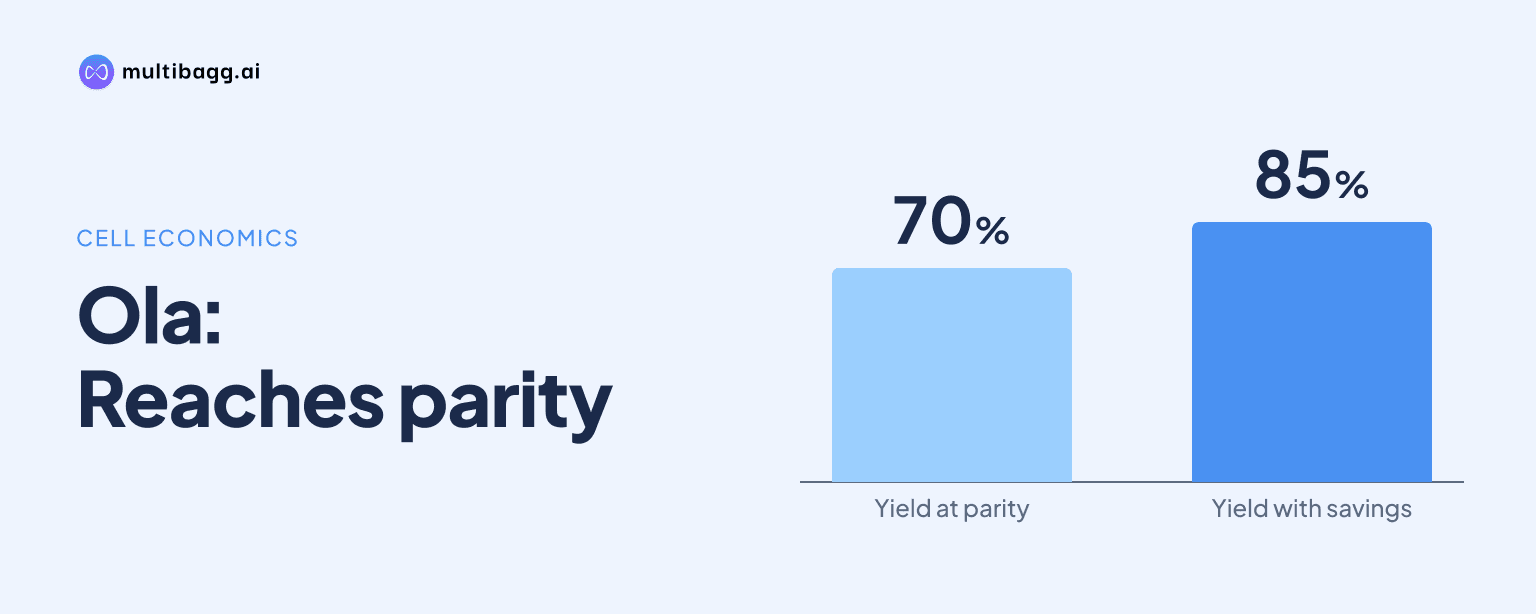
Ola Electric says a cell yield of about 70% matches the cost of buying cells from outside at the cell gross-margin level, while fixed and operating costs break even at 2–3 gigawatt-hours (GWh) of consumption. The company has commissioned 6 GWh of capacity and expects its automotive business to use 2–3 GWh in FY28.
Know Ola Electric Mobility inside out
Results, valuation, peers and who's buying, in one view.
When does Ola reach parity with externally bought cells?
Ola says its own cells reach break-even with outside purchases at a yield of about 70%, measured at the cell gross-margin level before fixed and operating costs. Management gave this threshold after the company commissioned 6 GWh of cell capacity ahead of schedule. The presentation does not disclose a rupee-per-cell or rupee-per-kilowatt-hour comparison with imported or externally bought cells.
At an 85% yield, Ola says it can save about 10–15% compared with buying cells from outside. Management expects raw-material buying costs to decline as consumption rises from current low levels to 2–3 GWh over the next few quarters. That expected cost movement depends on both higher output yield and greater procurement volume rather than on a disclosed external cell-price forecast.
Ola separates gross-margin parity from the break-even point for the Cell business as a whole. It says fixed and operating costs also break even against external purchases at 2–3 GWh of consumption, making the volume target distinct from the 70% yield threshold. In effect, the presentation identifies a unit-cost milestone first and an overhead-coverage milestone as consumption increases.
What is Ola's cell-yield timeline?
Ola reported nickel manganese cobalt, or NMC, cell yields of 70–75% and expects 80–85% by the end of Q3 FY27, followed by around 90% in Q4 FY27. If achieved, the Q3 FY27 target would place NMC output above the company’s stated 70% gross-margin parity level. Ola did not disclose NMC production volumes, scrap rates or its detailed yield methodology.
Ola says its lithium iron phosphate, or LFP, technology is ready and that LFP production is beginning to ramp in Q3 FY27. Management expects around 70% LFP yield by the end of Q4 FY27, when it plans to integrate its own LFP cells into vehicles. It then targets around 90% LFP yield in Q1 FY28, one quarter after the planned vehicle integration.
The two chemistries are at different stages. NMC was already at 70–75% yield when the presentation was issued, while LFP was entering production ramp-up in Q3 FY27; both are targeted to reach around 90%, with NMC in Q4 FY27 and LFP in Q1 FY28. Ola expects automotive cell requirements to be roughly 30% NMC and 70% LFP, making the LFP ramp the larger part of projected captive vehicle demand.
Got a follow-up? Ask IRIS
How much cell demand can Ola's vehicle business absorb?
Ola expects its automotive business to consume about 2–3 GWh of cells in FY28, the same range management identifies for fixed and operating-cost break-even. The company says its first Gigafactory priority is to meet its own automotive requirements. This links early capacity utilisation to the rollout of cells in its vehicle range rather than to an immediately disclosed external-customer sales programme.
The FY28 automotive requirement of 2–3 GWh equals about one-third to one-half of the 6 GWh capacity Ola has commissioned. Ola says capacity beyond the 2–3 GWh level will go to Shakti, its energy-storage offering. The presentation does not disclose expected Shakti unit volumes, revenue, utilisation or the date when its demand could use the remaining capacity.
Ola says Shakti Gen 2 is ready for launch in Q4 FY27 and is expected to grow into remaining capacity through FY28. The planned sequence is for automotive demand to establish the 2–3 GWh base, with Shakti intended to absorb capacity above that level. Both the planned LFP integration and the Gen 2 Shakti launch are scheduled for Q4 FY27.
What do Ola's reported Cell figures show before the ramp?
Ola's Cell segment reported revenue from operations of Rs 3 crore in Q2 FY27, gross margin of Rs 2 crore and operating expenses of Rs 40 crore. Operating earnings before interest, tax, depreciation and amortisation, or EBITDA, were a loss of Rs 32 crore, while free cash flow was negative Rs 170 crore. These unaudited results precede the projected FY28 consumption range of 2–3 GWh and do not establish the future break-even outcome.
The quarter-on-quarter figures show the segment’s limited reported revenue before the factory ramp. Revenue declined from Rs 5 crore in Q1 FY27 to Rs 3 crore in Q2 FY27, while operating expenses changed from negative Rs 21 crore to Rs 40 crore. Operating EBITDA moved from positive Rs 28 crore in Q1 FY27 to a loss of Rs 32 crore in Q2 FY27, and the presentation provides no matching data for production volume, yield or capacity utilisation.
Ola says the government extended its cell production-linked incentive programme to calendar year 2031 and that it expects incentive receipts from the next quarter because it is ahead of milestones. The presentation also cites a minimum 40% domestic-content requirement for grid-scale storage under a recently approved storage scheme. Ola does not quantify the incentive amount or state its effect on the 70%, 85% or 2–3 GWh economic thresholds.
Conclusion
Ola has set out two measurable economic gates for its cell business: about 70% yield for gross-margin parity with cells bought from outside, and 2–3 GWh of consumption for fixed and operating costs to break even on the same comparison. Its 6 GWh commissioned capacity is larger than the projected FY28 automotive requirement, while the expected 70% LFP share of vehicle cell demand makes that chemistry’s ramp central to the plan.
The next disclosed milestones are NMC yield of 80–85% by the end of Q3 FY27, LFP yield of around 70% and vehicle integration in Q4 FY27, and around 90% LFP yield in Q1 FY28. Management also plans to launch Shakti Gen 2 in Q4 FY27 and expects it to use capacity beyond 2–3 GWh through FY28.