










Ola Electric targets 700 dealer stores after store closures
Key highlights
- Ola Electric reported 319 dealer stores and 255 dealer partners as of 8 November 2026.
- Ola Electric forecasts about 450 dealer stores by December 2026 and 700 by March 2027.
- Dealer wholesale orders increased from 3,955 vehicles in September to 13,505 in October 2026.
- Ola Electric reported dealer-channel inventory of about 15 days and forecasts December production of about 25,000 vehicles.
powered by IRIS
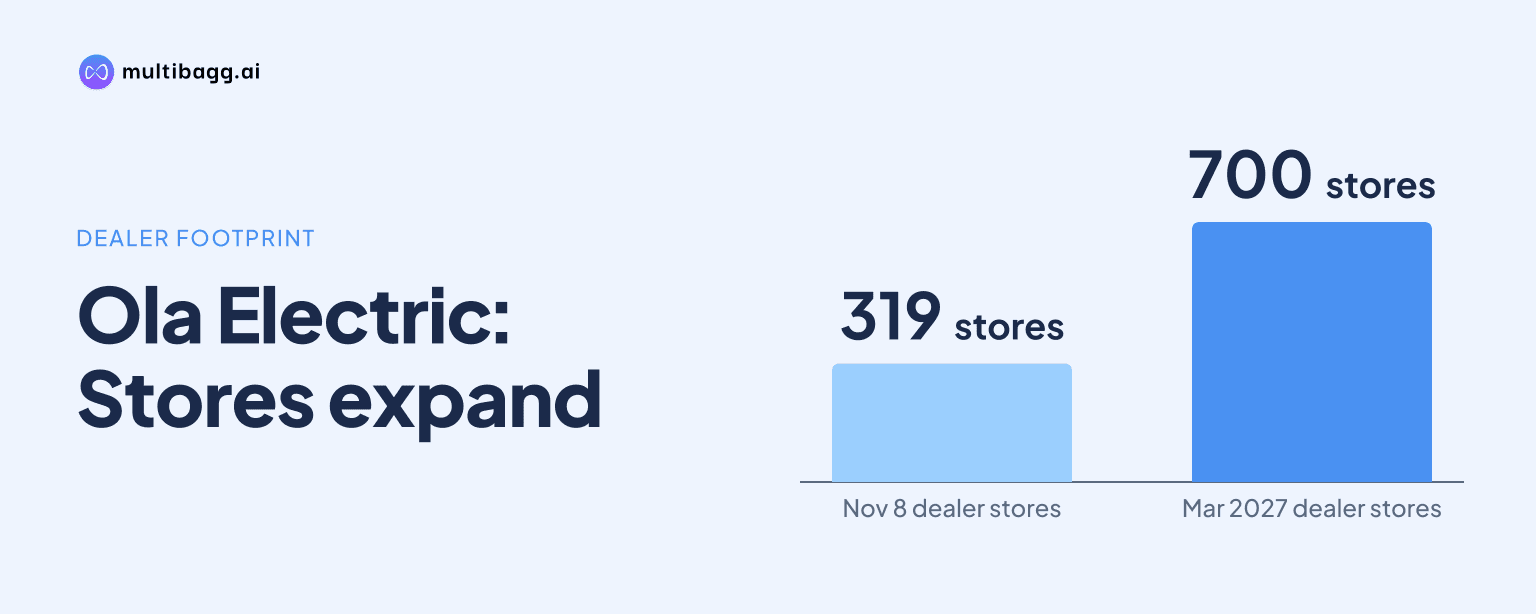
In Q2 FY27, Ola Electric Mobility Limited said it plans to operate about 700 dealer stores by March 2027, after opening 319 by 8 November and stopping orders at its direct-to-consumer stores on 1 November. The company says dealers pay when ordering and hold stock, linking the change to a better automotive working-capital cycle.
Know Ola Electric Mobility inside out
Results, valuation, peers and who's buying, in one view.
Why is Ola Electric closing its company-owned stores?
Ola Electric is shifting vehicle sales from company-owned direct-to-consumer, or D2C, outlets to dealer-run stores. The company stopped taking orders through D2C stores on 1 November 2026 and said those outlets would largely close by December, while most company stores had already been shut as of the presentation.
The operating model changes who carries vehicle inventory. Ola Electric said dealers pay for vehicles when placing orders and hold the stock in their own outlets, rather than the company funding inventory at its stores. It also said all new vehicle production now goes to dealers, making the dealer channel the route for new dispatches.
Management expects the change to lower front-end costs. In its shareholder letter, Ola Electric said operating expenses would decline by about Rs 50 crore after the company-store network is shut. The automotive segment’s reported operating expenses were Rs 269 crore in Q2 FY27, down from Rs 280 crore in Q1 FY27, although the company separately described consolidated operating expenses of Rs 369 crore in Q2 on a basis that adjusted Q1 for a Rs 57 crore one-time non-cash reversal.
How quickly is Ola Electric expanding its dealer network?
Ola Electric plans to expand from 319 dealer sales stores on 8 November 2026 to about 450 by December 2026 and 700 by March 2027. The first dealer stores opened on 4 September, and the company said it had appointed 255 dealer partners by 8 November.
The March target implies 381 additional stores from the 8 November base, more than doubling the network in under five months. The December forecast would add 131 stores from the reported November level, leaving a further 250-store increase between December and March if management’s plan is met.
The dealer count and store count are not the same measure. Ola Electric reported 255 appointed dealer partners operating 319 stores as of 8 November, indicating that some partners ran more than one outlet. The presentation identifies the rollout figures as forecasts for December 2026 and March 2027, rather than completed openings.
Are dealer orders and inventory supporting the new model?
Ola Electric says the early dealer data support the transition, citing rising repeat orders and channel inventory of about 15 days. It added that inventory was below one week in most stores that opened earliest, while registrations were somewhat slower in October as stock was built in the dealer channel.
Wholesale orders rose from 3,955 vehicles in September to 13,505 in October. For November, the company forecast 16,000 wholesale orders, followed by 20,000 in December; the November actual in the presentation covered only 1-11 November and was not stated in the wholesale-order table.
October wholesale orders were 9,550 vehicles above September, reflecting the initial build-out of stock in newly opened outlets. Ola Electric said repeat orders were becoming a larger share of wholesale orders and dispatches, but did not disclose the repeat-order percentage or a comparable registration total.
The company also reported that market share in many markets where earlier dealer outlets had stabilised was above its level before the transition. That statement is management’s assessment rather than a disclosed market-share figure. The wider electric two-wheeler, or E2W, market recorded 599,317 units in Q2 FY27, up 82.7% year on year, according to the presentation.
Got a follow-up? Ask IRIS
Can supply keep pace with Ola Electric's dealer rollout?
Ola Electric says supply-chain ramp-up, rather than customer demand or factory capacity, is the constraint on the dealer expansion. Monthly production rose from 9,235 vehicles in August to 12,284 in September and 14,092 in October, while the company forecast 20,000 vehicles for November and about 25,000 for December.
The company said it can sell every vehicle it produces and that approximately 5,000 paid September orders were delivered about a week late because chargers were unavailable, pushing deliveries into October. It now has a paid-order backlog after the dealer transition and intends to reduce it as suppliers increase their capacity.
The channel change is occurring while automotive revenue declined sequentially. Automotive segment revenue was Rs 420 crore in Q2 FY27, compared with Rs 455 crore in Q1 FY27, while automotive gross margin moved from 30.5% to 29.76%. Management said gross margin would reduce slightly over Q3 and Q4 FY27 because of the dealer rollout, but expects operating margin to improve meaningfully.
Ola Electric also linked the revised channel structure to its debt and cash-flow outlook. Automotive borrowings declined from Rs 2,422 crore in December 2024 to Rs 337 crore in September 2026, and management said the automotive business is expected to generate free cash flow in the near term. Reported automotive free cash flow remained negative Rs 134 crore in Q2 FY27, compared with negative Rs 123 crore in Q1 FY27.
Conclusion
Ola Electric’s dealer transition replaces a company-funded retail network with partners that order and hold vehicle stock. The early evidence presented is a network of 319 stores, wholesale orders rising from 3,955 in September to 13,505 in October, and inventory of about 15 days, but automotive revenue fell to Rs 420 crore in Q2 FY27 and free cash flow remained negative Rs 134 crore.
The next measures to watch are delivery against the 450-store target for December 2026 and the 700-store target for March 2027, alongside the planned rise in vehicle production to about 25,000 in December. Management has also said dealer rollout may reduce gross margin slightly through Q3 and Q4 FY27, making the reported movement in operating expenses, channel inventory and automotive cash flow relevant to the plan.