










Ola Electric to close most stores as dealer network expands
Key highlights
- Ola Electric had 255 dealer partners and 319 dealer stores as of November 8, 2026.
- Ola Electric targets 450 dealer stores by December 2026 and more than 700 by March 2027.
- Ola Electric stopped D2C-store orders on November 1 and expects most company-run stores to close by December.
- Ola Electric reported Q2 FY27 operating cash flow of negative ₹188 crore, versus negative ₹215 crore in Q1 FY27.
powered by IRIS
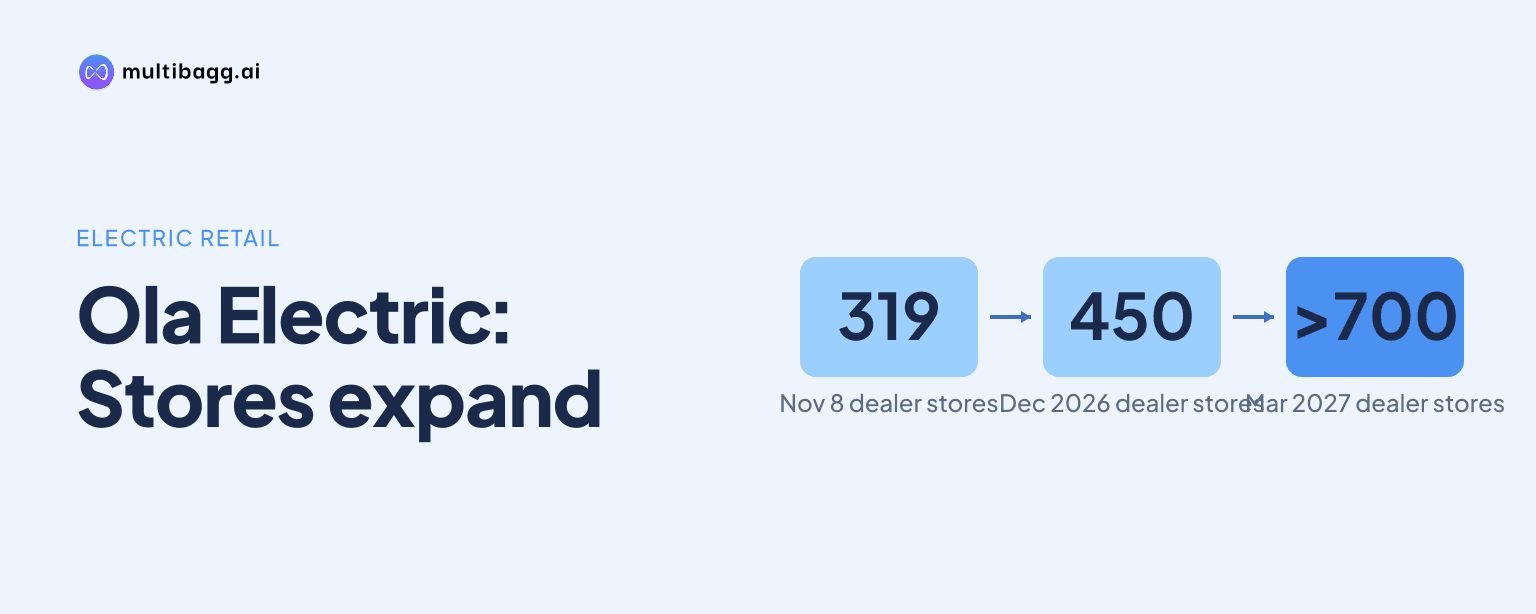
Ola Electric Mobility Limited will largely close company-run stores by December 2026 and target more than 700 dealer stores by March 2027, after building 319 outlets with 255 partners by November 8. Management says the conversion replaces inventory held in direct retail, although dealer commissions will lower gross margin in Q3 and Q4.
Know Ola Electric Mobility inside out
Results, valuation, peers and who's buying, in one view.
Why is Ola Electric closing most company-run stores?
Ola Electric is closing most company-run stores because it is replacing its direct-to-consumer, or D2C, retail structure with a dealer-led model that management expects to reduce operating expenses and alter working-capital requirements. Its first dealer started operations on September 4, 2026, and Ola Electric stopped accepting orders through D2C stores on November 1. A few company-operated stores will remain after the wider December closure.
Under D2C, Ola Electric held vehicle inventory on its own books until a retail sale was completed. Management said this also delayed goods and services tax, or GST, refunds associated with inventory. Under the dealer model, management expects working capital to turn negative because dealers purchase vehicles rather than Ola Electric carrying equivalent inventory across its own store network.
The transition follows an operating-cost comparison that management presented for Q2 FY27. Operating expenses were ₹369 crore in Q2, compared with ₹330 crore in Q1 FY27, but Q1 included a one-time positive adjustment of about ₹57 crore. On management's adjusted comparison, Q1 operating expenses were ₹390 crore, making Q2 expenses ₹21 crore lower before most company-store closures take effect.
How fast is Ola Electric expanding its dealer stores?
Ola Electric had 255 dealer partners operating 319 stores on November 8, less than two months after the September 4 launch of its first dealer. Management plans to reach 450 dealer stores by December 2026 and more than 700 by March 2027. That planned increase of at least 381 stores from November indicates the dealer network is intended to replace, rather than supplement, the former company-store footprint.
Dealer-channel inventory stood at about 15 days as of the November 12 earnings call. Management said inventory was below one week for some dealers that opened early and had stabilised. It also said market share in several such markets had risen above pre-transition levels, although it did not provide a company-wide market-share figure or quantify the increase.
The dealer rollout has a stated gross-margin cost. Ola Electric reported a 29.6% gross margin in Q2 FY27, down from 30.5% in Q1, with management attributing the decline largely to commodity costs. Management said gross margin would decline further in Q3 and Q4 as dealer commissions are introduced, while operating margin is expected to improve from Q3 as direct-retail costs are removed.
An analyst cited a possible dealer payment of ₹11,000 per vehicle, but Ola Electric did not confirm that figure. Management did confirm that dealer compensation is deducted from gross margin and described the initial terms as an introductory commission or margin structure. It expects that structure to reduce as dealers stabilise over the next two to three quarters.
Got a follow-up? Ask IRIS
What does the dealer model mean for Ola Electric cash flow?
Ola Electric said the dealer structure, lower company-store costs and changes to GST processing should improve Auto business cash flow, but it gave no date or target for free-cash-flow generation. Cash flow from operations was negative ₹188 crore in Q2 FY27, compared with negative ₹215 crore in Q1, an improvement of ₹27 crore. Management said the remaining gap between operating and free cash flow largely reflected Gigafactory capital expenditure and tail-end payments.
From November 1, management said the inverted-duty GST refund framework covered services as well as raw materials, whereas the earlier approach covered raw-material costs only. It also cited a 90% auto-approval process that management expects could shorten GST-refund timing from three to four months to one to two months. The potential benefit depends on implementation of the revised process as described by management.
An analyst referred to about ₹1,000 crore of GST-related amounts. Management said only 30% to 40% of that sum related to the inverted-duty structure, while the remainder would need to be consumed against future business. Ola Electric said dealing with GST receivables had been more complex under D2C because it had to work with multiple state governments rather than the single-state approach it said is typical for dealer-based automotive companies.
The distribution change follows a reduction in consolidated borrowings to ₹1,800 crore in September 2026 from ₹3,132 crore in December 2024. Management said Auto and original equipment manufacturer debt had declined, while borrowings related to the cell business rose to ₹1,482 crore from ₹714 crore as the project entered implementation. The company said recent equity raises were used for capacity additions and debt repayment.
Can Ola Electric supply its expanding dealer network?
Ola Electric said supply-chain ramp-up, rather than demand, is its constraint as dealer stores expand. Q2 FY27 revenue of ₹421 crore represented approximately 35,000 to 36,000 vehicles, according to management. It said charger shortages prevented revenue recognition on about 4,000 to 5,000 ready vehicles, which would otherwise have lifted quarterly volume to roughly 40,000 to 41,000 vehicles.
In September, around 5,000 paid-order deliveries were delayed by about one week into October because chargers were unavailable. Ola Electric said these vehicles were booked in the first week of October and should add some volume to Q3. Management said it has a paid-order backlog and is working with suppliers to increase supply, despite having substantial factory manufacturing capacity.
The cell operation is part of the supply plan. Ola Electric achieved commercial operations date, or COD, for an additional 3.5 gigawatt-hours, or GWh, of cell capacity on September 23, bringing total commissioned capacity to 6 GWh. Management expects a meaningful increase in cell production and cell-company revenue in Q3, initially from nickel manganese cobalt, or NMC, cells supplied to its own Auto business.
Management said NMC yields were in the mid-70% range and expected them to reach the mid-80% range over the next couple of months. It plans to start ramping lithium iron phosphate, or LFP, cell production in the next quarter, with LFP cells entering vehicles toward the end of Q4 or early Q1. Management expects roughly 30% of Auto business volume to use in-house NMC cells and 70% to use LFP cells.
Conclusion
Ola Electric's store conversion changes who holds inventory, incurs retail operating costs and manages sales-channel cash flows. The company had 319 dealer stores by November 8 and aims for more than 700 by March 2027, while Q2 operating cash outflow narrowed to ₹188 crore from ₹215 crore in Q1. The trade-off is a planned near-term decline in gross margin as dealer commissions replace costs previously carried in direct retail.
The next developments to watch are the planned December closure of most company stores, progress toward 450 dealer stores by December and the 700-plus target by March 2027. Management also said Q3 results, expected in January, should show a meaningful increase in cell output, while the paid-order backlog depends on suppliers resolving charger availability.