










Ola Electric Mobility Q2 loss widens to ₹362 crore as revenue falls
Key highlights
- Ola Electric Mobility's Q2 FY27 revenue was ₹421 crore, down 39% year-on-year from ₹690 crore.
- Ola Electric reported a Q2 FY27 net loss of ₹362 crore, compared with a ₹336 crore loss in Q1 FY27.
- Adjusted operating EBITDA loss widened to ₹246 crore from ₹195 crore in Q1 FY27.
- Ola Electric plans about 450 dealer stores by December 2026 and more than 700 by March 2027.
powered by IRIS
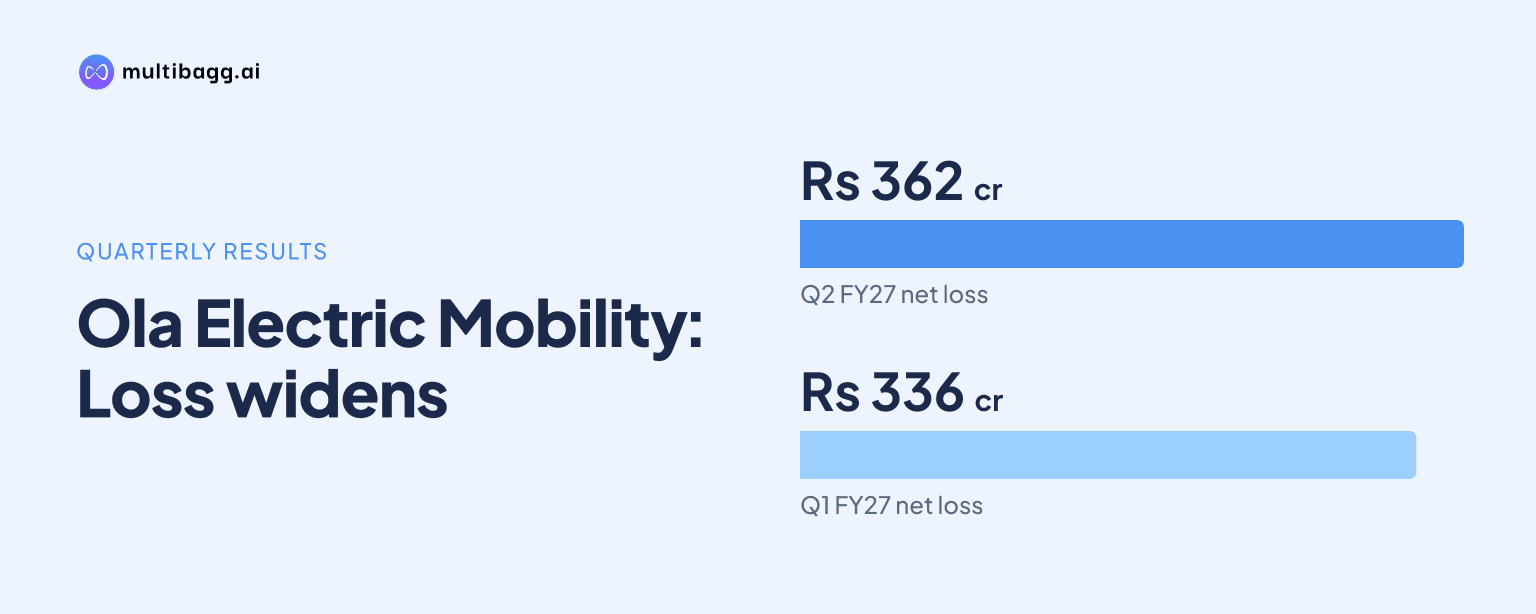
Ola Electric Mobility reported a net loss of ₹362 crore in Q2 FY27 as revenue from operations declined 39% year-on-year to ₹421 crore, while adjusted operating EBITDA loss widened to ₹246 crore from ₹195 crore in Q1 FY27. The results keep attention on production constraints, dealer expansion and the company’s ability to reduce operating costs.
Know Ola Electric Mobility inside out
Results, valuation, peers and who's buying, in one view.
What did Ola Electric report for Q2 FY27?
Ola Electric reported revenue from operations of ₹421 crore for Q2 FY27, compared with ₹690 crore in Q2 FY26. Revenue was also lower than ₹455 crore in Q1 FY27. The company reported a net loss of ₹362 crore, compared with a loss of ₹336 crore in the preceding quarter.
Gross profit stood at ₹126 crore, resulting in a gross margin of about 29.9%. This compared with gross profit of ₹139 crore and a gross margin of about 30.5% in Q1. Ola Electric said gross margin remained broadly stable despite higher commodity costs.
Adjusted operating EBITDA loss was ₹246 crore, wider than the ₹195 crore loss reported in Q1. Operating expenses were ₹369 crore, against ₹330 crore reported for Q1. However, the Q1 expense figure included a one-time positive adjustment of about ₹57 crore; excluding that adjustment, Q1 operating expenses were ₹390 crore.
Why did revenue decline and losses remain elevated?
Ola Electric described supply availability, rather than demand, as the near-term constraint on growth. During the earnings call, the company said demand exceeded supply and that supplier ramp-up was the principal operational limitation. It reported Q2 vehicle volumes of roughly 35,000 to 36,000 units.
The company also referred to approximately 5,000 paid orders affected by delivery delays. It said another 4,000 to 5,000 vehicles were delivered and booked in early October after charger-related delays. These figures indicate that delivery execution and component availability remained important factors in quarterly sales conversion.
Higher operating costs relative to revenue continued to weigh on earnings. Although operating expenses fell on a comparable basis after adjusting for the Q1 one-time item, the adjusted EBITDA loss increased sequentially as revenue and gross profit declined. The ₹362 crore figure is a net loss, not a net profit.
How is Ola Electric changing its distribution and manufacturing model?
Ola Electric is shifting from company-operated direct-to-consumer stores toward a dealer-led distribution model. The company said it planned to have about 450 dealer stores by December 2026 and more than 700 by March 2027. It expects operating expenses to decline further as most company-operated stores close.
The distribution change is intended to expand physical reach while reducing the cost burden associated with company-run outlets. The company did not provide a quantified revenue or profitability target linked to the dealer expansion in the available material.
On manufacturing, Ola Electric said it had achieved the scheduled commercial operations date for 6 GWh of cell capacity. Management described the auto and cell businesses as stabilised and said its focus was on sustainable, margin-accretive growth. It also indicated that PLI incentives were expected from the next quarter, though no financial amount was disclosed.
Got a follow-up? Ask IRIS
What does the quarter mean for Ola Electric investors?
The quarter shows that gross margin remained close to 30%, but this was not enough to offset the company’s operating cost base. Revenue fell around 7% sequentially from ₹455 crore, while adjusted EBITDA loss widened by ₹51 crore. For investors, the key reported tension is between stable unit-level gross margin and a loss-making operating structure.
Operating cash flow improved to negative ₹188 crore from negative ₹215 crore in Q1. This was an improvement of ₹27 crore quarter-on-quarter, but cash flow remained negative. The available earnings material also referred to liquidity needs and a qualified review, keeping balance-sheet and funding considerations in focus.
The company’s reported supply-constrained demand and delayed paid orders provide context for the revenue decline. But the financial impact will depend on whether production, supplier availability and dealership operations translate into deliveries without adding disproportionately to costs. No management commentary beyond the disclosed call material should be inferred.
What should investors monitor after the Q2 FY27 results?
Investors can track whether the dealer network reaches the stated milestones of 450 stores by December 2026 and more than 700 by March 2027. The pace of company-store closures and the related operating-expense trend will indicate how the distribution transition affects the cost structure.
Other disclosed indicators include the ramp-up of 6 GWh cell capacity, supplier availability, delivery of the paid-order backlog and the timing of PLI incentives. Quarterly revenue, gross margin, adjusted EBITDA loss and operating cash flow will remain the most direct measures of whether the company’s stated stabilisation efforts are reflected in reported financial performance.
Conclusion
Ola Electric Mobility’s Q2 FY27 results showed a 39% year-on-year decline in revenue to ₹421 crore and a sequential widening of net loss to ₹362 crore. Gross margin held near 30%, while negative operating cash flow improved modestly and supply constraints continued to affect deliveries.
The next disclosed milestones are the planned expansion to about 450 dealer stores by December 2026 and more than 700 by March 2027, alongside the ramp-up of 6 GWh cell capacity. Investors will also watch the reported timing of PLI incentives, order fulfilment and operating-cost reduction as the dealer-led model expands.