










Inox Wind drops FY27 growth target to improve cash flows
Key highlights
- Inox Wind said it will miss its earlier FY27 targets of 75% revenue growth and a 20%-22% EBITDA margin.
- Inox Wind expects debtor days to fall below 150 by the end of FY28.
- Inox Wind’s nearly 4 gigawatt order book represents more than Rs 20,000 crore of revenue over two years, according to management.
- Inox Wind retained its FY28 revenue target of about Rs 7,500 crore and its long-term EBITDA-margin objective of about 20%.
powered by IRIS
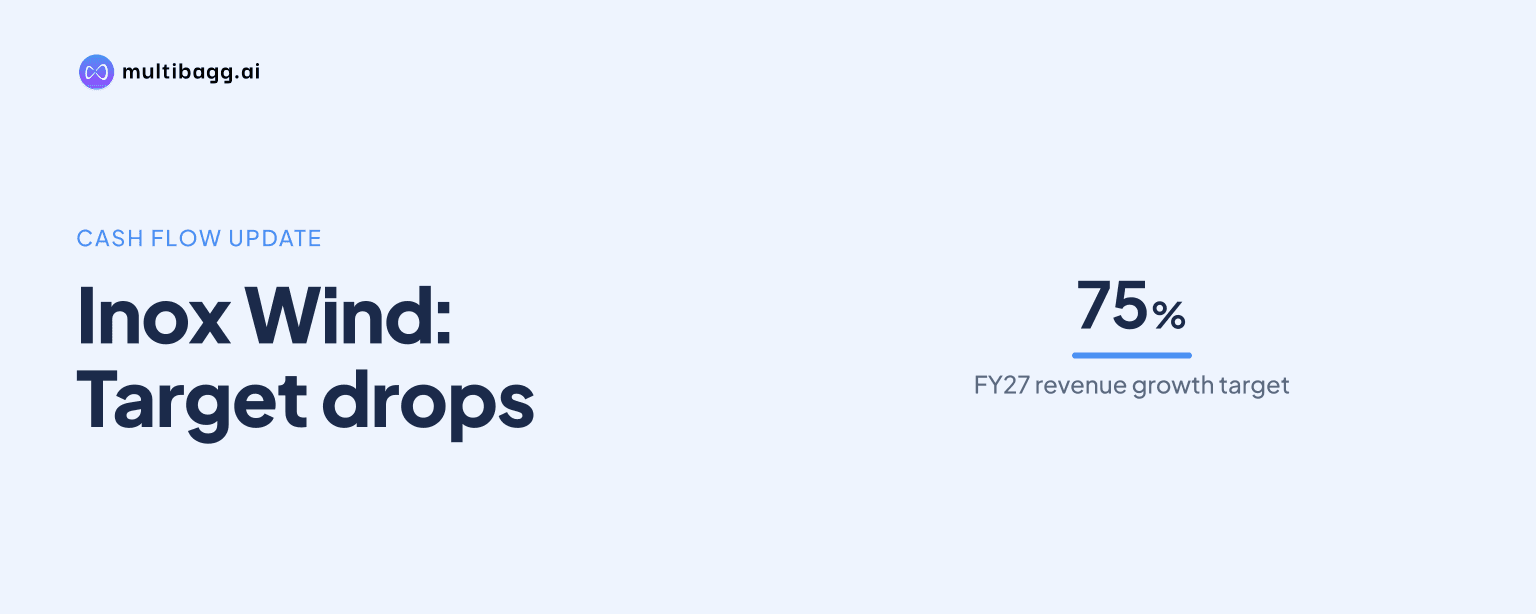
Inox Wind has withdrawn its earlier FY27 target of 75% revenue growth and 20%-22% EBITDA margin, choosing to forego some orders and revenue to reduce exposure to delayed projects and slow-paying customers. Management expects this shift toward equipment supply and selective turnkey work to bring debtor days below 150 by the end of FY28.
Know Inox Wind inside out
Results, valuation, peers and who's buying, in one view.
Why did Inox Wind withdraw its FY27 targets?
Inox Wind said it will not reach the FY27 revenue-growth and margin targets it had previously indicated. Management had earlier pointed to 75% revenue growth and an earnings before interest, tax, depreciation and amortisation, or EBITDA, margin of 20%-22%, but said during the Q2 FY27 call that it would refrain from providing specific FY27 revenue guidance.
The company attributed the change to a strategic recalibration toward the quality of growth, cash flows and balance-sheet discipline. Management said it had given up some orders during the quarter and would need to let go of some FY27 revenue, rather than execute projects that could leave substantial working capital tied up in delayed sites or unpaid customer bills.
Inox Wind’s revised approach favours equipment supply and strategically selected turnkey engineering, procurement and construction, or EPC, projects. Management said it could execute more projects, but did not want to fund customers’ projects through receivables that remain uncollected for months. That represents a change from pursuing the earlier 75% FY27 growth target to prioritising cash conversion.
What does the strategy reset mean for FY27 revenue?
Inox Wind expects significant growth in Q3 and Q4 of FY27, but will not provide a number for the full year. Management said Q2 FY27 revenue was a substantial sequential improvement over Q1 and expected momentum to continue through H2 FY27, while making clear that it would not reaffirm the earlier 75% growth indication.
Management said the change in execution mix takes time because it involves letting go of orders and shifting away from some turnkey activity. It described FY27 as a recalibration year, arguing that higher revenue would not be worthwhile if it created a larger receivables balance or required the company to carry customers through construction delays.
The company retained its FY28 revenue target of about Rs 7,500 crore and said it would review and reaffirm that outlook toward the end of Q4. Devansh Jain called the FY28 figure conservative and said there was an upward bias, but this was management’s view rather than revised formal guidance. Inox Wind’s long-term EBITDA-margin objective remains about 20%.
How will Inox Wind reduce receivables and improve cash flow?
Inox Wind plans to reduce receivables by increasing equipment supply and limiting turnkey projects to strategic opportunities. Management said the changed mix had put debtor days on a downward trajectory and set an expectation that they would fall below 150 days by the end of FY28.
The mechanism is customer and project selection. Management said turnkey contracts can expose the company to delayed project sites and instances where 20%-30% of customer payment is held up for months. By contrast, it said equipment supply, particularly to customers with dependable payment behaviour, should support a lower working-capital requirement.
The company said its current order book was close to 4 gigawatt, providing visibility for about 2.5 to three years. Management estimated that this backlog translated into more than Rs 20,000 crore of revenue over the next two years. It therefore said it did not need to target an order book extending four to six years ahead.
Inox Wind also cited an order pipeline of about 5 gigawatt that could mature over the next one to two quarters, but declined to give an FY28 order-inflow target. The comparison is between backlog size and cash quality: management said it was comfortable with nearly 4 gigawatt of existing orders and would focus on free cash flow, order quality and balance-sheet strength rather than simply accumulating more contracts.
Got a follow-up? Ask IRIS
Can Inox Wind still meet its long-term margin objective?
Inox Wind maintained its long-term EBITDA-margin objective of about 20%, although it said the previous FY27 margin range of 20%-22% would not be achieved. Management asked investors to assess margins annually because the revenue mix between equipment supply, blades, towers, nacelles, turnkey projects and operations and maintenance can vary across quarters.
Management said reported Q2 FY27 EBITDA margin was about 17%, and argued that it would have been above 20% if Wind World income had been recognised in the period. This was a management-adjusted comparison, not a reported restatement. The company did not provide a detailed split of the impact from foreign exchange, commodity costs or other drivers.
Management said Wind World income was absent from Q2 because the business would be consolidated line by line from Q3 FY27, following the NCLT-approved transfer process completed in October. It also said that the income should no longer be reported as other income after consolidation, instead entering turnover and profitability directly.
Inox Wind said it did not see significant domestic pricing pressure despite questions about additional competitors entering third-party wind supply. Management cited a limited number of wind-sector participants, high demand and contractual pass-through provisions. Its stated margin levers are a higher equipment-supply share, operating leverage and greater manufacturing utilisation.
How does Inox Green affect the group’s cash-generation plans?
Inox Green’s Wind World operations and maintenance portfolio is expected to begin contributing to reported results from Q3 FY27. Inox Green reported Q2 FY27 total income of Rs 113 crore and EBITDA of Rs 62.5 crore, neither of which included income from the acquired Wind World portfolio.
Management said Wind World generated annual revenue of Rs 580 crore in FY26 and that its Q3 FY27 contribution could be about Rs 120 crore because consolidation began in mid-October rather than at the start of the quarter. Inox Green owns 75% of the portfolio, meaning minority-interest accounting will affect the eventual profit attributable to shareholders.
Inox Green said Wind World’s current EBITDA margin was broadly 25%-30%, with an aim to raise it to about 40% through salary and employee-cost rationalisation, materials and service efficiencies, and value-added maintenance work. Management said it expected to capture that improvement within three to four quarters, though the timetable remains a management expectation during integration.
The wider group strategy supports Inox Wind’s focus on collection discipline rather than its FY27 growth target. Management said Inox Clean is a customer of Inox Wind and described payment reliability as a consideration when choosing between group demand and third-party turnkey work. Inox Wind declined to discuss Inox Clean’s capacity or funding because Inox Clean has filed a draft prospectus.
Conclusion
Inox Wind has explicitly exchanged its former FY27 growth and margin ambition for lower working-capital exposure and more selective execution. Its nearly 4 gigawatt order book, which management estimates represents more than Rs 20,000 crore of revenue over two years, provides the stated basis for prioritising collections, equipment supply and better-quality customers over near-term volume.
The next disclosures to watch are Q3 FY27, when Wind World will be consolidated line by line, and the end of Q4, when management plans to review its FY28 revenue target of about Rs 7,500 crore. The measurable operating target remains debtor days below 150 by the end of FY28, alongside the long-term EBITDA-margin objective of about 20%.