








Airpro Technology India Limited Jaipur plan is unappraised
MAX Plan at ₹4,999/yr

Find your next multibaggerBe a Pro Investor
Research stocks and track your picks on the go. Download the app.
Key highlights
- Airpro plans to allocate Rs 7.57 crore of Rs 24.91 crore net proceeds to the Jaipur factory.
- No Airpro IPO object has been appraised by a bank, financial institution or independent third party.
- The Jaipur factory has a stated cost of Rs 8.14 crore, with Rs 56.73 lakh expected from internal accruals or borrowings.
- Airpro targets about 1,25,000 units of annual capacity from five lines after the proposed capital expenditure.
powered by IRIS
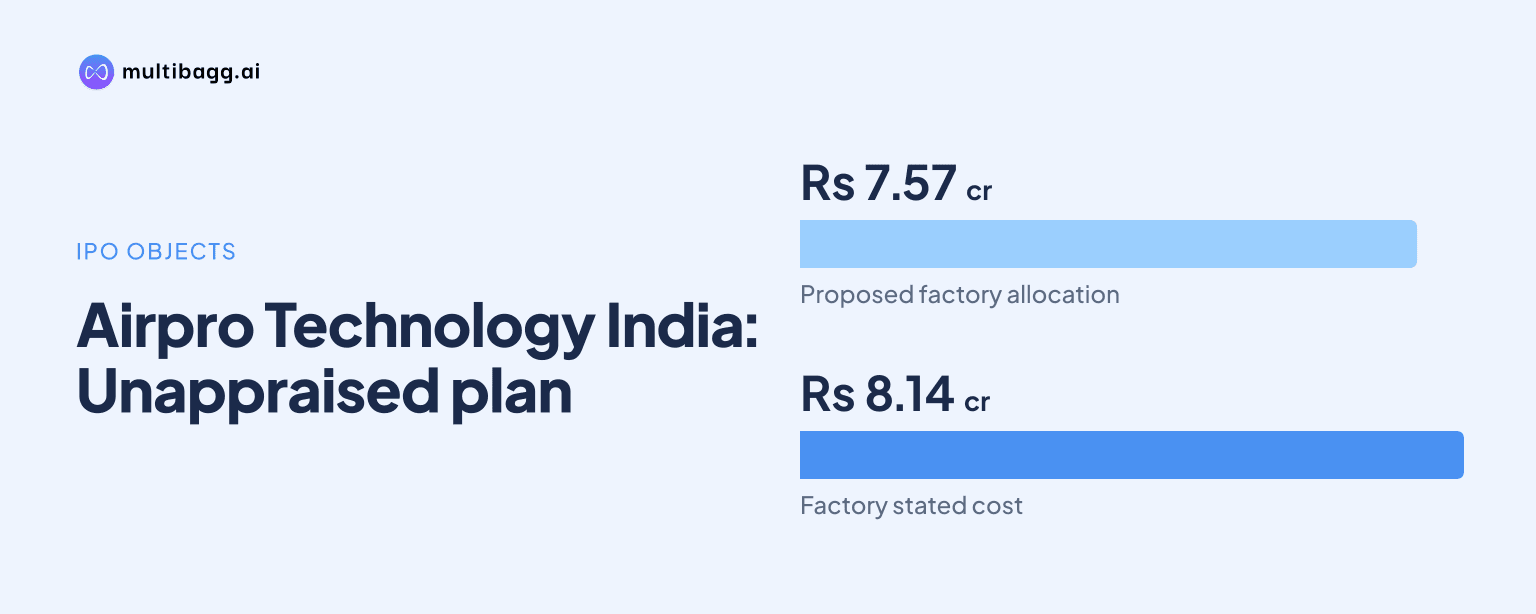
Airpro Technology India Limited’s Rs 7.57 crore Jaipur factory allocation from IPO net proceeds has not been independently appraised, and the company says management may revise spending or reallocate funds if costs vary. The prospectus bases all offer objects on quotations and management estimates, with shortfalls potentially funded through accruals, borrowings or unsecured loans.
How is Airpro funding its Jaipur factory plan?
Airpro proposes to deploy Rs 7.57 crore of estimated net proceeds to its Jaipur factory, comprising Rs 2 crore for machinery, Rs 60 lakh for the balance land payment and Rs 4.97 crore for construction. Net proceeds, meaning fresh-offer proceeds after offer expenses, are estimated at Rs 24.91 crore from gross fresh-offer proceeds of Rs 28.91 crore, after estimated expenses of Rs 4 crore.
The Jaipur factory’s total stated cost is Rs 8.14 crore, exceeding the Rs 7.57 crore IPO allocation by Rs 56.73 lakh. The machinery budget is Rs 2.04 crore, the land cost is Rs 1.11 crore and the building cost is Rs 4.99 crore; the remaining portions are to be funded through internal accruals or borrowings. Airpro also says goods and services tax on machinery, and taxes and interest on land and construction, will be paid from internal accruals rather than IPO proceeds.
Working capital is the largest stated use of net proceeds at Rs 13 crore, compared with Rs 7.57 crore for the Jaipur factory and Rs 4.34 crore for general corporate purposes. Airpro estimates working-capital requirements of Rs 34.72 crore for fiscal 2027, of which Rs 13 crore is expected from IPO proceeds and Rs 21.72 crore from internal accruals, bank borrowings or non-banking financial company financing.
Why is Airpro’s Jaipur factory plan not independently appraised?
Airpro states that none of its offer objects, including the Jaipur factory, has been appraised by a bank, financial institution or independent third-party organisation. Its Rs 24.91 crore deployment plan is based on available quotations and management estimates, which may change with interest rates, commercial conditions, financial condition, business strategy and other external circumstances.
The prospectus draws a distinction between machinery and the other objects. It says requirements other than machinery are based on internal management estimates and have not been verified by the book-running lead manager or appraised by a bank or financial institution. The Rs 2.04 crore machinery estimate is supported by a quotation dated June 25, 2026, valid for six months, while Airpro intends to finance Rs 2 crore of that cost from net proceeds.
The building estimate relies on a May 24, 2026 quotation from Ritekch Vikas Vijay for site development and civil work. The initial quoted civil-work amount was Rs 3.97 crore, while the disclosed building cost reaches Rs 4.99 crore after adding 10% for sanitary and electrical work. The quotation is valid until December 31, 2026, or until cancelled by the customer, whichever is earlier, and Airpro says any price escalation will come from internal accruals.
The lack of an appraisal does not alter the disclosed machinery, land and building budgets, but it leaves their adequacy dependent on management estimates and live quotations. Completion must therefore depend on the availability of materials and labour, the quoted costs remaining sufficient, and Airpro securing funds for expenditure outside the IPO allocation.
Got a follow-up? Ask IRIS
What capacity and timeline does Airpro’s Jaipur factory target?
Airpro targets aggregate capacity of about 1,25,000 units a year across five assembly lines after the proposed capital expenditure, compared with one existing assembly and testing line. Chartered Engineer Vikas V. Patankar certified the proposed post-capital-expenditure capacity on August 22, 2026, but Airpro says actual utilisation can be assessed only after installation, trial runs and regular production begin.
Airpro’s existing Mumbai facility has about 1,400 square feet of land area and primarily assembles and tests access-point devices. Annual assembly capacity was 24,000 units in fiscal 2024, fiscal 2025 and fiscal 2026; utilisation increased from 77%, or 18,500 units, in fiscal 2024 to 100%, or 24,000 units, in fiscal 2025 and fiscal 2026. For the period ended September 30, 2026, stated capacity and utilisation were both 12,000 units.
The Jaipur facility is planned at Plot No. F-23 in Shri Ram Janki Industrial Area, Kunjbiharipura, Jaipur, under a lease agreement with Rajasthan State Industrial Development and Investment Corporation Limited dated April 23, 2026. Airpro had paid Rs 30.37 lakh of the Rs 1.11 crore land premium by the prospectus date and intends to use Rs 60 lakh of IPO proceeds for the balance payment, with the residual requirement from internal accruals or borrowings.
Airpro expects construction to take about six to eight months, subject to timely materials, labour and other resources. Its disclosure projects completion by April 30, 2027 if listing occurs on October 15, 2026; the operating capacity target additionally depends on machinery installation, trial runs and commencement of regular production.
How could Airpro respond if Jaipur project costs change?
Airpro may reschedule expenditure, revise funding requirements and use surplus money from one stated object for another object facing a shortfall, subject to applicable law. If actual spending on an object is lower than proposed, the balance may be used for general corporate purposes, provided that this category does not exceed 15% of gross proceeds or Rs 10 crore, whichever is lower.
A funding shortfall or cost overrun would not necessarily be met by additional IPO proceeds. Airpro says it may use internal accruals, seek additional debt from existing or future lenders, or use unsecured loans. It confirms that no firm financing arrangement is required under Regulation 230(1)(i) of the Securities and Exchange Board of India Issue of Capital and Disclosure Requirements Regulations because funding beyond IPO proceeds is intended to come from internal accruals.
Airpro has not raised bridge loans intended to be repaid from net proceeds as of the prospectus date. The company is not required to appoint a monitoring agency because its offer size does not exceed Rs 50 crore, but its Audit Committee will monitor use of proceeds and its statutory auditor will provide a utilisation certificate with half-yearly financial results until the proceeds are fully used.
Airpro must also disclose actual deviations and category-wise variations in net-proceeds use to stock exchanges every six months until utilisation is complete or the stated purpose is achieved. A change in the objects of the offer requires shareholder authorisation through a special resolution under Section 27 of the Companies Act, 2013, with the prescribed notice and disclosure requirements.
Conclusion
Airpro’s Jaipur expansion combines a stated Rs 8.14 crore factory cost, a Rs 7.57 crore IPO allocation and Rs 56.73 lakh of expected non-IPO funding, but none of the offer objects has independent appraisal. The financial outcome consequently depends on management estimates, the continued availability of quotations and the company’s ability to meet shortfalls through internal accruals, borrowings or unsecured loans.
The next disclosed points to watch are the December 31, 2026 validity date for the civil-work quotation and the conditional April 30, 2027 construction target. Airpro’s half-yearly statements on deviations in use of proceeds, along with statutory-auditor utilisation certificates, should show whether the Rs 24.91 crore net-proceeds plan remains on schedule.

