








Fixed Wireless Broadband base rose 50% to 17.1 million
MAX Plan at ₹4,999/yr

Find your next multibaggerBe a Pro Investor
Research stocks and track your picks on the go. Download the app.
Key highlights
- Fixed Wireless Broadband subscribers increased from 11.4 million in August 2025 to 17.1 million in March 2026.
- The seven-month increase of 5.7 million subscribers represented approximately 50.0% cumulative growth.
- December 2025 recorded the largest monthly subscriber addition at 1.02 million.
- India had 302 data centres, with Maharashtra accounting for 99, or approximately 32.8%, of the total.
powered by IRIS
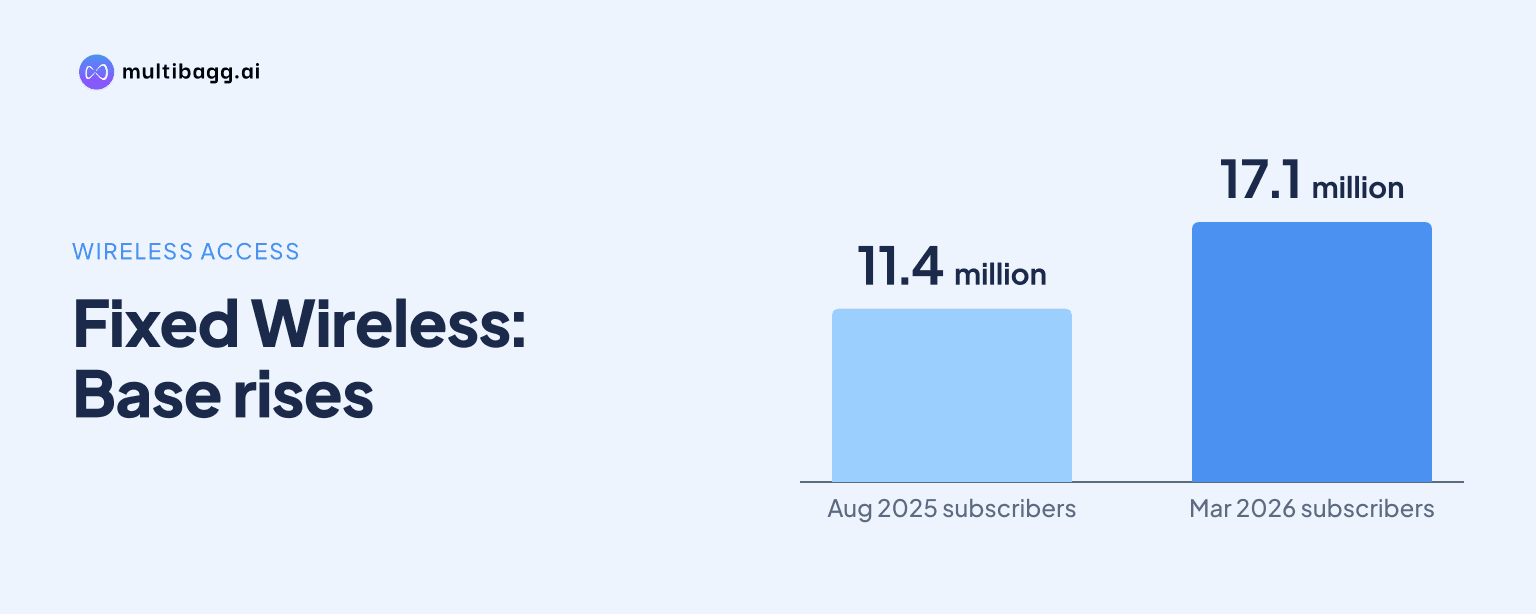
India’s Fixed Wireless Broadband subscriber base rose 50.0% to 17.1 million in March 2026 from 11.4 million in August 2025, according to Telecom Regulatory Authority of India monthly data. The 5.7 million increase is a demand indicator for Wi-Fi routers, wireless access points, modems and other connectivity equipment used across homes, enterprises and institutions.
How fast did Fixed Wireless Broadband base grow?
Fixed Wireless Broadband added 5.7 million subscribers between August 2025 and March 2026, and the base increased in each month of the reported period. The March 2026 total of 17.1 million was approximately 50.0% above the August 2025 base of 11.4 million.
The largest month-on-month numerical increase was 1.02 million subscribers in December 2025, after the base stood at 14.06 million in November 2025. Additions were 0.87 million in January 2026, 0.56 million in February 2026 and 0.59 million in March 2026, so the total continued to rise despite lower additions than in December 2025.
The Telecom Regulatory Authority of India series covers a combined wireless-broadband category, not a count of 5G Fixed Wireless Access alone. It includes subscribers using 5G Fixed Wireless Access, Wi-Fi and Wi-Max, making the 17.1 million March 2026 figure a measure of the combined base for the technologies identified in the source.
What is driving Fixed Wireless Broadband subscriber growth?
Fixed Wireless Broadband growth is attributed in the industry assessment to 5G network deployment, broader broadband connectivity, rising internet penetration and demand for high-speed access. Fixed Wireless Access, or FWA, provides internet to homes, enterprises and institutions through radio-based infrastructure instead of traditional wired broadband connections.
The deployment mechanism is relevant because 5G FWA, Wi-Fi and Wi-Max use wireless transmission systems to provide coverage across urban and rural regions. Continued growth beyond March 2026 depends on further wireless-infrastructure deployment and sustained adoption of high-speed connectivity by residential, enterprise and institutional users.
Remote working, digital learning, smart devices, over-the-top, or OTT, platforms, cloud applications and enterprise digital infrastructure are also cited as demand factors. The March 2026 total of 17.1 million does not, however, split subscribers by household, enterprise or institution, or by 5G FWA, Wi-Fi and Wi-Max technology.
Got a follow-up? Ask IRIS
Why does Fixed Wireless Broadband growth matter for networking hardware demand?
Fixed Wireless Broadband growth may raise demand for Wi-Fi routers, wireless access points, modems and related connectivity devices as users install or expand wireless coverage. The relationship is demand-led because a broadband connection requires equipment to receive, distribute or manage connectivity, although the subscriber series does not quantify device sales, replacement demand or supplier revenue.
India’s 302 data centres provide a separate indicator of enterprise and cloud-related networking demand. Maharashtra had 99 data centres, representing approximately 32.8% of the total, while Tamil Nadu had 39, Telangana 37, Karnataka 31 and Uttar Pradesh 21; the industry assessment expects data-centre expansion to support routers, switches, fibre networking systems and enterprise communication equipment.
The equipment categories identified in the industry assessment extend beyond home routers to switches, wireless access points, controllers and communication equipment. Digitally connected commercial spaces, cloud computing, artificial intelligence, Internet of Things, or IoT, systems and cybersecurity requirements are cited as further sources of demand, so Fixed Wireless Broadband is one signal within a market also affected by enterprise, telecom and data-centre spending.
What must persist for Fixed Wireless Broadband growth to support the sector?
Fixed Wireless Broadband can continue supporting equipment demand if 5G and broadband expansion, wireless-coverage deployment and high-speed-connectivity adoption persist beyond March 2026. The industry assessment categorises expansion of broadband connectivity and 5G network deployment as a high-impact growth driver over one to two years, three to four years and five to seven years.
Telecom and enterprise capital-expenditure cycles are another condition because networking-equipment demand is linked to investment by telecom operators, enterprises, government institutions and data-centre operators. The assessment calls this dependence a moderate challenge over one to two years and a high challenge over three to four years and five to seven years, meaning delayed infrastructure projects could reduce equipment deployment even with subscriber growth.
Imported-component availability is a further constraint for Indian IT hardware and networking businesses. The source says the industry depends significantly on imported semiconductors, chipsets, electronic components and communication modules, while rapid technological change can shorten product cycles and require continued product-development investment; therefore, the 17.1 million subscriber base alone does not establish domestic manufacturing output, supplier margins or purchase timing.
Conclusion
Fixed Wireless Broadband expanded by 5.7 million subscribers in seven months, from 11.4 million in August 2025 to 17.1 million in March 2026. The 50.0% increase indicates rising use of wireless broadband and may support connectivity-equipment demand, while India’s 302 data centres represent a separate enterprise and cloud-related demand base for networking products.
What to watch next is whether the monthly subscriber series continues to rise after March 2026 as broadband, fibre-optic and 5G infrastructure deployment proceeds. The industry assessment also identifies telecom and enterprise capital-expenditure cycles, imported-component dependence and technology-upgrade requirements as unresolved factors that can affect networking-equipment demand and supply.

