










Shree Siddhivinayak IPO RHP Analysis: Fresh Issue Funds Debt
Key highlights
- FY 2026 revenue from operations was Rs 75.27 crore and profit after tax was Rs 11.59 crore.
- The IPO is a fresh issue of up to 65.96 lakh shares with no offer for sale.
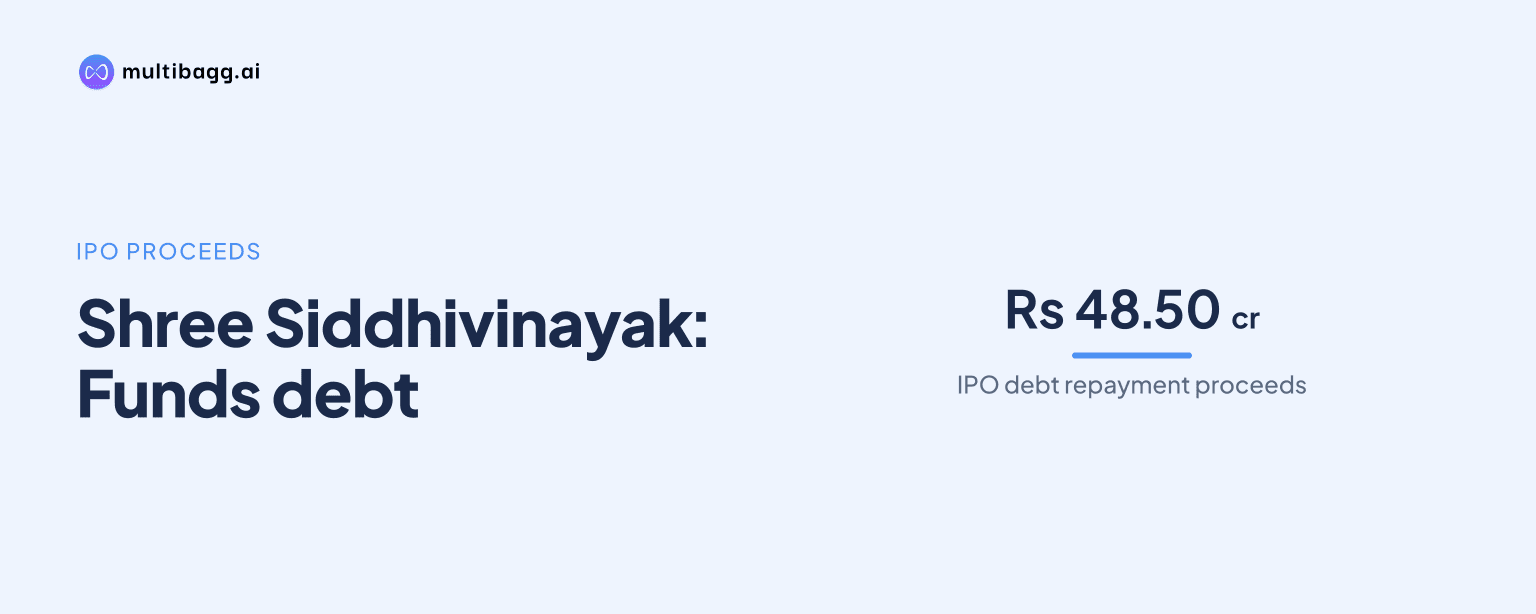
- Rs 48.50 crore of proposed proceeds is earmarked for repayment or prepayment of certain borrowings.
- The top five customers accounted for 97.45% of revenue in the period ended July 31, 2026.
powered by IRIS
Shree Siddhivinayak Greentech Industries Limited is undertaking a fresh-share IPO to expand sugarcane crushing capacity and repay borrowings, after reporting FY 2026 profit after tax of Rs 11.59 crore on Rs 75.27 crore of revenue from operations. The company’s most material disclosed use is Rs 48.50 crore for repayment or prepayment of certain secured borrowings; the issue price remains undisclosed.
What are the IPO offer terms and shareholding details?
Shree Siddhivinayak is offering up to 65.96 lakh new equity shares, with the issue price, price band and minimum bid lot not disclosed in the RHP.
The entire offer is a fresh issue, so proceeds, after issue expenses, will go to Shree Siddhivinayak rather than selling shareholders. The 65.96 lakh shares include a market-maker reservation of 3.30 lakh shares and a net issue to the public of 62.66 lakh shares. The issue represents 35.00% of post-issue paid-up equity capital and is proposed to list on NSE Emerge.
Basan Equity Broking Limited is the market maker, with a stated market-making term of three years from listing. The offer is 100% underwritten, with Erudore Capital Private Limited disclosed as underwriting up to 65.96 lakh shares. The RHP states that the price band and minimum bid lot will be advertised at least two working days before issue opening.
What does Shree Siddhivinayak sell, who buys it, and what are its dependencies and concentrations?
Shree Siddhivinayak processes sugarcane into jaggery powder, khandsari sugar, jaggery-based pre-mixes, cane seeds and by-products, and it derives almost all revenue from business-to-business sales.
The company began commercial operations in FY 2024. It started jaggery powder production in FY 2024, entered jaggery-based pre-mixes in FY 2025, and added khandsari sugar and cane-seed cultivation in FY 2026. Its B2B offerings include jaggery powder, khandsari sugar, bagasse, molasses, press mud, ash and cane seeds. Consumer products are sold under the Feel Guddy brand through a Pune retail outlet, Amazon and Meesho. It proposes to introduce consumer-pack khandsari sugar under the Simply Sakhar brand in FY 2027.
Jaggery powder was the main product, generating Rs 33.07 crore, or 94.46% of product sales, in the period ended July 31, 2026. In FY 2026, it generated Rs 64.94 crore, or 86.28% of product sales. B2B revenue was Rs 34.98 crore, or 99.90% of revenue from operations, in the July 2026 period, while B2C revenue was Rs 3.64 lakh.
Customer and geographic concentration are substantial. The five largest customers contributed Rs 34.12 crore, or 97.45% of revenue from operations, in the July 2026 period; the top 10 contributed Rs 34.99 crore, or 99.92%. Madhya Pradesh accounted for Rs 27.70 crore, or 79.11%, of revenue in that period, while Maharashtra accounted for Rs 7.32 crore, or 20.89%. In FY 2026, Maharashtra accounted for 63.92% and Madhya Pradesh for 27.81% of revenue.
Sugarcane is procured directly from farmers in Maharashtra. The company has no long-term supply arrangements, no formal hedging policy and does not hedge on commodity futures platforms. In FY 2026, sugarcane purchases were Rs 36.89 crore, equal to 49.01% of revenue, and harvesting and transportation cost Rs 14.48 crore, or 19.23% of revenue. By contrast, the top 10 suppliers represented 3.03% of sugarcane purchases, indicating a less concentrated supplier base than customer base.
What is Shree Siddhivinayak’s multi-year financial track record?
Shree Siddhivinayak reported revenue and profit growth from FY 2024 to FY 2026, while the July 2026 figures cover a four-month period and are not directly comparable with full-year results.
Revenue from operations grew 28.52% in FY 2026, after 61.44% growth in FY 2025. Profit after tax increased from Rs 5.50 crore in FY 2025 to Rs 11.59 crore in FY 2026, and PAT margin rose to 15.40% from 9.39%. The figures should be read alongside seasonality because manufacturing typically runs from around October-November to April-May.
Government incentives recognised were Rs 2.82 crore in FY 2026, Rs 2.42 crore in FY 2025 and Rs 54.66 lakh in FY 2024. The company’s PSI-2019 eligibility certificate for its Khamaswadi facility is effective from January 1, 2024 to April 30, 2035, with a stated total admissible incentive amount of Rs 43.50 crore, subject to its terms and conditions.
How do margins and returns compare with listed peers named in the RHP?
Shree Siddhivinayak’s FY 2026 EBITDA margin, PAT margin and return on capital employed exceeded those reported for the two peers in the RHP benchmarking table, while its debt-to-equity ratio was higher.
The comparison is limited to the companies selected and metrics disclosed by the RHP. Shree Siddhivinayak’s FY 2026 return on equity was 53.24%, while its return on net worth in the issue-price section was 46.24%, reflecting different stated measures and calculations in the document.
What do cash flow, debt and loan terms show?
Shree Siddhivinayak generated positive operating cash flow in FY 2025 and FY 2026 but had Rs 74.72 crore of borrowings as at July 31, 2026.
Operating cash flow was Rs 16.72 crore in the period ended July 31, 2026, Rs 5.04 crore in FY 2026, Rs 13.24 crore in FY 2025 and negative Rs 17.79 crore in FY 2024. Capital expenditure, defined here as purchases of property, plant and equipment or transfers from capital work-in-progress, was Rs 13.78 crore in FY 2026, Rs 4.35 crore in FY 2025 and Rs 56.20 crore in FY 2024.
At July 31, 2026, long-term borrowings were Rs 31.85 crore and short-term borrowings were Rs 42.87 crore. The debt-to-equity ratio was 2.62 times, down from 3.59 times at March 31, 2026. Secured borrowings totalled Rs 49.27 crore, or 65.94% of total borrowings. Borrowings repayable on demand were Rs 28.99 crore, including Rs 25.45 crore of director loans and Rs 3.54 crore of cash credit.
The company disclosed compliance with prescribed financial ratios and no defaults, rescheduling or restructuring during the stub period and preceding three financial years. HDFC Bank facilities had disclosed interest rates of 8.50% to 9.50% as at October 31, 2026, and certain facilities may carry prepayment penalties of up to 4%, plus taxes. Security includes debtors, fixed deposits, plant and machinery, pledged stock and property collateral.
Got a follow-up? Ask IRIS
What is Shree Siddhivinayak’s valuation at the upper price band?
Shree Siddhivinayak’s price-to-earnings, enterprise-value-to-EBITDA, price-to-book and price-to-sales multiples cannot be computed because the RHP does not disclose a price band or issue price.
These are our own calculations from document figures once a cap price is available. Inputs would include post-issue shares of up to 188.46 lakh, FY 2026 adjusted earnings per share of Rs 9.46, adjusted net asset value per share of Rs 20.47, FY 2026 revenue of Rs 75.27 crore, FY 2026 EBITDA of Rs 20.46 crore, borrowings of Rs 74.72 crore and cash and bank balances of Rs 50.57 lakh as at July 31, 2026.
The RHP discloses P/E ratios of 22.65 times for Dhampure Specialty Sugars Limited and 16.39 times for Dollex Agrotech Limited. The disclosed industry P/E range is 16.39 to 22.65 times, with an average of 19.52 times. Peer EV/EBITDA, P/B and P/S multiples are not disclosed in the RHP.
Who receives the IPO money, and are there selling shareholders or pre-IPO placements?
Shree Siddhivinayak will receive all IPO proceeds because the offer comprises only fresh shares and has no offer-for-sale component.
There are no selling shareholders and therefore no seller cost of acquisition applicable to the offer. The company does not intend to undertake a pre-IPO placement. All pre-issue shares were held in dematerialised form and the RHP states that no shares were pledged or otherwise encumbered as of its date.
The promoters’ disclosed average cost of acquisition was Rs 0.19 per share for Dattatray Kashinath Kulkarni’s 26.25 lakh shares and Rs 4.00 per share for Dipali Dattatraya Kulkarni’s 96.25 lakh shares. Dattatray also received 10.00 lakh shares at nil consideration through a gift transfer in January 2026. Promoter lock-in terms are not disclosed in the RHP notes supplied.
How will Shree Siddhivinayak use the IPO proceeds?
Shree Siddhivinayak has identified Rs 72.04 crore for capacity expansion and repayment or prepayment of certain borrowings, with deployment estimated by March 31, 2028.
The capital expenditure is intended to increase sugarcane crushing capacity from 1,250 tonnes crushed per day to 2,000 tonnes crushed per day. The equipment quotation is Rs 19.95 crore plus Rs 3.59 crore of goods and services tax. The company had not placed an order as of the RHP date and estimates completion by December 2027.
As at October 31, 2026, secured bank and financial-institution borrowings were Rs 50.54 crore. The proposed Rs 48.50 crore repayment represents 95.96% of that portfolio. The stated proceeds will not be used to repay loans from directors, promoters, promoter-group members or group companies. No external agency appraised the objects, and any shortfall is proposed to be met through internal accruals.
Who are the promoters and what related-party dealings are disclosed?
Shree Siddhivinayak is promoted by spouses Dipali Dattatraya Kulkarni and Dattatray Kashinath Kulkarni, who will retain 65.00% combined post-issue ownership.
Dipali is managing director and holds 78.57% pre-issue and 51.07% post-issue. Dattatray is executive director and chief financial officer, holding 21.43% pre-issue and 13.93% post-issue. Both have more than five years of experience in jaggery and sugar manufacturing. Dattatray has served as Bharatiya Janata Party president for Dharashiv District since June 2025 and was disqualified from November 2016 to October 2021 following the strike-off of a company where he was a director.
The promoters’ other ventures include Shree Siddhivinayak Foodtech Farmer Producer Company Limited, while Dipali also discloses Siddhtech Transportation and Other Multiservices and Dattatray discloses Shri Siddhivinayak Petroleum. Factory and godown properties are leased from Dattatray; one factory lease runs until July 2042 at Rs 50,000 monthly rent, increasing by 10% every three years.
Related-party expenses were Rs 31.29 lakh in the period ended July 31, 2026 and Rs 1.63 crore in FY 2026. Related-party unsecured loan balances were Rs 25.45 crore at July 31, 2026, or 34.06% of total loans, comprising Rs 4.09 crore from Dattatray and Rs 21.36 crore from Dipali.
What are the top risks disclosed in the RHP?
The RHP first identifies product concentration, geographic concentration and customer concentration as its leading risks.
- Jaggery powder accounted for Rs 33.07 crore, or 94.46%, of product sales in the period ended July 31, 2026.
- Madhya Pradesh accounted for Rs 27.70 crore, or 79.11%, of revenue in that period.
- The five largest customers accounted for Rs 34.12 crore, or 97.45%, of revenue, while the top 10 accounted for 99.92%.
- Production is seasonal: the factory operated for 120 days in FY 2026, 102 days in FY 2025 and 146 days in FY 2024.
- Debt-to-equity was 2.62 times at July 31, 2026, and finance cost was Rs 1.74 crore in the stub period.
- Sugarcane purchases and harvesting and transportation together equalled 68.24% of FY 2026 revenue; there are no long-term supply arrangements or commodity hedging.
- Ten trademark applications were objected, and the company states it does not have statutory protection associated with registered trademarks.
- Insurance coverage was Rs 69.56 crore against tangible assets of Rs 93.66 crore, or 74.27%, and the company had no product-liability insurance.
The RHP also describes a March 2024 private-placement compliance matter. The company filed e-Form GNL-1 in June 2026, and adjudication proceedings were pending at the RHP date. Potential penalties disclosed are up to Rs 2 lakh for the company and Rs 50,000 for each officer in default.
What litigation is outstanding?
The RHP reports six company tax proceedings with Rs 28.75 lakh involved, seven promoter tax proceedings with Rs 10.86 lakh involved, and group-company tax and criminal matters.
The company’s tax matters include two pending income-tax adjustment notices with amounts not ascertainable and tax deducted at source defaults totalling Rs 28.75 lakh. The board’s material-litigation threshold was Rs 33.62 lakh. Separately, trade creditor dues at July 31, 2026 were Rs 5.12 crore across 385 creditors, including Rs 27.27 lakh due to eight micro, small and medium enterprise creditors.
Conclusion
Shree Siddhivinayak’s RHP describes a young, seasonal sugarcane processor that recorded higher revenue, EBITDA and PAT through FY 2026, while retaining material dependence on jaggery powder, a limited customer base and Maharashtra and Madhya Pradesh markets. The fresh IPO is designed principally to reduce secured debt and fund a manufacturing expansion, while the undisclosed issue price prevents an assessment of market capitalisation or valuation multiples.
The next disclosed events are publication of the price band before the November 25, 2026 issue opening, the November 25 to 27 bidding period and intended deployment of proceeds by March 31, 2028. Investors can watch whether the company completes its expansion by December 2027, finalises debt prepayment, obtains post-expansion operating approvals and resolves the pending private-placement adjudication.