










Foodlink’s seven kitchens support over 100,000 daily meals
Key highlights
- Foodlink operates seven centralized kitchens, with six in India and one in Dubai.
- Foodlink’s kitchen network spans over 91,500 square feet and can provide more than 100,000 meals a day.
- Foodlink catered 1,092 events through its events catering business in Fiscal 2026, up from 911 in Fiscal 2024.
- Banquets and integrated food-and-beverage services contributed 22.51% of Fiscal 2026 revenue from operations, up from 11.35% in Fiscal 2024.
powered by IRIS
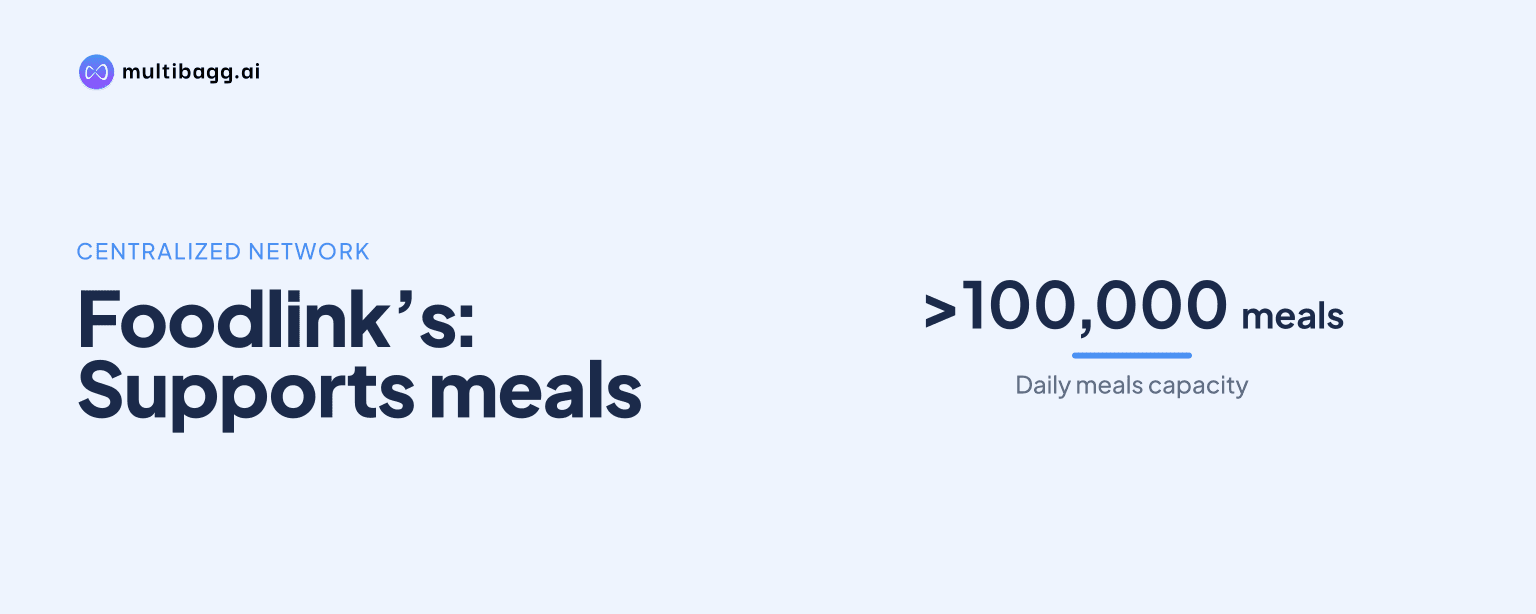
Foodlink F&B Holdings (India) Private Limited operates seven centralized kitchens with capacity to provide more than 100,000 meals a day across over 91,500 square feet. Foodlink uses the six Indian kitchens and one Dubai kitchen as production hubs for events catering, restaurants and cloud kitchens, and banquets and integrated food-and-beverage services.
How do Foodlink’s seven centralized kitchens support 100,000 daily meals?
Foodlink’s seven centralized kitchens support more than 100,000 daily meals by concentrating production in hubs that supply its three operating businesses. The network comprises six kitchens in Mumbai, Ahmedabad, Mohali, Hyderabad, Jaipur and New Delhi, plus one in Dubai, United Arab Emirates, as of the Red Herring Prospectus date.
Foodlink describes the arrangement as an asset-light hub-and-spoke model, in which central production serves restaurants, venues and catering assignments instead of replicating full kitchens at every operating location. The stated daily-meal figure is capacity rather than reported production or sales, so achieving it depends on available ingredients, chefs, equipment, refrigerated logistics and customer demand.
Foodlink states that its kitchen network can handle more than 30,000 guests at a single event and multiple events across locations at the same time. During Fiscal 2026, its events catering business served 1,092 events, compared with 1,012 in Fiscal 2025 and 911 in Fiscal 2024, demonstrating the level of event activity the network was designed to support.
Where are Foodlink’s kitchens and storage facilities located?
Foodlink’s centralized kitchens are located across six Indian cities and Dubai, while its event-catering equipment storage is concentrated in Mumbai and Dubai. The Indian production bases cover Maharashtra, Gujarat, Punjab, Telangana, Rajasthan and the National Capital Territory of Delhi, providing regional locations for procurement and production.
Foodlink has three storage facilities in Mumbai and three in Dubai for cooking equipment used in events catering. Where it does not have a centralized kitchen, Foodlink says it develops temporary satellite kitchens and warehouses, a mechanism intended to support destination assignments without a permanent production facility.
The seven kitchens cover more than 91,500 square feet, exceeding the more than 51,339 square feet occupied by Foodlink’s 28 casual dining restaurants and cloud kitchens. The restaurant and cloud-kitchen network comprised 15 outlets in India across two cities and 10 locations, and 13 outlets in the United Arab Emirates across two cities and seven locations.
How do Foodlink’s kitchens connect its three revenue businesses?
Foodlink’s kitchens connect events catering, casual dining restaurants and cloud kitchens, and banquets and integrated food-and-beverage services, which generated Rs 565.037 crore combined in Fiscal 2026. Events catering was the largest business at Rs 300.128 crore, while banquet revenue increased materially over the three fiscal years.
Foodlink’s events catering share of revenue from operations declined to 52.89% in Fiscal 2026 from 59.42% in Fiscal 2024, a fall of 6.53 percentage points. Banquets and integrated food-and-beverage services increased to 22.51% from 11.35%, a rise of 11.16 percentage points, while the restaurant and cloud-kitchen share moved to 24.17% from 28.49%.
Banquet activity increased alongside the change in revenue mix. Foodlink catered 1,089 events through banquets and integrated food-and-beverage services in Fiscal 2026, versus 1,020 in Fiscal 2025 and 658 in Fiscal 2024; the business had three Jade Banquets and three exclusive food-and-beverage mandates as of the prospectus date.
Foodlink’s Jade Banquets in Mumbai, Ahmedabad and New Delhi cover more than 242,000 square feet. Its Delhi convention mandate runs for 10 years from October 1, 2023, and covers a facility with 300,000 square metres of indoor exhibition and convention space, a 6,000-seat plenary hall and a multipurpose arena capacity exceeding 20,000.
Got a follow-up? Ask IRIS
What operating controls and dependencies affect Foodlink’s kitchen model?
Foodlink supports its kitchen model through standardized operating procedures, food-safety processes, refrigerated trucks and local procurement at its kitchen locations. All centralized kitchens are certified and compliant with Food Safety and Standards Authority of India, or FSSAI, norms, and Foodlink had applied for renewal of ISO 22000:2018 and Hazard Analysis and Critical Control Points, or HACCP, certification.
The facilities have dry, chilled, ambient and frozen storage, and Foodlink prepares mise-en-place, meaning ingredients prepared and organized before cooking, along with semi-cooked base gravies for restaurants and event venues. Foodlink selects suppliers for specified ingredients through tenders and enters long-term contracts with selected suppliers, while sourcing grocery, fresh and dairy products locally at respective kitchen locations.
Raw-material availability and pricing remain operating dependencies because Foodlink discloses that it does not have a long-term agreement with any fixed raw-material supplier. Food and beverage consumption was Rs 108.554 crore in Fiscal 2026, or 20.02% of total expenses excluding tax, compared with Rs 90.819 crore, or 20.48%, in Fiscal 2025 and Rs 107.014 crore, or 26.85%, in Fiscal 2024.
Foodlink’s stated capacity also requires labour availability during periods of high demand. As of September 30, 2026, Foodlink had 1,481 employees, including 658 production employees and 520 operations employees, while permanent-employee attrition was 23.08% for the six months ended September 30, 2026.
What expansion plans depend on Foodlink’s kitchen network?
Foodlink plans to use its existing production capabilities to expand restaurants, cloud kitchens, catering and banquet operations in additional geographies. The company proposes to open four casual dining restaurants in Abu Dhabi and Dubai through its material subsidiary, Foodlink Global Restaurants & Catering Services LLC.
Foodlink also intends to open China Bistro, India Bistro, Glocal and Art of Dum outlets in phases, including in the United Arab Emirates and the United Kingdom. The source does not disclose opening dates, capital expenditure or projected revenue for those outlets, so the scale and timing of the expansion remain unspecified.
For banquets, Foodlink intends to establish proposed venues in Rajasthan and Bangalore and says it aims to locate banquet operations where it already has centralized kitchens. The Delhi convention facility is also undergoing capacity additions, and Foodlink expects its food-and-beverage services there to scale with those additions.
Conclusion
Foodlink’s seven centralized kitchens are the production link across a business that generated Rs 567.499 crore of revenue from operations in Fiscal 2026. Capacity of more than 100,000 meals a day and the ability to handle more than 30,000 guests at a single event describe potential scale, while the increase in banquet revenue share to 22.51% shows a broader operating mix than Fiscal 2024.
The next measures to watch are the four proposed UAE restaurants, the proposed Rajasthan and Bangalore banquets, and the Delhi convention facility’s capacity additions. Foodlink’s ability to convert those plans into operating activity will also depend on ingredient supply, food-cost management, logistics and retention of its production and operations workforce.